

Construction
Optimize during production
A new approach makes it possible to optimize a CAD model, according to which workpieces are manufactured, during production.
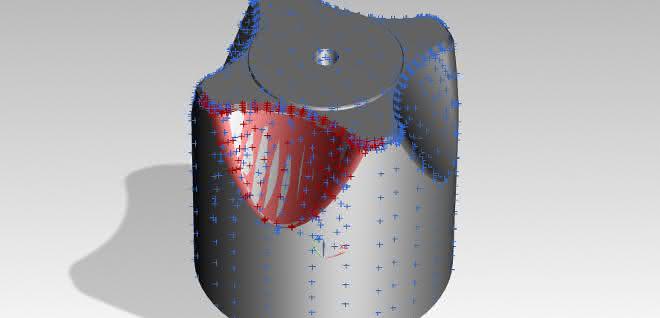
Industrially produced components are usually manufactured on the basis of a 3D CAD model. As numerous influences affect the workpieces during machine production, their geometries often deviate significantly from the CAD model. The result is sometimes considerable additional work in planning the subsequent processes; in the worst case, the component is even unusable. In a consortium project, the Fraunhofer Institute for Production Technology IPT in Aachen has now succeeded in adapting the CAD model to the actual manufactured workpiece geometry using process data and a newly developed algorithm. In this way, the effort required for the subsequent production steps and the amount of waste can be significantly reduced.
The aim of the recently completed "AdaptCAD" project was to identify and minimize deviations between the 3D CAD model and the actual component. "By adapting the CAD model to the actual production result, the planning effort for subsequent processes is significantly reduced. This saves time and money," says Alexander Ibach, who led the project at the Fraunhofer IPT.
The Aachen team first designed a 3D CAD model of the demonstrator component. During the manufacturing process, the scientists recorded high-frequency machine and sensor data from the machine tool. This data was automatically transferred to a database and stored in a structured format. The scientists then used the data to compare the actual geometry of the workpiece with the CAD model designed in advance and to adapt the model according to the deviations.
The central task of the project was to develop an algorithm that allows three-dimensional models to be adapted for the first time. An existing algorithm for two-dimensional modelling served as the basis, which the Aachen research team expanded and optimized for three-dimensional modelling.
"Creating the customized 3D model was an enormous challenge. The model was not to be constructed solely on a numerical basis, as is usually the case. Numerical models are either inaccurate or the computer takes days or even weeks to calculate. In addition, numerical models are difficult to use for CAM path planning of subsequent processes," says Alexander Ibach.
The AdaptCAD approach is based on an analytical model. Analytical models are much more accurate than numerical models. Using this method, the project partners were able to plan the path of the subsequent processes directly on the adapted CAD model. The analytical model is also suitable for subsequent calculations. The consortium partners integrated the algorithm into a commercial CAD/CAM system. In the final phase of the project, the team successfully produced demonstrator components in several test series together with a partner from the automotive industry.
The Aachen research team is satisfied with the results of the project. "The new algorithm is another building block in the digitalization of production. It can help to plan and design production processes even more efficiently in the future. With a tool like this, we can improve the quality of small series components in particular and reduce rejects. In addition, we are also making a contribution to the further development of geometry acquisition and the adaptation of digital twins," says Philipp Ganser, Head of the High Performance Machining department at the Fraunhofer IPT, looking to the future. In a number of planned follow-up projects, his team intends to further develop the algorithm and test it in new fields of application, such as the production of turbomachinery components and medical implants.


You might also be interested in
A quantum computer that performs calculations using oscillations
When it comes to storing information, quantum computers have so far run up against technical limitations. Instead of electromagnetic storage, researchers are now using mechanical vibrations. Their vibrating memory can store significantly more...
 read more...
Hydrogen Pipelines Put to the Test
New real-world lab tests safety and resilience
The Federal Institute for Materials Research and Testing (BAM) is opening a real-world laboratory to study pipelines and components for the safe operation of future hydrogen networks.
read more...Research Platform for the Energy Supply of the Future
For the first time, the Karlsruhe Institute of Technology (KIT) is bringing together key hydrogen technologies in a single research environment. The facility is intended to demonstrate how the production, storage, transport, and use of hydrogen can...
read more...When the quantum computer arrives
The Research Race to Ensure the Security of Critical Infrastructure
How can we protect our critical infrastructure from attacks by quantum computers in the future? As part of the QUEST project, Darmstadt University of Applied Sciences is researching new methods—post-quantum cryptography—designed to withstand even...
read more...VDE study on electrical engineering
More retirements than graduations
According to a VDE analysis, more than 30,000 electrical engineers will retire by 2029 without enough graduates to replace them. This is due to falling student numbers and high drop-out rates.
read more...Giving lightweight construction a profile
Pultrusion: A process that forms fibers under tension
Pultrusion is developing from a niche process into a key process for lightweight construction and sustainable fiber composite structures. The Fraunhofer IWU shows applications from energy to mobility.
read more...Green hydrogen directly from the sun and water
A start-up project at the Karlsruhe Institute of Technology (KIT) aims to fundamentally simplify the production of green hydrogen: Mass-produced photoreactor panels are to be used to produce hydrogen directly from sunlight and water - without...
read more...Fraunhofer shows industrial future between AI, data and new materials
At Hannover Messe 2026, the Fraunhofer-Gesellschaft will be presenting solutions for a resilient industry: from AI and data rooms to hydrogen technologies and material and recycling innovations.
read more...The bottleneck is in the system
Is the transformation of the industry failing due to "German Angst"?
A recent ISF study examines what is slowing down change in German industrial companies. According to the results of the study, the causes of innovation bottlenecks often lie in internal structures and a lack of strategic orientation.
read more...