
Coscom ECO system at Mayer Stahl- und Apparatebau
Process acceleration through virtual manufacturing
Virtual manufacturing in terms of safeguarding results, avoiding errors and speeding up processes: Mayer Stahl- und Apparatebau relies on the Coscom ECO system based on a central production and tool database and networks CAD/CAM, simulation and the store floor.

Mayer Stahl- und Apparatebau is also thinking big when it comes to digitizing the store floor. The contract manufacturer of large components makes full use of the possibilities of end-to-end virtual production based on the open Coscom ECO system. This ensures 1:1 result validation with "real" NC programs in the simulation. A further contribution to overall process acceleration is made by comprehensive setup optimization through digital workbooks in a fully networked store floor.
50 tons in weight, 18 meters in length - precision in the production of large components is a special kind of challenge. In addition to high-tech machinery and a comprehensive digital tool infrastructure, the employees' manual skills and technical expertise are required. This is because dimensional accuracy must be maintained over an enormous distance. We are talking about 0.03 to 0.05 millimetres with a processing length of up to 18 meters. For contract manufacturer Mayer Stahl- und Apparatebau from Heidenheim, such values are "day-to-day business". For more than a hundred years, the company has been manufacturing large components and steel constructions of uncompromisingly high quality, in trusting cooperation with the customer and with a high degree of flexibility.
Digitally straight into the future
In the production of single large parts, it is only possible to survive in a highly competitive market if there are no collisions or other errors during machining. The entire process must be safeguarded without any gaps - after all, there is only one component that is machined and there is only one test. It is also about the 1:1 simulation of sub-processes, such as the complex set-up, time-consuming clamping and re-clamping as well as tool changes during actual machining. "Failure is not an option", this well-known saying from the movie about the Apollo 13 moon landing mission has a special meaning for Managing Director Martin Gentner, Master Machinist Dietmar Koch and CNC programmer Marijan Lokner. After all, their maxims are: maximum result assurance, 100% error prevention, set-up optimization and, derived from this, maximum acceleration of the entire work process.
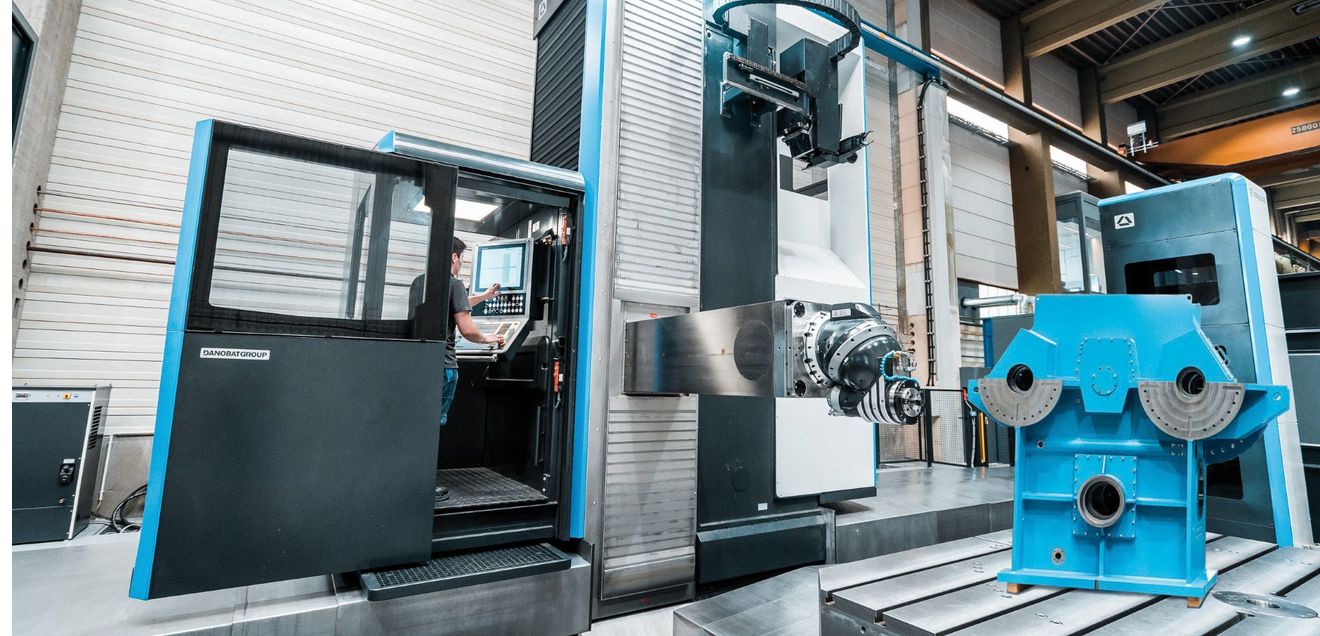
But how can these ambitious goals be achieved? A professional CAM system is an important solution component. But that alone is not enough. A bridge must be built from the idealized world of CAM simulation to the hard reality of machining centers. This is why Mayer Maschinenbau opted for Proficam Virtual Machining (VM) from Coscom Computer GmbH for CAM programming and Vericut from CG-Tech with its NC block simulation. Both tools are linked to the Coscom ECO system, consisting of Factory-Director VM and Tool-Director VM, which supplies CAM programming and machine simulation with all relevant digital manufacturing and tool information. The FR 12000, FR 14000 and FS 18000 moving-column milling and drilling centers as well as the SL 8000 and SP 10000 fixed-bed milling machines, all from Soraluce, are fed with NC programs as part of the mechanical processing.
Full protection of CAM programming
The Coscom project began a few years ago with the introduction of Profi-CAM VM for milling machines with multi-sided machining with the aim of parallel 3D programming. Shortly afterwards, the Tool Director VM tool management system was added, which supplies the CAM system with tool data and thus enables programming with realistic tool geometries. Step by step, the Tool Director VM was enriched with data on tool components and complete tools.
Around 4,200 complete tools are now stored in the system. Dietmar Koch is now firmly convinced: "No more CAM system without tool management!" and adds: "We opted for Vericut for the machine simulation of the complete machining cycle in order to secure the result 100% on the basis of the NC code after the post-process run in Profi-CAM VM: We were already aware at the time that the NC data records absolutely had to be tested again after the post-processor export, i.e. those NC records that are actually used in the machine.
Error prevention and setup optimization
Even though Coscom delivers good NC codes through machine-optimized postprocessors in its CAM system, the user wanted to be completely sure of collision control. Economical large-scale production requires this reassurance. The Soraluce machines do not have a fixed tool change point, but take the tool magazine with them during machining in order to maximize the spindle running time. This is taken into account in Vericut's NC block-based simulation. "This is very important because you can't imagine exactly whether the tool with a length of 300 millimetres, for example, will hit the workpiece somewhere at a height of five centimetres or more when it is changed," explains Marijan Lokner.
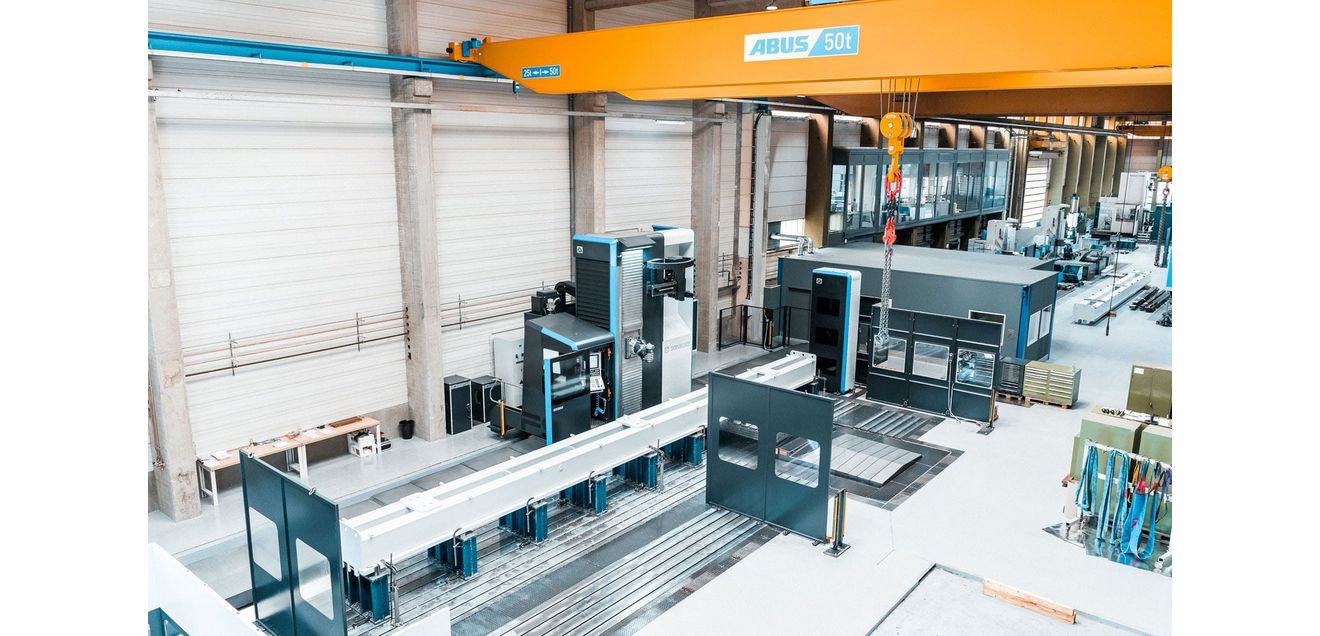
The Profi-CAM-Vericut link ensures 100 percent control with "real" NC programs after post-processor export - the open Coscom system architecture with the universal CAM and simulation interface Coscom TCI (Tooldata Cooperation Interface) makes this possible.
Seamless data process right up to the machine
The introduction of Tool-Director VM raised CAM programming to a new level of quality and at the same time ensured a seamless end-to-end process in terms of passing digital tool information through to tool presetting and the machine: tool lists, assembly instructions for complete tools and measured actual tool data were now immediately available throughout the entire process. "The provision of up-to-date data is extremely important because set-up and machining times of sometimes several hundred hours are involved. No errors are allowed. However, despite all the digitalization, the skilled worker is still needed at the machine because it is a matter of manufacturing individual parts. After all, each component has to be run in individually," emphasizes Dietmar Koch.
The details are recorded in the digitally captured clamping plans, for example. The exact positioning of a blank weighing several tons on the machine bed alone is the first, particularly important prerequisite for fast job processing. And it has to be fast, so work is carried out in parallel: "For example, a workpiece is machined on the left-hand side of the machine table, while the next workpiece is clamped on the right-hand side, protected by a mechanical and electronic separation, and prepared for the next machining process - provided, of course, the situation allows this," says Dietmar Koch, illustrating a typical machining task on large machines.
The end of paperwork
The dimensioning (in relation to the zero point) and the clamping plans were previously only available in paper form on the machine. However, there was always the fear that not all the necessary information or outdated data would reach the machine. Over the years, Mayer Stahl- und Apparatebau took further steps towards "virtual manufacturing" and introduced the Factory-Director VM to digitize all paper documents and visualize them on Infopoints. From Dietmar Koch's point of view, it was a big step forward when each machine was equipped with a PC and a monitor, putting an end to the paperwork: "All the data provided is now visualized directly in front of the machine with the Coscom Info Point VM. Even the simulation can be called up there, and the specific clamping situation can be displayed in 3D and viewed from all sides."
Communication via the VM Info Point
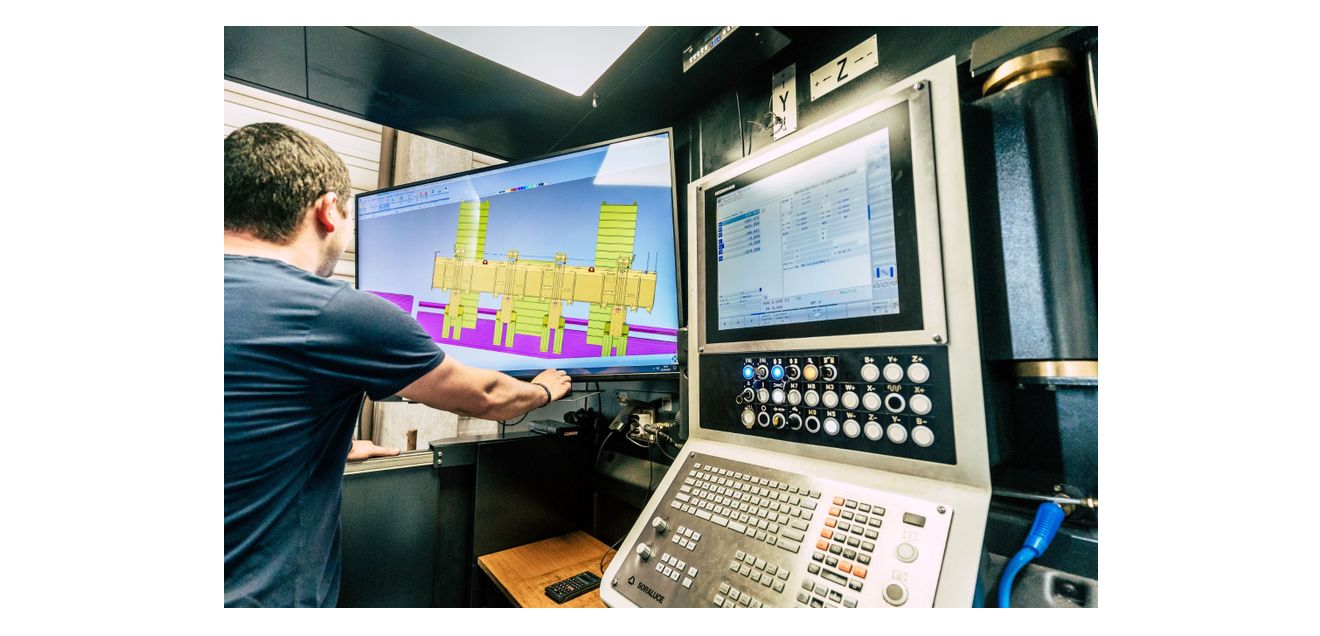
Everything that is needed on site can now be accessed completely digitally via the Info-Point VM: Tool lists, clamping plans, NC programs and simulations, which leads to a significant reduction in errors and an increase in precision during machining. However, the data flow at the Info-Point VM should not be thought of as a "one-way street", because in the expansion stage with a communication module, the worker can give feedback to the work preparation department or the foreman, for example if something is not in stock. This increases productivity, as a lack of information means machine downtime. The worker documents his work processes directly in the PDF drawings via the Info-Point VM, which guarantees the immediate traceability of the individual activities. This "digital marking" is a special feature of Mayer, as the responsible Coscom sales representative Peter Schrumpf emphasizes. The workers work in three shifts. Each colleague is assigned a color, which they use to mark the areas of the component that they are working on.
Digitalization thought through to the end - goodbye paper!
At Mayer Stahl- und Apparatebau, the Factory-Director VM serves as a central database for all production data and digital production documents. All technology data relating to a workpiece, such as NC programs, production drawings, setup lists and clamping plans, are now managed centrally in a database and made available to all process participants in accordance with the task at hand in work preparation and on the store floor. The Factory-Director VM also works in both directions: This means that the NC codes optimized during the production process, for example in terms of adapted feed rates or milling path corrections, are fed back into the database.
Production information is digitized without exception
"In the case of repeat part production, this production documentation means that the Coscom ECO system is a push-button solution based on sophisticated know-how backup from previous production," says Managing Director Martin Gentner enthusiastically. All production information is digitized without exception. In total, there are around 12,000 order-related technology data records to date - the result of an average of 250 orders per year, with an average of four to five NC programs being created for each order.
The Managing Director calculates: "Whereas a typical component machining operation used to take around 15 working days, it now takes less than ten. We have achieved a good 25 percent of the time savings through digitalization with Coscom." Marijan Lokner puts it no less succinctly: "We wouldn't be able to produce 70% of all parts efficiently and competitively today without digitalization!"
In other words, virtual production secures Mayer Stahl- und Apparatebau's existence as a contract manufacturer of large parts, whereby competitiveness should not only be understood in terms of minimum processing times, but also as the ability to continue to meet the increasing quality requirements of customers.


You might also be interested in
Commvault Appoints Brian Lanigan as Chief Partner Officer
Commvault has appointed Brian Lanigan to the position of Chief Partner Officer. He is responsiblefor thecompany’s global partner strategy and is tasked with further expanding the global partner networkof the data security, backup, and recovery...
 read more...
Is sovereignty a question of hardware?
Industry warns of dependencies in IT infrastructure
Europe is seeking digital independence: how sovereignty can be implemented in concrete terms remains a key question in view of the high level of dependencies in the IT infrastructure. Frank Konrad, Managing Director of Microsens GmbH & Co. KG,...
read more...Factory planning without compressed air...
How vacuum becomes mobile
Modular factories, mobile robotics and rising energy prices are fundamentally changing automation. One solution: into the future without compressed air. Electric vacuum systems reduce costs, save energy and support flexible manufacturing and...
read more...Opening the store floor for data rooms
The WGP wants to support SMEs with digitalization
At its spring conference, the Scientific Society for Production Engineering (WGP) focused on the digitalization of small and medium-sized enterprises (SMEs) in particular. Against the backdrop of the ongoing crisis in the industry, the researchers...
read more...Integration of existing meters into digital...
Spectra digitizes existing meter infrastructures
The G30 M-Bus gateway from Spectra GmbH & Co. KG integrates existing meters via Modbus and WLAN into energy management and building management systems for efficient monitoring and retrofitting.
read more...AI as an efficiency driver in production
From pilot project to AI factory
Industrial AI raises key production figures such as OEE, quality and energy efficiency to a new level - but only with the right IT architecture. This is what Chris Kramar, Director and General Manager OEM Solutions DACH at Dell Technologies, says in...
read more...Trade fair preview all about automation 2026
Platform for industrial automation, robotics and digitalization
Over 500 exhibitors, a packed program with presentations, special areas and guided tours: all about automation in Friedrichshafen (10 + 11 March 2026) stands for industrial automation, robotics and digitalization - and for direct dialogue. Three...
read more...Digitizing manual assembly
In modern production, craftsmanship and high-tech come together. Where once only human skill was required, today production lines are created that combine manual precision with digital intelligence.
read more...Digitization of the entire value chain
At SPS 2025, ifm will be demonstrating how the digitalization of the entire value chain can be implemented in practice. In an interview, Michael Marhofer, CEO of the ifm group of companies, explains which technologies are in focus, which industry...
read more...