

Material testing
Testing fiber composites at ultra-low temperatures
Cryotechnology is used in many areas of materials testing. The aim is to identify material characteristics and gain insights into material behavior at extremely low temperatures. This is particularly important in connection with the rapidly growing hydrogen technology. ZwickRoell offers various solutions for testing composites at temperatures in a cryogenic environment.
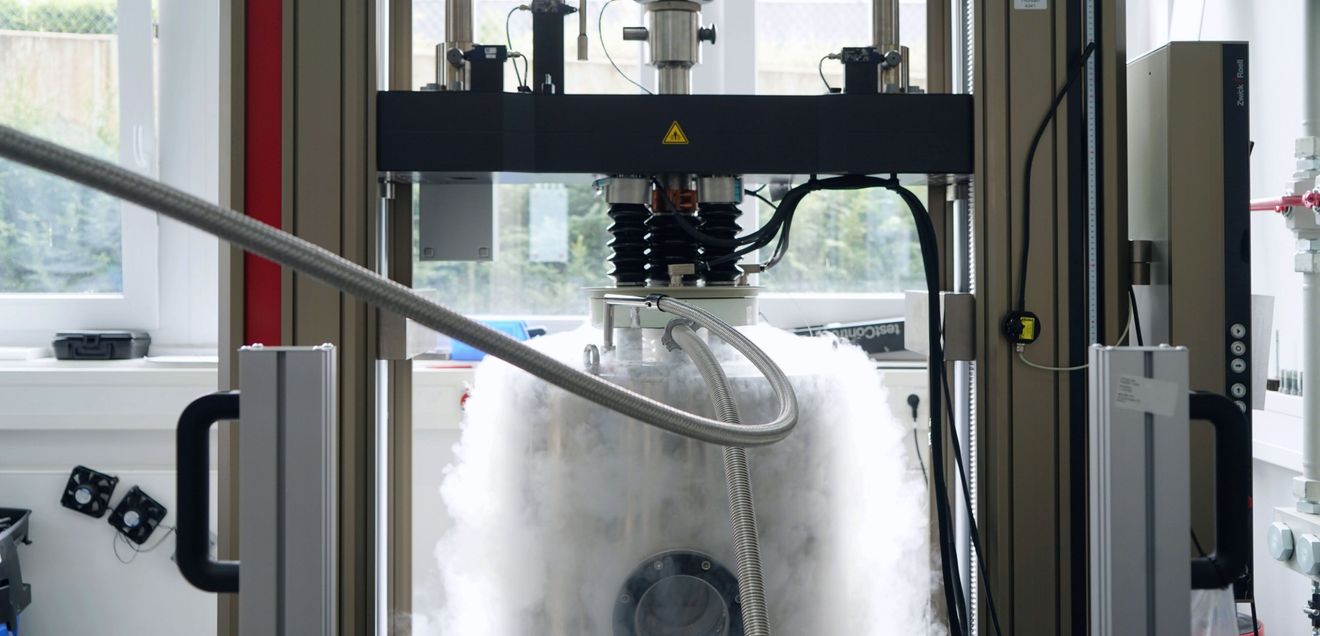
Fiber composites have one major advantage over metals: their low weight. This aspect plays a particularly important role in aerospace and automotive applications in order to develop very lightweight hydrogen tanks. In the aerospace sector, for example, applications of liquid hydrogen at cryogenic temperatures are interesting - due to the more efficient storage density, for example. In the automotive sector, on the other hand, the industry is also increasingly focusing on tanks for storing gaseous hydrogen at high pressures.
Characterize materials that come into contact with hydrogen
Hydrogen becomes liquid at temperatures of 20 K (-253 °C) and is easier to handle in this state - for a high storage density - than under pressure. It is therefore important to characterize materials that are exposed to hydrogen on the one hand (metals) and to temperatures on the other (composites/plastics). In static tensile, compression or shear load tests, the materials are tested at ultra-low temperatures of up to 20 K. This allows their fatigue and shear strength to be determined. This allows their fatigue and fracture mechanical behavior to be determined in a cryogenic environment. "During refueling processes, for example, the composite walls of tanks are exposed to large thermal fluctuations and changing pressures, which lead to stresses on the materials," explains Stefan Pubantz, Project Manager Cryogenic and Hydrogen Technology at ZwickRoell. "Due to different coefficients of thermal expansion of fiber-reinforced plastics and stresses already frozen in the manufacturing process, microcracks can occur in the material, which in turn lead to leaks. This is why permutation testing plays a major role in addition to the aforementioned tests."
Hydrogen storage: three options for high efficiency
In addition to chemical bonding, there is also storage under certain pressure and temperature conditions. There are three possibilities for particularly effective hydrogen storage, from which the requirements for different tank types are derived, which are decisive for the test parameters to be selected. Firstly, in the liquid state at pressures of up to 4 bar in the hydrogen liquefaction range at 20 K. Secondly, in the pressure range from 250 to 700 bar at room temperature and thirdly, in the pressure range from 500 to 1000 bar between 33 and 73 K. ZwickRoell offers several options for testing fiber composites in a cryogenic environment.
Option 1: Cooling with temperature chamber
Temperature chambers are suitable for tests at elevated temperatures and ultra-low temperatures down to around -170 °C. The low temperature depends on the cooled volume in the chamber and the volume of the test rods that protrude into the temperature chamber. In the version with a temperature chamber, the rods are inserted into the temperature chamber from above and below.
Option 2: Cooling with nitrogen immersion cryostat
In nitrogen immersion cryostats, the composite sample is immersed in a nitrogen bath. The test temperature range of immersion cryostats is reduced to the temperature of liquid nitrogen. The samples are inserted into the immersion cryostat from above via a self-contained load yoke with sample holder. As soon as the test is complete, the nitrogen is usually emptied or evaporates into the atmosphere.
Option 3: Cooling with nitrogen and helium in a flow-through cryostat
Nitrogen and helium flow cryostats are operated from room temperature to cryogenic temperatures of around 20 K, depending on the cooling medium. It is crucial to reduce the volumes and the bodies that protrude into the cryostat to the essentials. The formula is: the less (metal) volume protrudes from the flow-through cryostat, the lower the temperatures that can be achieved. For cost reasons, flow-through cryostats are pre-cooled with nitrogen. Once the lowest possible temperature of the nitrogen has been reached, helium from a Dewar vessel is used for post-cooling until the final temperature of 10 to 20 K is reached. Helium is always the ambient medium around the sample. Due to the cost, it is possible to collect the gas and either compress it or liquefy it again. If required, these two solutions should be included in the overall project. As a special variant, ZwickRoell flow-through cryostats can also be operated with hydrogen. In this case, hydrogen is the ambient medium around the sample. Provided that the appropriate safety precautions are taken when handling hydrogen, only a few technical adjustments are required to operate the flow cryostat.
Use in static and dynamic testing machines
ZwickRoell offers the three temperature control devices mentioned for both static and dynamic testing machines. The lower the temperature, the more complex the mechanical complexity. To keep the costs of the coolant, for example, manageable and to achieve the lowest possible temperature gradient across metallic feedthroughs, it is advisable to ensure that the masses to be cooled - such as specimen grips and feedthroughs - have the smallest possible volume. In addition, the maximum test force should be as low as possible. This is because, in contrast to testing at room temperature, generously selected dimensions result in high costs and have an effect on the achievable lowest temperature, temperature controllability and ultimately on reliable and reproducible test results. The rule "as much as necessary" is particularly relevant in this case and must be given special consideration as early as the project planning phase of the system. The cryogenic testing systems in the ZwickRoell product portfolio have a maximum load of 100 kN.


You might also be interested in
Sustainability Through Simulation
Digital material selection reduces CO2 emissions by 40 percent
The use of digital material simulations can significantly reduce CO₂ emissions during the development and manufacturing of components. A real-world project by Schunk and Cadfem demonstrates how data-driven material selection can yield savings of up...
 read more...
Clever solutions for sensitive gripping
Innovative systems and exciting world premieres? That's what visitors will find at productronica in Munich from November 18 to 21. In Hall B3 at Stand 301, vacuum specialist Schmalz will be showcasing efficient and future-oriented handling systems -...
read more...Proprietary plastic compounds for extreme conditions
Cables must reliably transmit energy, data and signals, even in extreme cold or heat or under heavy mechanical stress. Specially developed plastics ensure that the cables remain robust and resistant. Lapp produces its own plastic compounds.
read more...Efficiency comparison of 3D printing, CNC manufacturing and injection molding
3D printing, CNC manufacturing or injection molding? When designers are looking for the most suitable manufacturing process for an individual component, they often lose time and also quickly lose track. Igus is changing this with the Triboteile...
read more...Heat transfer and additive manufacturing
Conflux Technology enters the hypercar sector
Pagani has announced the signing of a six-year contract with Conflux to integrate Conflux heat exchangers into the transmission of its latest exclusive model, the Pagani Utopia, further advancing additive manufacturing in the hypercar industry.
read more...Metal foam and PFAS replacement improve environmental balance
Metal foam contains up to 90 percent air and has amazing properties. In the factory, it ensures greater sustainability and helps to improve the environmental balance in industrial production.
read more...PFAS alternatives with high performance
Igus wants to set an example for innovation and sustainability and will be presenting new products at HMI 2025, including PTFE-free materials and products made from recycled material.
read more...No splinters, no maintenance
New properties also apply to load carriers in logistics and intralogistics processes. Craemer's portfolio includes high-quality returnable load carriers that are hard-wearing, versatile, maintenance-free and recyclable.
read more...Tensile strength of 3D components
Voxelfill strategy overcomes inhomogeneous strengths in 3D printing
The company AIM3D has succeeded in demonstrating the advantages of the patented voxelfill process. Strength tests now prove that this process can overcome inhomogeneous strengths of 3D components in the X, Y and Z axes and thus comes close to...
read more...