

Quality assurance in battery production
Direct leak test on filled lithium-ion cells for the 3C market
Every manufacturer in the computer, communication and consumer electronics market segment wants to avoid image problems caused by prematurely failing or even burning batteries.
Also, nobody in the 3C industry wants to have to replace lithium-ion batteries during the warranty period. This is why many manufacturers are aiming for a life expectancy of three to five years for their batteries. To ensure this, no liquid electrolyte solution may escape from a battery cell and no humidity may penetrate - the electrolyte could react with water to form hydrofluoric acid.
However, testing filled lithium-ion cells for leaks during production is a challenge. Until now, there were hardly any suitable, indirect methods for this. Inficon, a specialist in leak testing with a development and production site in Cologne, has now developed an innovative method that directly detects the smallest leaks in battery cells - by means of escaping electrolyte solvent.
Failure modes for battery cells
Lithium-ion cells can be differentiated according to their housing shapes. On the one hand, there are cells with rigid, stable housings. These include round and button cells. The other category consists of cells with a soft, pouch-like exterior: Pouch cells. Two damage mechanisms are common to all these cell types: if electrolyte leaks out of the cell, its capacity is reduced - the battery's service life is shortened. And if humidity penetrates the cell, the electrolyte can react with water to form hydrofluoric acid - which leads to further leaks in the cell housing and reduces its service life even further.
There is another damage mechanism for soft pouch cells. All cell types are generally filled with electrolyte to a maximum of atmospheric pressure. In round and button cells with a solid housing, the pressure is close to atmospheric pressure; in pouch cells with a soft housing, the aim is even to achieve a significant vacuum. Leaks in pouch cells therefore also cause them to fill with penetrating air - and thus lose mechanical stability and capacity.
Inaccurate pressure drop test
Until now, leak tests on operationally filled cells have been hampered either by the insensitivity of the method - as with the pressure decay test - or by the unreliability of this application - as with helium bombing. In the supposedly cost-effective pressure decay test, a test chamber is filled with air up to a defined overpressure of a few bars and measured over a defined time interval to determine whether pressure changes occur because air enters the cell through a leak. In practice, limit leakage rates of up to 10-3 mbar∙l/s can be determined in this way. However, a major problem with this method is its susceptibility to temperature fluctuations. If the temperature only rises by fractions of a degree during the test, leaks remain undetected, but if the temperature falls, the pressure drop test detects phantom leaks.
Unreliable helium bombing
Helium bombing is a method that is highly sensitive in principle, but proves to be unreliable in this particular application scenario of cell testing. During bombing, the battery cell is placed in a vacuum chamber and exposed to a helium atmosphere at a pressure of around 5 bar. This allows the helium tracer gas to penetrate the cell through any leaks. The tracer gas is detected in a subsequent step when the penetrated helium escapes back into the now evacuated vacuum chamber. However, the exact location of the leak and the position of the battery cell are crucial for the success of the bombing method. The light helium may rise in the liquid electrolyte and is then no longer directly in front of the leak. During the final test, electrolyte solution escapes into the vacuum chamber instead of helium: The leak remains undetected.
The sniffer leak search also fails
Because the electrolyte solution is never filled into the cells with excess pressure, sniffer leak detection also fails in the cell production application scenario. The principle of sniffer leak detection is to suck in a gas escaping at a leak point through a sniffer tip so that it can be detected. In addition, in this case - under atmospheric external pressure and at a room temperature of 20 degrees Celsius - the vapor pressure of the electrolyte solvent escaping from a leak in the cell wall is simply too low. For solvents such as ethyl methyl carbonate (EMC) or dimethyl carbonate (DMC), the vapor pressure under the conditions described is only 43 or 53 mbar. For diethyl carbonate (DEC) it is even only 13 mbar. Direct detection of escaping electrolyte solvent is therefore not possible with conventional sniffer leak detection. The situation is only different if the filled cell is tested in a vacuum chamber.
Direct detection of leaking solvent
Inficon makes use of this effect in its new test method for pre-filled battery cells. If the cells are in a vacuum, sufficient solvent can escape into the vacuum chamber in the event of a leak, where it evaporates quickly and is easy to detect. In this way, the new ELT3000 from Inficon detects all common electrolyte solvents directly as they escape from the cell: whether DMC, DEC or EMC - whereby mixtures of these solvents are also very frequently used for battery cells. The innovative method also detects leaks in lithium-ion cells with rigid housings, i.e. in round and button cells, as well as in soft pouch cells.
Leak rate and leak diameter
The new method detects leaks up to a helium equivalent leak rate of 1∙10-6 mbar∙l/s. For soft pouch cells with an internal pressure of 400 mbar, for example, and a foil thickness of approximately 150 µm, this results in a minimum detectable leak diameter of 1.9 µm. For stable cells with a wall thickness of 1 mm, for example, and an internal pressure of 1000 mbar, the new method identifies leaks up to a diameter of 1.7 µm. As a rule, no whole drops of electrolyte solution can escape from leaks of this size - and no humidity can penetrate the cell. A leak test against the limit leak rate of 1∙10-6 mbar∙l/s therefore helps to ensure that the service life of three to five years that the 3C industry aims for its lithium-ion batteries is actually achieved.
Vacuum testing for all cell types
The new Inficon test system for the direct detection of leaking solvent consists of several components: a gas detection system for electrolyte solvents (the Gas Detection Unit, GDU) and a control unit for the gas flows (the Gas Control Unit, GCU). In addition, there is the vacuum chamber in which the cells are subjected to the test process. Inficon supplies various test chambers for tests on round and button cells, as well as a chamber for tests on the soft, more sensitive pouch cells. Once the battery cells are in the respective chamber, the test starts at the push of a button. The control unit then generates a vacuum of 5 mbar absolute in the chamber. The pressure difference to the inside of the cell, which is filled with electrolyte at a pressure of several hundred mbar, ensures that the electrolyte solution escapes from the cell through any leaks and the solvent component evaporates in the vacuum of the test chamber. The mass spectrometer of the gas detection system then detects this solvent - and thus the leak.
Vacuum testing of soft pouch cells
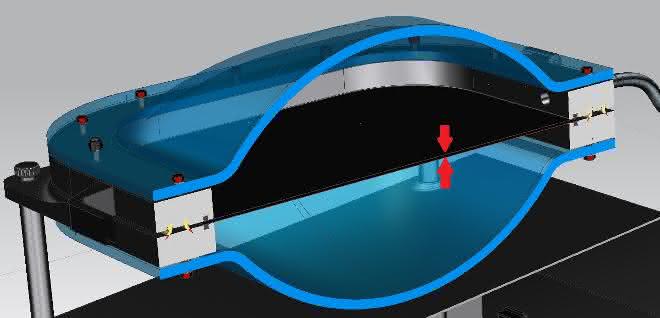
Until now, vacuum tests on soft pouch cells were impossible, as the pressure difference between the inside of the cell and the vacuum in the test chamber would cause expansion and damage the cells. The flexible FTC3000 test chamber, which Inficon has patented, solves this problem. This is because a foil membrane fits snugly against the cell surface during evacuation and thus stabilizes the sensitive cells. This prevents the pouch cell from swelling or even bursting and enables fast and reliable vacuum testing. The flexible test chamber is also a good tool for development departments, which sometimes have to test cell prototypes of various shapes for leak tightness. Last but not least, the ELT3000 is designed for use in automated production lines.
Always traceable results
Whether with a rigid or flexible chamber, the new test device from Inficon minimizes sources of human error and is intuitive to use thanks to its simple test procedure and touch display. It can be reliably calibrated using a special e-check test leak - for the subsequent detection of various solvents. The detection system compares the result of each test with a previously defined rejection limit and indicates leaks immediately. It is also very easy to assign test results to the specific test specimen. To do this, a barcode scanner is connected to the standardized interface of the device, with which each cell can be individually recorded. The system then links the exact test results with the respective part ID and a time stamp. It also saves all test data for export - this also guarantees traceable results.
Batch testing and short test cycles
If the new test method is to be used in large-scale production, it is advisable to design the test chamber individually. The duration of a test cycle ultimately depends on the size of the test chamber and whether a user wants to use various protective mechanisms such as a rinsing phase between two cycles. Typically, the test cycle time for the smaller chambers offered by Inficon is in the range of 45 to 60 seconds. 10 to 30 seconds of this is pump-down time, and the actual measurement process takes 10 seconds.
For tests in large chambers, it is advisable to use additional external pumps for rough evacuation in order to reduce cycle times. In industrial cell production in particular, it makes sense to load a larger, individually designed chamber automatically, for example using a robot arm or pneumatic grippers, in order to test several cells in one batch. Experienced system integrators are able to design such vacuum chambers and integrate them into test systems. Inficon also works with system integrators to automate test chambers with flexible film membranes.
Quality-assured cell production
Thanks to its mass spectrometer and vacuum method, the new device from Inficon can detect leaks in filled lithium-ion cells that are thousands of times smaller than conventional pressure methods. At the same time, the new method delivers highly reliable results, which helium bombing is unable to do in this application. The direct detection of escaping electrolyte solvent opens up completely new possibilities for quality assurance in cell production - indispensable for the desired service life of the battery, whether in smartphones, wearables or medical devices.
Dr. Yessica Brachthäuser, Application Engineer Batteries & E-Mobility, Inficon


You might also be interested in
Rethinking mobile energy
Electrification, battery storage and intelligent energy management are changing industry and construction sites. Lukas Krüger, product specialist for battery storage systems at Bredenoord, talks in an interview about trends, technologies and the...
 read more...
Solutions for surface treatment
Lasers make batteries safe
At the parts2clean trade fair, Trumpf will be presenting manufacturing solutions for surface processing in automotive production, including the TruPulse 5050 nano short-pulse laser and the PFO33 scanner optics.
read more...Electric motors and batteries in a circuit
Batteries and electric motors are electromobility components that contain valuable raw materials. The "Zirkel-Konsortium" has set itself the task of developing technologies to feed these raw materials into a circular economy. One key to an efficient...
read more...Production of high-voltage batteries
Electrically mobile - sustainable on the road
High-voltage batteries for electric cars are produced at the BMW plant in Leipzig. SEW-Eurodrive supplies proven and new drive solutions from the Movi-C modular system for all process steps - from cell preparation to end-of-line testing.
read more...Producing battery cells flexibly and sustainably
The industry needs more and more battery cells. However, their production in gigafactories consumes enormous amounts of energy. In addition, the large production lines are very inflexible. A possible alternative has now been successfully tested at...
read more...Battery technology for material transportation
Strong and robust for indoor and outdoor use
Farasis Energy, the developer and producer of high-performance battery technology and pouch cells, will be showcasing its products for electromobility at Logimat.
read more...Mobile labeling in a complete package
The P-touch E300VP mobile labeling device from Brother helps trade and industry to keep track of things. Weighing just 740 g, the P-touch E300VP with its long-life Li-ion batteries has been specially developed for use on the move.
read more...Yamaha shows robots, cobots and battery cell assembly
Yamaha will be bringing pioneering products and new application examples to Automatica 2023, such as the assembly of battery cells for electric cars.
read more...E-scooter with customizable damping
The startup Scuddy has significantly improved the flexibility, performance, customizability and ergonomics of its second-generation foldable e-scooter of the same name - thanks in part to damping technology from ACE.
read more...