
Ultra-high vacuum
Leak detector in the CERN particle accelerator
Leak detectors from Pfeiffer Vacuum are used in the LHC particle accelerator at CERN. The ASM 340 detects leaks in ultra-high vacuum.
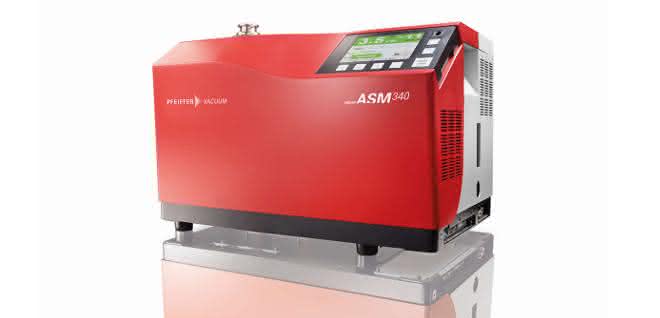
Pfeiffer Vacuum has received another major order for leak detectors from CERN. CERN, based in Geneva on the French-Swiss border, is the world's largest research center for particle physics. The main focus here is on basic research into physics and the structure of matter. The particle accelerator LHC (Large Hadron Collider) - in which protons or ions collide at almost the speed of light - has a circumference of around 27 kilometers. It is the largest vacuum structure in the world with thousands of welded joints, flanges, feedthroughs and complex internal installations.
An ultra-high vacuum (UHV) is essential so that the accelerated particles in the beamlines can move as freely as possible. Maintaining such a low pressure requires the lowest possible leakage rate and therefore sophisticated leak detection technology. At CERN, the decision was once again made in favor of technology from Pfeiffer Vacuum. Andreas Schopphoff, Head of Market Segment R&D at Pfeiffer Vacuum: "The cooperation between CERN and Pfeiffer Vacuum is based on many years of trustful collaboration. We are very proud that our advanced leak detection technology has once again been selected for future projects."
The ASM 340 leak detector is an easy-to-use device that can detect leaks up to < 5 x 10-13 Pam3/s. With the integrated backing pump's pumping speed of 15m3/h, tests can be carried out to detect leaks in both small and large volumes. The ASM 340 is particularly suitable for such a large facility as the LHC, as the patent-pending process enables leak detection from a pressure of 100 hPa. In addition, the leak detector is so compact that it can be easily maneuvered under the cryostats and the beam tubes of the LHC.
Helium leak detectors today are based on a patent by Dr. W. Becker of Pfeiffer Vacuum, who proposed using a turbopump as a kind of filter and safety element in front of a mass spectrometer. CERN was one of the first customers to use this innovative technology and is still an important user of Pfeiffer Vacuum products today. The generation of the vacuum inside the LHC as well as the total and partial pressure measurement require comprehensive vacuum technology. A large part of this is also supplied by Pfeiffer Vacuum.
CERN was founded in 1954. In addition to the approximately 2,500 employees, more than 10,000 guest scientists from all over the world work there today.


You might also be interested in
Pfeiffer Vacuum weiht neues Werk in China ein
Pfeiffer Vacuum feierte am 23. Oktober die Erweiterung seines Standorts in Wuxi, China. Mit der Verdopplung der ursprünglichen Größe setzt das neue Werk einen wichtigen Schritt in der Entwicklung des Unternehmens in China.
 read more...
Pfeiffer Vacuum eröffnet Produktionsstandort in Rumänien
Am 26. September feierte Pfeiffer Vacuum die Eröffnung des neuen Produktionsstandortes in Cluj, Rumänien. Das Wachstum der Unternehmensgruppe und die Nachfrage nach Vakuumtechnologie hatten den Neubau erforderlich gemacht.
read more...Filtration and sound attenuation in circuits
In liquid or air circuits, filter housings and silencers protect measuring devices, ensure particle-free vacuum and pneumatic systems, keep cooling circuits clean and reduce noise.
read more...KSS ultrafine filtration for grinding oils
Modular concept for pure oil
In order to grind economically, reliably and with the highest quality, extremely clean grinding oils are required. Filter manufacturer Vomat offers the metalworking industry high-performance and customized concepts for the filtration of cooling...
read more...Up to 95 percent less flue gas thanks to direct extraction
The requirements for occupational safety measures and safety technology are also constantly increasing in welding technology. The Technical Rules for Hazardous Substances (TRGS) stipulate that welding fumes and harmful substances must be extracted...
read more...Everything accurate in switch cabinet construction
To ensure smooth work processes, tools for processing enclosures and housings must function flawlessly and reliably. Häwa rounds off its punching range with the Multi-Press 500.
read more...Cooling and temperature control units
Hygienic packaging sells safely
In few industries are the requirements for hygiene in the production process as strict as in the food sector - the health of consumers has top priority. This results in enormous challenges for all machines and components involved, especially in...
read more...Efficient and sustainable
Rotary screw compressors are the reliable backbone of industrial compressed air generation. The innovative CSD/CSDX series from Kaeser Kompressoren with its numerous features produces them efficiently and saves energy costs. This also reduces theCO2...
read more...Healthy air during welding
Welding produces fumes and gases that are hazardous to health. Extraction is necessary to comply with the occupational exposure limits and is even mandatory when welding high-alloy steels.
read more...