
Precise image evaluation
Equalization from a bird's eye view
Distorted images taken with a strong wide-angle lens are only of limited use for industrial image processing applications. Baumer presents a solution to perspective distortion for Verisens vision sensors.
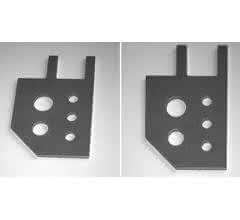
Extreme wide angles such as fisheye lenses capture an entire scene in one image. But such a 180-degree panoramic view takes its toll. The image is circular and flows together at the edges. Wide angles are also often useful for industrial image processing applications. A large object can be monitored up close with little installation space. However, the associated lens distortion is usually counterproductive, as the objects initially look "crooked" and therefore faulty.
An unwanted deviation of the image from the real object is not only caused by the commonly used so-called entocentric lenses. The arrangement of the camera or vision sensor in relation to the object can also play a role. This results in a different image if the object has to be viewed from the side, for example to allow robots or humans unhindered access in the same working area. Image processing in industry aims to produce results that provide information about the quality of the object or transmit its position and orientation to a handling system. A distorted or distorted object is therefore often less suitable for finding precise results. In pick-and-place applications, exact robot positioning does not work at all without corrective measures.
A simple method is not to correct the image, but only the coordinates after they have been taught in through calibration. The problem with this is that people take in around 80 percent of information through their eyes. Setting up an application on a distorted image and using this state later as a visualization remains a challenge with the potential for error. Simplicity and ease of use are crucial, especially in the complex field of image processing.
The optimum solution is therefore to completely rectify the entire image using calibration, mathematical processes and high computing power. How is this possible? If you know the ideal image, you can derive the deviation based on the image "seen" by the vision sensor and a known template. In this way, even a laterally distorted view, which can occur when mounted at an angle, can be mathematically corrected, as can distortion caused by the lens.
Selected 700/800 Verisens models from the XF and XC series already support image rectification in real time or can be retrofitted with a simple software update. After image calibration using a calibration plate, the vision sensor knows the image conditions from the installation position, viewing angle and lens and corrects the entire image automatically. This makes it similar to a bird's eye view. The inspection task is therefore carried out on an "ideal" image without distortions. Objects thus correspond again to the appearance perceived by humans. This is easy for the user and supports a correct and quickly set up application.
Calibration is a simple and structured process that does not require reading any documentation. Intelligent algorithms in the background constantly check the calibration conditions and provide information on when teaching is advisable. The user is only required where the Verisens vision sensors need further information.
Angled mounting also changes the lighting conditions, as part of the light source is further away from the object. For this reason, an optional shading correction was implemented at the same time. A white sheet of paper is sufficient as a template to teach the algorithm the ideal situation with a click of the mouse. As a result, this is then included in the image correction and regulates the image brightness for each pixel to match the installation situation.
Comparison with world coordinates is an established function of Verisens vision sensors. This means that any units of measurement can be processed instead of pixels. This supports applications such as dimensional inspection and pick-and-place, where thinking in pixels is often not sufficient. Teaching the world coordinates benefits from the image structure of the calibration plate for image distortion and uses its square structure for automatic setup.
A rectified image is an optimal prerequisite for demanding dimensional inspections. The effects of the perspective position of the object can be reduced in addition to lens distortion. Presence and completeness checks, where the vision sensor often has to be mounted at an angle to avoid reflections or to facilitate access, are also made easier. Thanks to image rectification, this no longer affects the recording and inspection of objects and imprints.
If robots use image processing for orientation, the image processing coordinate system is added to the robot coordinate system, which is naturally undistorted. If this is rectified, appropriately scaled and adapted to the origin and orientation, the direct positions of the objects can be transmitted to the robot. Visually, there are no deviations between the image and the robot orientation. If the vision sensor is permanently installed above the robot, the image processing may get in the way of the robot in pick-and-place applications. An angled installation solves the problem with the aid of rectification.
Verisens vision sensors are able to detect several objects simultaneously and provide the robot with intelligent input. Both the optimal arrangement of the objects and the consideration of unwanted part overlaps are possible.
as
Baumer, http://www.baumer.com
h


You might also be interested in
Sustainability Through Simulation
Digital material selection reduces CO2 emissions by 40 percent
The use of digital material simulations can significantly reduce CO₂ emissions during the development and manufacturing of components. A real-world project by Schunk and Cadfem demonstrates how data-driven material selection can yield savings of up...
 read more...
From ERP System to AI Platform
RNA, based in Aachen, manufactures up to 2,000 custom-designed feeding systems annually and handles all order processing through a central ERP platform.
read more...Cybus Brings in Siemens Executive Stefan Schwab to Lead the Company
The Hamburg-based software provider Cybus will have a dual leadership structure going forward: Stefan Schwab will join co-founder Peter Sorowka as co-CEO.
read more...Artificial Intelligence for the Physical Space
Alibaba Expands Qwen Model Family with a Robotics Suite for Physical AI
Alibaba is expanding its Qwen model family with a robotics suite for Physical AI. The three models—for manipulation, navigation, and simulation—are designed to assist autonomous robots with complex tasks in real-world environments.
read more...5 Challenges for AI Projects in Manufacturing
Manufacturing companies have high hopes for AI. IFS highlights the five most common reasons why AI projects fail.
read more...Implementing Manufacturing Software: 5 Practical Tips
To remain competitive in the market in the future, more and more companies are considering digitizing their CNC manufacturing processes. The right software solutions can make process knowledge transparently accessible and significantly reduce the...
read more...AI automation specialist reorganizes...
Generation change at Insiders Technologies
After almost 30 years at the helm, Werner Weiss is handing over the management of Insiders Technologies. Andree Albrecht takes over the management after a transition phase.
read more...Intelligent brownfield networking
Many industrial companies are struggling with established plant structures and proprietary interfaces. Stefan Klaus' presentation will show in a practical way how brownfield environments can be efficiently networked with open technologies and made...
read more...Factory-X in practice
How can set-up processes in highly variant production be automated efficiently? Markus Benndorff from soffico shows how Factory-X, industrial data rooms and modular architectures create new possibilities for flexible production concepts.
read more...