
Sensor technology
Dosing needle monitoring: The right dose makes the difference
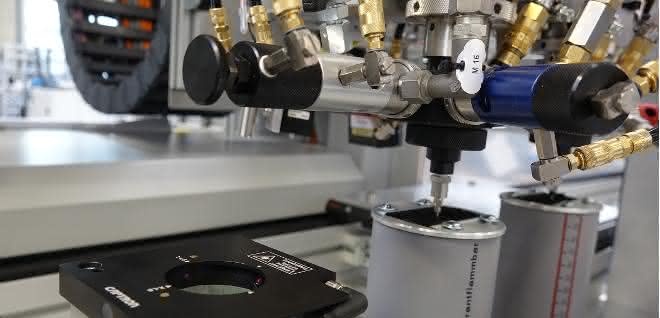
Bdtronic in Weikersheim develops plant systems and process solutions in the fields of dosing technology, impregnation technology, hot riveting, plasma pre-treatment and automation. With its dosing systems, the manufacturer serves suppliers to the automotive and electronics industries worldwide. Continuous monitoring and control circuits ensure process reliability in order to guarantee a smooth process for each individual dosing system. In addition to conveying capacity, fill level monitoring and temperature control in the material container, this also includes regular dosing needle monitoring. For this, Bdtronic relies on the high-quality sensor technology components of its long-standing partner Captron Electronic.
The Baden-Württemberg-based company has been developing and producing dispensing systems since 1976, initially under the name Bartec. While the machines were mainly used for the company's own purposes at the time, the dosing technology division has developed so well since 1983 that the company has become a global supplier of 1K and 2K dosing systems and equipment.
Reduce error rate, simplify installation
For more than 30 years now, Bdtronic has been designing and building manual to fully automated systems for customers in the automotive, electrical and electronics industries, medical and filter technology and many other sectors. The company has relied on Captron's sensor solutions for around 25 years.
The integration of sensors into the first Bdtronic systems was very complex compared to today. Special brackets had to be designed and manufactured. It was also necessary to harmonize many components, align two sensors individually and check them manually on a regular basis. This was because vibrations in the systems caused the sensors to become misaligned over time and work inaccurately. Without extensive readjustment, it was not possible for the individual system components to work together with lasting precision. Twelve years ago, the two companies therefore set themselves the goal of developing a one-piece system in a flat design that would enable simpler installation, greater accuracy and more process reliability. In the meantime, the solution has long since proven itself in the dosing market.
Accuracy in three dimensions
The solution is based on Captron's TCP measurement technology for industrial robots. A total of around 150 to 200 Bdtronic systems are equipped with ORL2 sensors every year. The closed measuring unit is characterized by a particularly flat design. Two laser light barriers are integrated into the sensor, which create a correction field like a kind of coordinate system. This enables precise, three-dimensional needle measurement. The robot moves the potting needle into the laser cross from above as part of a reference run. The routine can then be used to determine whether the tool tip is positioned correctly. In addition to the position, the sensor also checks the condition of the needle: if the robot is at the so-called zero point of the light barriers, the measuring unit can measure the length of the dispensing needle based on the robot's traversing speed as it plunges in. During this process, it is also possible to determine whether the needle is bent or dirty.
Especially when dispensing robots are used in adhesive processing, curing times are a potential risk. Chemical reactions of the adhesives in the air could lead to premature curing and unwanted residues on the dispensing needles. During the dispensing process, it is therefore necessary to regularly check whether the dispensing tip is clean and fully functional in order to avoid faulty deviations.
The customer software used in each case evaluates the data for regular analyses and statistics in continuous monitoring and control loops. If the needle is positioned incorrectly, the sensor reports the error directly to the system, which reacts without manual assistance. If an incorrect needle has been inserted, an error message is issued and the operator can intervene. This ensures process reliability and reduces the system's error rate. Fitting holes for precise assembly considerably reduce the effort required for Bdtronic. As a plug-and-play system, it can be easily installed directly onto the dowel pins on the dosing systems and fixed in place with two screws. Whereas the sensors previously had to be manually aligned and adjusted by the user, they are now preset at the factory according to the end customer's specifications.
Open system for systems with multiple grouting
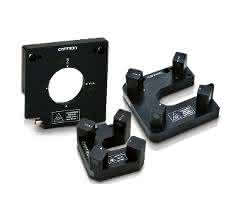
Parallel to the closed system based on the ORL2 models, an open solution was developed, which is also used by Bdtronic. While the dispensing needle is inserted into the ORL2 measuring unit from above and can only be moved within a limited measuring field, the OGLW2 model is open at the side. Some end customers work with dispensing systems that cast several parts at the same time and therefore have a battery of dispensing needles.
Using the open system, several needles can be measured in direct succession as they pass through, which is not possible in the closed system. The laser light barriers are integrated into a raised optical structure of the sensor for this purpose. Recesses between the lasers prevent the other needles from colliding with the housing while a dispensing needle is being measured. Here too, the one-piece structure milled from solid material ensures optimum mechanical stability.
The fully automatic process saves the system operators time. Instead of having to manually check the settings of the dosing robots several times an hour and carry out re-measurements, the system automatically runs through the measuring system after a certain number of bonding operations and decides whether all settings are correct and the dosing process can be resumed. The system automatically reports potential faults by means of visual or acoustic signals. The targeted use of the system operators ensures higher productivity. At the same time, the error rate is reduced.
In order to meet the high standards and individual requirements of customers from the automotive and electronics industries, Bdtronic is continuously developing its dosing systems. Today, the range already extends from small, manual to large, fully automatic dispensing systems. Together with Captron, the expert for customized sensor technologies, the dosing specialist from Baden-Württemberg is also ideally positioned for developments in the production systems of the future.
Bettina Greiffer, freelance journalist / am


You might also be interested in
Filtration and sound attenuation in circuits
In liquid or air circuits, filter housings and silencers protect measuring devices, ensure particle-free vacuum and pneumatic systems, keep cooling circuits clean and reduce noise.
 read more...
KSS ultrafine filtration for grinding oils
Modular concept for pure oil
In order to grind economically, reliably and with the highest quality, extremely clean grinding oils are required. Filter manufacturer Vomat offers the metalworking industry high-performance and customized concepts for the filtration of cooling...
read more...Up to 95 percent less flue gas thanks to direct extraction
The requirements for occupational safety measures and safety technology are also constantly increasing in welding technology. The Technical Rules for Hazardous Substances (TRGS) stipulate that welding fumes and harmful substances must be extracted...
read more...Everything accurate in switch cabinet construction
To ensure smooth work processes, tools for processing enclosures and housings must function flawlessly and reliably. Häwa rounds off its punching range with the Multi-Press 500.
read more...Cooling and temperature control units
Hygienic packaging sells safely
In few industries are the requirements for hygiene in the production process as strict as in the food sector - the health of consumers has top priority. This results in enormous challenges for all machines and components involved, especially in...
read more...Efficient and sustainable
Rotary screw compressors are the reliable backbone of industrial compressed air generation. The innovative CSD/CSDX series from Kaeser Kompressoren with its numerous features produces them efficiently and saves energy costs. This also reduces theCO2...
read more...Healthy air during welding
Welding produces fumes and gases that are hazardous to health. Extraction is necessary to comply with the occupational exposure limits and is even mandatory when welding high-alloy steels.
read more...Wire mesh filters in medical technology
In hardly any other industrial development sector are the demands placed on products as high as in medical technology. After all, human lives depend on the performance and reliable quality of medical devices.
read more...Energy efficiency and sustainability in the smallest of spaces
With the StingR ultra-fine filter system, Lehmann-UMT has created a solution for the energy-efficient and precise treatment of fluids during tool grinding for extended tool life and high tool quality.
read more...