
Drive electronics
Load indicator already in
Sieb & Meyer has integrated the load indicator function as standard in all frequency inverters and servo drives in the SD2x series. It makes it possible to reliably detect load changes in the connected motor.
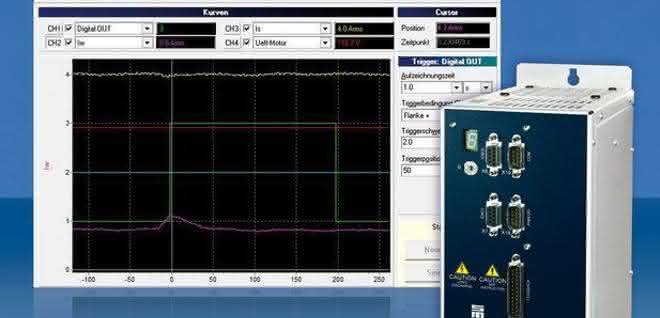
If a tool breakage in processing machines is not detected immediately, this can result in danger for man and machine. The load indicator integrated in the frequency inverters and servo drives of the SD2x series helps to prevent this: It is not based on acoustic sensors, but instead the actual torque-generating current of the motor is evaluated. Load changes in the motor are thus detected with great accuracy. This allows conclusions to be drawn about the condition of the respective machine: If, for example, a current change expected during the machining process does not occur, tool breakage is likely and the user can stop the machine immediately.
Thanks to the load indicator, tool wear can also be detected, as they consume more power when worn. If a pre-set load threshold is reached, a message is issued and the tool in question can be replaced at short notice - ensuring continuous processing quality.
With the frequency inverters and servo drives from the SD2x series, the load indicator can also detect contact between the tool and workpiece ("sparking") - a process that is necessary during the grinding process, for example, and is usually covered by expensive structure-borne sound sensors. Last but not least, the output signal from the load indicator can be used to flexibly adjust machining feed rates. This is always helpful when workpieces with different material densities, such as wood, need to be processed.
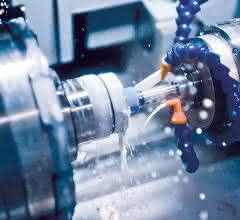
Machining and machine tools do not only pose risks due to possible tool breakage. Tools that are still rotating or rotating at too high a speed are also a risk for operators and service technicians. The challenge for the machine manufacturer is to implement the aspects of personal safety and productivity simultaneously in an optimal and standard-compliant manner. With conventional safety solutions, the motors and spindles must be equipped with safe speed sensors in order to detect and prevent dangerous operating conditions. If this is not the case, machine manufacturers have to accept compromises in productivity or guarantee corresponding safety integrity levels through complex safety concepts for different applications. To avoid this, Sieb & Meyer has added the encoderless functions "Safe Frequency Monitor" (SFM) and "Safe Limited Output Frequency" (SLOF) to the SD2 drive system. They have been tested by TÜV Nord and meet the requirements of a safety integrity level of SIL3.
To implement the safety functions, the manufacturer has integrated hardware and software into the drive amplifiers of the SD2 series. The functions are based on the "Safe Torque Off" (STO) function integrated as standard in all SD2x devices. The result is a functional solution for machine manufacturers that is suitable for sensorless systems.
With the SFM safety function, the operator can detect whether an encoderless spindle has reached standstill after switching off or has fallen below a safe speed frequency. As long as this has not happened, a safety gate, for example, is not released. This safety function is intended for rotating axes - including grinding or milling spindles. SFM detects the electrical rotating field of the motor. The number of poles of the motor can therefore be used to make a precise statement about the mechanical rotating field.
The SFM function is based on a frequency-dependent voltage induced by the motor or the residual magnetization. This voltage can be measured at the motor terminals for both synchronous and asynchronous motors. The drive uses this voltage to determine the current rotating field frequency and compares it with the parameterized limit value. If the rotating field frequency is below the parameterized limit frequency, the drive generates the status signal "Standstill" (safe standstill). The standstill signal can only be generated when the output stage is deactivated and the main voltage is switched off. When the output stage is switched on or the main voltage is switched on, the status "No standstill" is always assumed.
The SLOF safety function can be used to ensure that a critical speed is not exceeded - for example, because a tool could burst due to overspeed. To do this, the function determines the rotating field frequency currently generated by the inverter and compares it with the parameterized limit value. If the rotating field frequency is within the parameterized range, the drive generates the status signal "Frequency In Limits" (frequency not too high). If the limit value is exceeded, the output stage is enabled via STO, the system generates no further torque and therefore no further acceleration. This corresponds to the status "Frequency Out Of Limits" (frequency too high).
The SLOF function therefore enables the safe limitation of the rotating field of a spindle. It prevents the connected spindle from being actively accelerated to too high a frequency by the drive. pb


You might also be interested in
Further simplify assembly processes
In addition to the proven racks with a length of one meter, Wittenstein alpha now offers optional two-meter racks for linear systems. They are particularly suitable for use in short axes, for example, in order to simplify assembly even further.
 read more...
Hiwin manufactures its own shaft gearboxes
Have you ever waited several months for an urgently needed corrugated gearbox? Hiwin has too. That's why the Offenburg-based drive specialist has decided to produce its own space and weight-saving reduction talent.
read more...Human-robot interaction at the trade fair
Sumitomo Drive Technologies is presenting its drive solutions for automation and robotics at Automatica 2023 together with the Lafert Group. The company will be showcasing two different applications of the Tuaka drive system for robot applications...
read more...Partial automation with robots
At Automatica, Promess will be showcasing its modular individual workstations and how these can be partially automated with robot support. The servo press manufacturer will also be providing information about the latest features of its Revolution X...
read more...A new benchmark for collaborative robots
At this year's Automatica, Denso Robotics will be showcasing its innovations in the field of robotics. The collaborative Cobotta Pro product family will be the focus of the presentations. Visitors to the trade fair can see all variants in various...
read more...Clamping system for a new milling machine
Investments in machinery often lead to further purchases - as is the case at Joma-Maschinenbau, whose modern production facility has recently been supplemented by a 5-axis milling machine.
read more...Schunk wants to simplify processes in automated production
The declared aim of automation specialist Schunk is to make its customers' processes comprehensible, simple and efficient. Data transparency plays an important role in this. It enables reliable processes and provides the basis for resource-saving...
read more...Festo and Hahn Automation develop battery tester for greater safety
The success and reputation of electric vehicle manufacturers depend on the safe and flawless functioning of batteries. Hahn Automation has therefore developed a battery tester that performs a fully automated 100% test of mobile energy storage...
read more...SPN Schwaben Präzision presents gearbox solutions for automation and industrial robotics
Short cycle times, robust technology, wear-free surfaces and compact designs have always been relevant for automation and robotics solutions. This year's Automatica trend topics include "Sustainable production" and "Digitalization and AI". SPN aims...
read more...