

Industrial robots
Increasing the accuracy of robots
The elasticity of the drive train limits the accuracy of industrial robots. In combination with traditional control methods that only use motor-side variables, this elasticity leads to a limitation of path accuracy, which in turn is crucial for opening up new areas of application. Modern control methods in combination with additional sensor technology for the feedback of joint-side variables should now shift these limits.
In production technology, there is an increasing desire to open up new areas of application for industrial robots (IR). This is mainly due to the good ratio of investment costs to working space and the high number of degrees of freedom. However, this development has so far been hampered by the limited absolute accuracy and the high susceptibility of IR to vibrations. More and more robot manufacturers are offering their manipulators with sensors on the output side, but without fully exploiting the additional potential in terms of control technology.
Solution approach
The joint-side position sensors can be used to detect any vibrations that occur and actively dampen them due to the comparatively low mechanical natural frequencies compared to the bandwidth of the drives. It should be noted that the serial kinematics result in a non-linear pose dependency of the system properties. If this is not taken into account in the controller design, as is the case with classic P-PI cascade control, this results in a high degree of conservatism.
As a result, a modern control method was developed at the ISW of the University of Stuttgart as part of the SDaR project funded by the German Research Foundation (DFG), which extends the classic P-PI cascade control. With the help of an unscented Kalman filter, the joint-side speed is observed on the basis of the position measured at the output. The oscillations that can be detected in this way are actively damped in the form of additive nominal motor speeds in order to increase the dynamic path accuracy. To take account of the non-linear robot dynamics, the linear control approach initially designed using linearization was extended by gain scheduling for adaptive control (figure above). In order to ensure sufficient robustness and performance in the entire workspace, a systematic methodology for controller parameterization was developed.
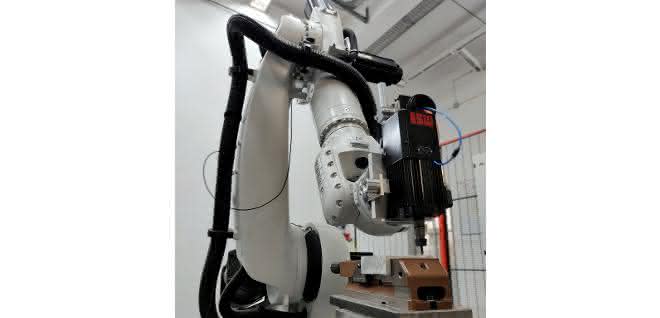
A Kuka KR210-2 IR with an open control platform and additional position sensors on the output (image left) is available at the ISW for the practical validation of adaptive control. Based on trajectory following experiments and the milling of test workpieces made of aluminum, an improvement of up to 72% compared to the P-PI cascade control was demonstrated.
Summary and outlook
The results obtained show the high potential of the adaptive control method for IR with joint-side position measurement. In the future, the control method is to be extended to take into account not only the position-dependent inertia but also the non-linear joint stiffness. It is known that the joint stiffness varies depending on the joint torsion. As this is recorded indirectly during operation via the position sensors on the joint side, it should also be included in future.
Patrick Mesmer, M. Sc., Univ.-Prof. Dr.-Ing. Dr. h.c. mult. Alexander Verl, Institute for Control Engineering of Machine Tools and Manufacturing Units (ISW), University of Stuttgart


You might also be interested in
Filtration and sound attenuation in circuits
In liquid or air circuits, filter housings and silencers protect measuring devices, ensure particle-free vacuum and pneumatic systems, keep cooling circuits clean and reduce noise.
 read more...
KSS ultrafine filtration for grinding oils
Modular concept for pure oil
In order to grind economically, reliably and with the highest quality, extremely clean grinding oils are required. Filter manufacturer Vomat offers the metalworking industry high-performance and customized concepts for the filtration of cooling...
read more...Up to 95 percent less flue gas thanks to direct extraction
The requirements for occupational safety measures and safety technology are also constantly increasing in welding technology. The Technical Rules for Hazardous Substances (TRGS) stipulate that welding fumes and harmful substances must be extracted...
read more...Everything accurate in switch cabinet construction
To ensure smooth work processes, tools for processing enclosures and housings must function flawlessly and reliably. Häwa rounds off its punching range with the Multi-Press 500.
read more...Cooling and temperature control units
Hygienic packaging sells safely
In few industries are the requirements for hygiene in the production process as strict as in the food sector - the health of consumers has top priority. This results in enormous challenges for all machines and components involved, especially in...
read more...Efficient and sustainable
Rotary screw compressors are the reliable backbone of industrial compressed air generation. The innovative CSD/CSDX series from Kaeser Kompressoren with its numerous features produces them efficiently and saves energy costs. This also reduces theCO2...
read more...Healthy air during welding
Welding produces fumes and gases that are hazardous to health. Extraction is necessary to comply with the occupational exposure limits and is even mandatory when welding high-alloy steels.
read more...Wire mesh filters in medical technology
In hardly any other industrial development sector are the demands placed on products as high as in medical technology. After all, human lives depend on the performance and reliable quality of medical devices.
read more...Energy efficiency and sustainability in the smallest of spaces
With the StingR ultra-fine filter system, Lehmann-UMT has created a solution for the energy-efficient and precise treatment of fluids during tool grinding for extended tool life and high tool quality.
read more...