
Wire EDM machines
Repeat offenders
Compared to other available cutting materials, the synthetically produced cutting material PCD (polycrystalline diamond) has a very high hardness and wear resistance. By varying the grain sizes, the toughness and wear resistance can be influenced according to the application. However, due to their hardness, tools with PCD cutting edges can only be machined economically by erosion. Mapal relies on Vollmer erosion machines for this - and has done so for the hundredth time.
It was 20 years ago that the PCD Tools Competence Center, then still known as WWS, ordered its first wire EDM machine from Vollmer. Since then, Mapal has continuously developed its diamond tools, thanks in part to Vollmer technology and a productive partnership with the machine manufacturer.
Inspired by the spirit of optimism at the time, both companies launched development projects relating to the precise machining of PCD-tipped tools. These offer a number of advantages. On the one hand, tool life is many times longer than with carbide. Secondly, the extremely hard material allows a higher cutting speed and guarantees consistent quality.
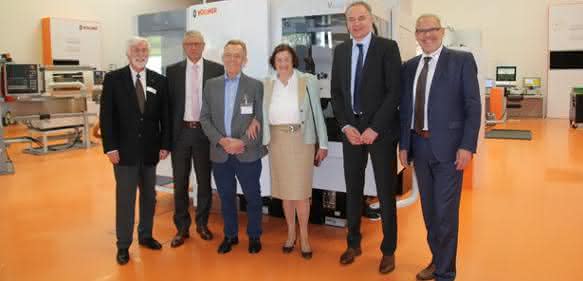
Thanks to the experience gained, both partners now see themselves as pioneers in this field. In view of their shared history, it was a special moment at the Biberach Technology Service Center (TDZ) when the VPulse 500 wire EDM machine from Vollmer was handed over. Not only because it is the 100th EDM machine, but also because the handover was attended by three people who have represented the partnership between the two companies for decades: In addition to Werner Stief, the founder of WWS and former Managing Director after the takeover by Mapal, Lothar Reinhardt, Head of Strategic Market Development at the Vollmer Group, and Sieglinde Vollmer were also present at the TDZ. The latter is a trustee of the Sieglinde Vollmer Foundation, a member of the Supervisory Board of Vollmer Werke and the daughter of company founder Heinrich Vollmer.
EDM technology of the future
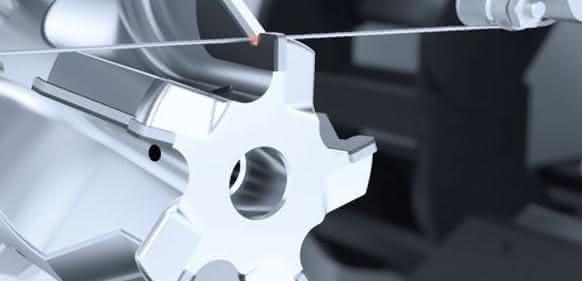
During erosion, opposite electrical potentials are applied to an electrode and the workpiece to be machined. As soon as the electrode is brought into contact with the workpiece, the electrical charge is discharged via an electric arc. The resulting temperatures of 8,000 to 12,000 ˚C melt material particles out of the workpiece. This takes place in a non-conductive dielectric. As a result, the ablation solidifies and is flushed away. This process is repeated thousands of times in one second. Depending on the application and electrode shape, a distinction is made between three processes: die-sinking, wire and rotary erosion.
Wire erosion is suitable for complex geometries. Even the smallest inner radii of milling head systems, end mills or bell tools can be precisely sharpened. Mapal has Vollmer wire EDM machines at 13 international locations, including the USA, China, Japan, Italy and France. At the Pforzheim site alone, 110,000 PCD tools are manufactured or repaired every year, and around 150,000 worldwide.
The recently handed over VPulse 500 is equipped with a new erosion generator and advanced technology which, in addition to precise tool machining, also enables production from batch size 1 to large quantities.
The erosion generator is crucial for the discharges or pulses between the workpiece and tool. It regulates various parameters such as voltage, current, pulse duration and pulse pause. Eroding programs with different parameter sets are stored in the generator for varying removal rates and machining qualities. To control the erosion process and thus the erosion gap between the workpiece and tool, the generator monitors the current flow and passes the information on to the generator controller. Based on the information, the controller ensures a constant distance between the workpiece and tool and thus regulates the eroding gap.
Looking back on the collaboration with Mapal, Dr. Stefan Brand, Managing Director of the Vollmer Group, explains: "It's not every day that we are able to hand over the 100th machine to one of our customers, which is why the handover of the VPulse 500 to Mapal is a special event for us." cs
GrindTec, Hall 1, Stand 1003
"Shaping Success Together"
... is Vollmer's motto at GrindTec 2018. The specialist for grinding and erosion machines has further developed both technologies and services for its sharpening and processing machines and will be showcasing its latest innovations at GrindTec in Hall 1, Stand 1003. In addition to the VPulse 500 wire erosion machine and the QXD 250 erosion machine, these include the new CHX 840 grinding machine for processing the rake and flank face of circular saw blades with diameters of up to 840 millimetres in just one clamping operation.
The Swabian sharpening specialist will also be presenting variants of the VGrind 360 tool grinding machine, which can be used to produce carbide tools. The machine is available in two versions: either with two vertically arranged spindles for grinding wheel packs or with a grinding wheel spindle plus a high-frequency spindle (HF spindle) with an automatic tool changer. The HF spindle enables the grinding of special pocket seats for PCD (polycrystalline diamond) plates. A new feature is the HC 4 automation solution, which has a compact design and includes a chain magazine with 39 slots for standardized HSK 63-A (hollow shank cones) or can optionally hold up to 158 shank workpieces.


You might also be interested in
Lifting oven grates
Bharat Forge CDP is a supplier of forged chassis and engine components as well as non-automotive systems. Since 2020, the company has been working with Kito-ER2 electric chain hoists to lift furnace grates in the production hall.
 read more...
Mobile and intelligent handling solutions
Scaglia Indeva has been developing and producing industrial manipulators and handling solutions for more than half a century. The company will be presenting its latest products for logistics at LogiMat.
read more...Mink at the Hannover Messe 2023
Transportation on brushes
Technical brushes from Mink are suitable for the gentle transportation of sensitive workpieces. According to the manufacturer, the adaptability of the brushes to different surfaces ensures part quality and avoids rejects.
read more...Partial automation in wood processing
Rescue from the staff shortage
The Schnurr company in Nordrach in the Black Forest has been processing wood for almost 170 years. Today, the company is a sought-after partner when it comes to individual wooden packaging or sawn and planed wood.
read more...Products for better ergonomics
At Intec, Scaglia Indeva will be presenting innovative ergonomic products for intralogistics. The focus is on products for better ergonomics, smoother work processes and protection of employees against overload.
read more...New pallet roller for the warehouse
Conveyor technology specialist Rulmeca is expanding its range of conveyor rollers for pallets and other heavy goods with the XPS series.
read more...Individual energy management
When a Festoon cable carrier system for a crane system with a travel distance of 30 meters was to be replaced, Tsubaki Kabelschlepp designed a complete package consisting of chain and cables, guide channel including substructure and an individual...
read more...Plan and manage maintenance
The health and safety regulations and statutory inspection guidelines for operating equipment in companies are strict and extensive. As a result, it is not easy to keep track of all inspection regulations and periods in day-to-day operations.
read more...Fully automated conveyor system for battery systems
With a fully automated and flexibly expandable conveyor system for truck loading, a manufacturer of battery systems in the electric automotive industry is meeting the increasing demand.
read more...