

Materials research
Coated metal foam withstands explosions
A lightweight metal foam developed by researchers at Saarland University becomes rock-hard when coated. The discovery is also interesting for lightweight construction.
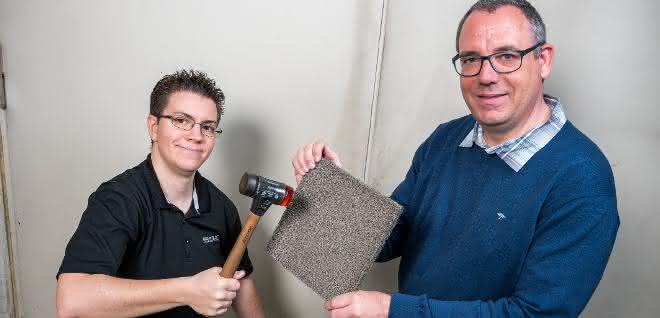
As impact protection in cars or as protection against shock waves from explosions, the areas of application of the rock-hard yet lightweight metal foam, which has been developed by materials researchers Stefan Diebels and Anne Jung from Saarland University, are many and varied. The model from nature is the structure of bone: It consists of a hard shell and a scaffold of fine beads that leave room for countless cavities inside. This construction saves material and makes the bone light. Metal foams imitate this model: The porous materials are made from metals and look like a sponge. Although the foams commonly used today are lightweight, they are complex and expensive to produce. The beads are also too soft and pliable for many applications, such as the most commonly foamed aluminum today. "This is why metal foams have not yet been able to establish themselves on the market," says materials scientist Stefan Diebels, Professor of Technical Mechanics at Saarland University.
Diebel's research team has found a way to reinforce the framework of the metal foams. The result is a lightweight, extremely stable and versatile material. Each of the beads is coated using a patented process in such a way that the metal foam, stabilized from the inside out, can withstand extreme loads. At the same time, it is still lightweight. They use aluminum foams and now even inexpensive plastic foams made of polyurethane as a framework, which are made strong by the coating alone. "The resulting metal foams have a low density and large surface area with a small volume. In relation to their weight, they are extremely rigid and strong," explains Diebels. They are so strong that they act as mobile protective walls to absorb shock waves during explosions. They can also simply "swallow" sound and pressure waves during underwater explosions - and thus protect sensitive marine life from the consequences. "But above all, we are also thinking about less spectacular applications such as lightweight construction," explains lecturer Anne Jung. For the first of her two doctoral theses on metal foams, she received the Körber Foundation's German Study Award for "the most important dissertation of the year with particular social significance."
Following nature's example, many products can be made lighter and more stable. For example, load-bearing parts in cars and airplanes can be made from the metal foam: "They can be installed as rigid struts in the car body and at the same time take on the function of impact protection. They absorb a lot of energy and absorb the force of an impact if some of the pore layers break," says Anne Jung. The foams can be used in a variety of ways: as a catalyst, as the material can be flowed through, as vibration damping or as a heat shield, as it is very heat-resistant. It can also be used as electromagnetic shielding or even in architecture, for example for sound-absorbing cladding or as a design element. The researchers use an electroplating bath for the coating. The trickiest part was applying the wafer-thin coating deeply and, above all, evenly inside the foam. The problem: "The metal foam acts like a Faraday cage," says Anne Jung. Its interior is surrounded on all sides by conductive material, so electricity is conducted around the outside, just like the coating, and does not run through it - like lightning around a car. The materials researcher achieved the breakthrough with a special anode cage and can now coat the foam evenly and completely nanocrystalline. "The patented process also works industrially for large-area foams," she says. With its scientific publications, the Saarbrücken group is now one of the world leaders in the micromechanical characterization of metal beads. Using experiments, simulations, tensile and compression tests, light microscopy and X-ray computed tomography, they have investigated the structure, geometry of the pores and the curvature of the webs and have shown, among other things, how nanocoatings of different thicknesses give the metal foam different material properties. By varying the coating, its thickness or the pore size, they can adapt the material to different requirements. For example, coating with nickel makes the foams stable, with copper they are good heat conductors, with silver they are antibacterial and with gold the foam looks good as decoration. The researchers are working on further optimizing the process and the material. Students and doctoral candidates are also involved in this research.
According to documents from Saarland University.


You might also be interested in
Research at the Intersection of Fiber...
New Fiber-Optic Technology Reduces Energy Consumption in Photonic Computers
Frozen at -196 °C: A new liquid-core fiber combines light and sound with high efficiency, opening up new avenues for quantum computing and photonics.
 read more...
A quantum computer that performs calculations using oscillations
When it comes to storing information, quantum computers have so far run up against technical limitations. Instead of electromagnetic storage, researchers are now using mechanical vibrations. Their vibrating memory can store significantly more...
read more...Hydrogen Pipelines Put to the Test
New real-world lab tests safety and resilience
The Federal Institute for Materials Research and Testing (BAM) is opening a real-world laboratory to study pipelines and components for the safe operation of future hydrogen networks.
read more...Research Platform for the Energy Supply of the Future
For the first time, the Karlsruhe Institute of Technology (KIT) is bringing together key hydrogen technologies in a single research environment. The facility is intended to demonstrate how the production, storage, transport, and use of hydrogen can...
read more...When the quantum computer arrives
The Research Race to Ensure the Security of Critical Infrastructure
How can we protect our critical infrastructure from attacks by quantum computers in the future? As part of the QUEST project, Darmstadt University of Applied Sciences is researching new methods—post-quantum cryptography—designed to withstand even...
read more...VDE study on electrical engineering
More retirements than graduations
According to a VDE analysis, more than 30,000 electrical engineers will retire by 2029 without enough graduates to replace them. This is due to falling student numbers and high drop-out rates.
read more...Giving lightweight construction a profile
Pultrusion: A process that forms fibers under tension
Pultrusion is developing from a niche process into a key process for lightweight construction and sustainable fiber composite structures. The Fraunhofer IWU shows applications from energy to mobility.
read more...Green hydrogen directly from the sun and water
A start-up project at the Karlsruhe Institute of Technology (KIT) aims to fundamentally simplify the production of green hydrogen: Mass-produced photoreactor panels are to be used to produce hydrogen directly from sunlight and water - without...
read more...Fraunhofer shows industrial future between AI, data and new materials
At Hannover Messe 2026, the Fraunhofer-Gesellschaft will be presenting solutions for a resilient industry: from AI and data rooms to hydrogen technologies and material and recycling innovations.
read more...