

Aluminum alloy
Light metal alloy for additive manufacturing
Less weight combined with a high level of safety - these are the requirements of both the aerospace and automotive industries. New materials are needed to achieve this. A research project with partners Oerlikon, Linde and the Technical University of Munich is tackling the challenge.
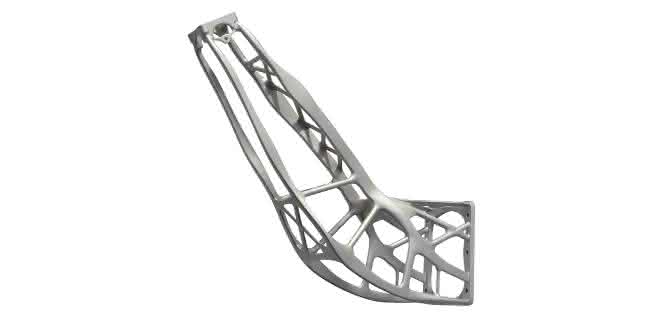
Oerlikon, Linde and the Technical University of Munich are jointly developing new high-strength aluminum-based light metal alloys. The material is intended to meet the high demand from the aerospace and automotive industries for greater safety and weight reduction. The research project with a volume of 1.7 million euros is 50 percent funded by the Bavarian Ministry of Economic Affairs.
Processing an aluminum alloy with a high proportion of light elements such as magnesium in an additive manufacturing process requires an in-depth understanding of the underlying chemical, thermal and fluid dynamic processes. During the manufacturing process, the metal powder is melted layer by layer on a build plate using a laser. The process takes place in an inert gas atmosphere that is optimally adapted to the materials.
Three partners, three expert opinions
Oerlikon is contributing its expertise in the field of powders and materials to the development of the new material. "Thanks to our in-house software Scoperta-RAD, we can offer highly relevant solutions for the development of innovative materials or optimize the performance spectrum of already available materials through extensive big data simulations and analyses," says Dr. Alper Evirgen, metallurgist at Oerlikon AM. "The processing of aluminum alloys using additive manufacturing poses a number of challenges. The extreme conditions in the melt bath caused by the high temperatures can lead to low-boiling alloy components such as magnesium simply evaporating," explains Dr. Marcus Giglmaier, Project Manager AM Institute. "In addition, cooling rates of more than 1 million °C per second are reached during the solidification process, which creates extremely high stress states in the material and can result in so-called micro-cracks."
The melting process takes place in a gas atmosphere. This is where Linde contributes its expertise: Controlling the gas atmosphere during the manufacturing process helps to avoid impurities in the printing process and achieve optimum printing conditions. "Characterizing and controlling the gas process during additive manufacturing not only has the potential to prevent evaporation losses, but can also speed up the entire printing process," explains Thomas Ammann, Expert Additive Manufacturing at Linde. "The use of tailored gas mixtures for the new alloy will help to control the processes occurring in the melt pool, minimize the changes in the composition of the alloys and prevent cracking during the printing process."
The Institute of Aerodynamics and Flow Technology (AER) at the Technical University of Munich has gained a detailed understanding of the physical processes that occur during the additive manufacturing process with the help of numerical simulations. "The AM research alliance closes the gap between our latest numerical modeling results and future industrial applications," says Prof. Nikolaus Adams, Chair of Aerodynamics and Flow Technology. The institute has developed a process simulation tool that covers the entire melt pool dynamics. It includes models for the phase change between solid-liquid-gas and includes effects such as surface tension and heat transport. "A detailed insight into all simultaneously occurring thermofluid dynamic phenomena is an essential prerequisite for a better understanding of the overall process and the resulting material properties," adds Dr. Stefan Adami.
The cooperation arose in direct connection with a joint project announced in October: together with GE Additive, the three project partners announced the establishment of a Bavarian AM cluster (additive manufacturing) and an institute for additive manufacturing in order to promote cooperation and interdisciplinary research between the three companies and the university. By bundling complementary core competencies at one location, the industrialization of additive manufacturing is to be accelerated.
According to documents from Oerlikon / ag


You might also be interested in
Sustainability Through Simulation
Digital material selection reduces CO2 emissions by 40 percent
The use of digital material simulations can significantly reduce CO₂ emissions during the development and manufacturing of components. A real-world project by Schunk and Cadfem demonstrates how data-driven material selection can yield savings of up...
 read more...
From ERP System to AI Platform
RNA, based in Aachen, manufactures up to 2,000 custom-designed feeding systems annually and handles all order processing through a central ERP platform.
read more...Cybus Brings in Siemens Executive Stefan Schwab to Lead the Company
The Hamburg-based software provider Cybus will have a dual leadership structure going forward: Stefan Schwab will join co-founder Peter Sorowka as co-CEO.
read more...Artificial Intelligence for the Physical Space
Alibaba Expands Qwen Model Family with a Robotics Suite for Physical AI
Alibaba is expanding its Qwen model family with a robotics suite for Physical AI. The three models—for manipulation, navigation, and simulation—are designed to assist autonomous robots with complex tasks in real-world environments.
read more...5 Challenges for AI Projects in Manufacturing
Manufacturing companies have high hopes for AI. IFS highlights the five most common reasons why AI projects fail.
read more...Implementing Manufacturing Software: 5 Practical Tips
To remain competitive in the market in the future, more and more companies are considering digitizing their CNC manufacturing processes. The right software solutions can make process knowledge transparently accessible and significantly reduce the...
read more...AI automation specialist reorganizes...
Generation change at Insiders Technologies
After almost 30 years at the helm, Werner Weiss is handing over the management of Insiders Technologies. Andree Albrecht takes over the management after a transition phase.
read more...Intelligent brownfield networking
Many industrial companies are struggling with established plant structures and proprietary interfaces. Stefan Klaus' presentation will show in a practical way how brownfield environments can be efficiently networked with open technologies and made...
read more...Factory-X in practice
How can set-up processes in highly variant production be automated efficiently? Markus Benndorff from soffico shows how Factory-X, industrial data rooms and modular architectures create new possibilities for flexible production concepts.
read more...