
Automatic industrial trucks in mixed traffic
Slowly(er), but surely
Automated industrial trucks in mixed traffic Hörmann relies on automated processes with still trolleys for more efficient production supply.
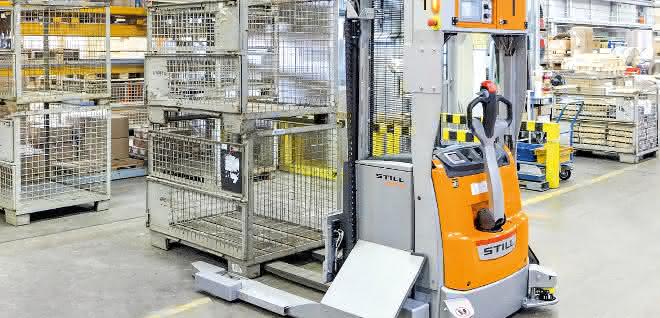
Hörmann is one of the market leaders for various doors and gates for use in private and commercial properties. The company operates a plant with ten warehouses and production halls for garage doors and sectional doors in Ichtershausen, Thuringia. The Hamburg-based logistics system provider Still was on board from the very beginning for the intralogistics. Around 30 different Still industrial trucks are now in operation at the Hörmann plant in Thuringia. Hörmann considered using automated guided vehicles (AGVs) to supply materials to the production areas.
Smooth, slower travel significantly reduces maintenance and repair costs compared to manually operated forklifts
In test operation at the end of 2015, Still was able to demonstrate with an automated pallet truck how conventional forklift transport of standard load carriers can be carried out with a high level of safety. The test convinced Hörmann - and the decision to use AGVs followed in August 2016. The aim was to commission the system after a five-month project planning and implementation period.
Every day, Hörmann unloads an average of 30 trucks between 6.00 a.m. and 2.00 p.m. using still stackers. Goods are booked into the SAP system and labeled with a warehouse code when they arrive. Standard pallets or pallet cages are then transported to the buffer area for production supply. The automated supply process for the production areas begins with the transfer of the palletized goods from the buffer area to an automatically operating chain conveyor using an FM-X 14 reach truck. The warehouse label is scanned on the way to the chain conveyor. The data is then sent to the SAP control system, which generates the transport order for the AGV based on an EXP 20 high-lift truck. This moves with the forks into the load handling device to pick up the goods from the chain conveyor.
Automation has reorganized the transport processes, for example with a one-way system. It offers the best safety conditions due to the heavy mixed traffic. The EXP 20 finds its way to the respective staging area for production using guidance control via magnetic points embedded in the floor. It has also been equipped with various safety modules. These include Sick scanners, which stop the AGV if a person or object is in the vicinity. Two additional scanners installed at the top act like a safety curtain: hazards in the upper area are reliably detected.
The EXP 20 currently travels to a total of twelve destinations over a total distance of 600 meters in two halls. After setting down the goods, it takes the empty pallets provided on the return route and places them in the incoming goods area. Hörmann also wants to incorporate the waste containers from production into the AGV cycle. The automated transport process runs around the clock - without errors. The regular process means that fewer kilometers are driven on the route and valuable time is freed up for productive activities. For example, forklift trucks no longer have to make search trips to collect the pallets and waste bins that have been set down. pb


You might also be interested in
Lifting oven grates
Bharat Forge CDP is a supplier of forged chassis and engine components as well as non-automotive systems. Since 2020, the company has been working with Kito-ER2 electric chain hoists to lift furnace grates in the production hall.
 read more...
Mobile and intelligent handling solutions
Scaglia Indeva has been developing and producing industrial manipulators and handling solutions for more than half a century. The company will be presenting its latest products for logistics at LogiMat.
read more...Mink at the Hannover Messe 2023
Transportation on brushes
Technical brushes from Mink are suitable for the gentle transportation of sensitive workpieces. According to the manufacturer, the adaptability of the brushes to different surfaces ensures part quality and avoids rejects.
read more...Partial automation in wood processing
Rescue from the staff shortage
The Schnurr company in Nordrach in the Black Forest has been processing wood for almost 170 years. Today, the company is a sought-after partner when it comes to individual wooden packaging or sawn and planed wood.
read more...Products for better ergonomics
At Intec, Scaglia Indeva will be presenting innovative ergonomic products for intralogistics. The focus is on products for better ergonomics, smoother work processes and protection of employees against overload.
read more...New pallet roller for the warehouse
Conveyor technology specialist Rulmeca is expanding its range of conveyor rollers for pallets and other heavy goods with the XPS series.
read more...Individual energy management
When a Festoon cable carrier system for a crane system with a travel distance of 30 meters was to be replaced, Tsubaki Kabelschlepp designed a complete package consisting of chain and cables, guide channel including substructure and an individual...
read more...Plan and manage maintenance
The health and safety regulations and statutory inspection guidelines for operating equipment in companies are strict and extensive. As a result, it is not easy to keep track of all inspection regulations and periods in day-to-day operations.
read more...Fully automated conveyor system for battery systems
With a fully automated and flexibly expandable conveyor system for truck loading, a manufacturer of battery systems in the electric automotive industry is meeting the increasing demand.
read more...