
Modular palletizers
Reliable palletizing around the clock
IEF-Werner supplies palletizing systems for handling components and assemblies for assembly in production - even in three-shift operation. They save time and energy and save employees physical effort.
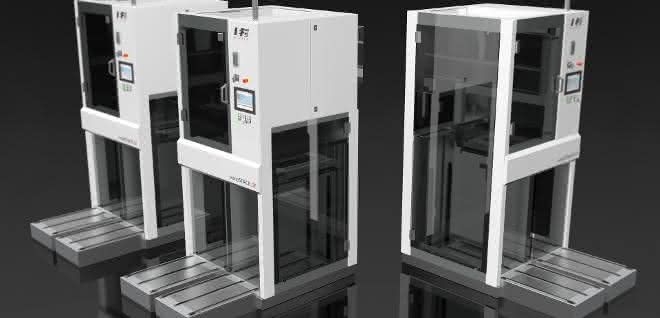
IEF-Werner from Furtwangen in the Black Forest offers open and modular palletizing systems that can be tailored to any task. Users can operate them with an integrated IEF product handling system or connect them to an existing robot or handling system as required. The compact systems can also be loaded with pallet trolleys or conveyor belts as standard - even from the side with the belt loader version. As the use of floor rollers is steadily increasing at companies, the automation expert is also designing its systems for the use of these transport trolleys. This allows companies to automatically feed heavy stacks of pallets into and out of the machine - without any physical effort on the part of an employee.
The operator can use the palletizers to provide components that are to be transported from a production line to a connected assembly line in an oriented manner and feed them in the specified position for further processing. After assembly, the system collects the finished parts from the processing line. Depending on the application, the machines can be equipped with single or multiple grippers.
Karl Klinck is a sales representative at IEF-Werner and knows his customers well. As an example, he cites a company that uses several palletizers: "One system takes the assemblies and components from the assembly line and places them in the packaging provided. It runs in three-shift operation up to 24 hours a day." Maintenance takes place at regular intervals. "There has been no major damage in the past. Only defined wear parts, such as deflection rollers, had to be replaced," he explains.
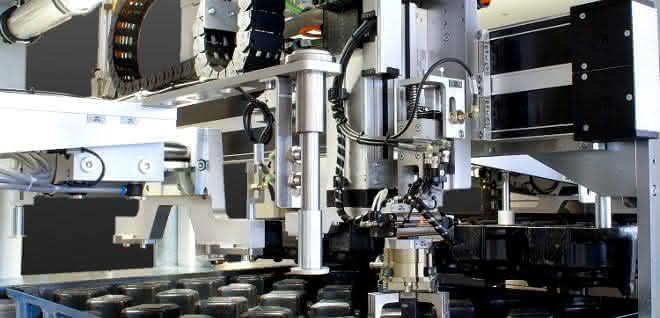
In another application, palletizers load parts and their components from a trolley onto assembly belts and pick them up again after processing. "As a rule, these are large and heavy subracks. So heavy that it would be very difficult for the personnel to lift a loaded pallet," says Klinck. "We have therefore designed the system so that an employee can push the loaded trolley directly onto the conveyor. There, the palletizer picks up the complete stack and feeds it to the assembly line. The employee does not have to perform any physically demanding tasks."
Machines also have a lot to offer in terms of energy efficiency. IEF-Werner equips some series completely without energy-intensive - and therefore expensive - compressed air. Components that are not currently required switch off automatically. This saves even more energy. In addition, the power supply is interrupted, for example, when the machine is at a standstill, at the end of a shift or during breaks. The systems are also very quiet during operation, which is reflected in a much more pleasant working atmosphere. "We were able to reduce the noise level by up to 20 decibels," says Klinck. What strikes the technical consultant is that, with the numerous improvements, the demand for the palletizers from companies in various industries is also continuously increasing.
And where is the development heading?
In a research project, IEF-Werner has built a prototype in which an intelligent toothed belt axis permanently monitors its own condition and performance and analyzes wear. This allows machine failures to be predicted before they occur. The axle also communicates with other components and can therefore keep production running if there is a risk of failure. "We want to transfer this principle to our palletizers in the future," explains Klinck. This further increases the reliability of the systems in operation. The responsible employee is always informed about the current status of the system and the service technicians from IEF-Werner can react to impending damage to the components at an early stage. "The user receives information about the service life of the components and is also immediately suggested the next maintenance date," promises Klinck. He can plan service measures in good time and thus increase his system availability. as


You might also be interested in
Predictive maintenance in retrofit
Predictive maintenance pays off. This is because early detection of impending failures means that systems can be serviced in a targeted manner before production downtime occurs. But how complex is it to integrate such a maintenance concept into an...
 read more...
Maintenance instead of replacement
The circular economy starts with the machinery
Sustainability in industry starts with machines, says our guest author from Deguma: How maintenance, modernization and the 5R strategy save resources, energy and CO₂.
read more...3D printing for unplanned requirements
The material fails and the machine suddenly stops? Then you need to take the right measures to be able to resume production quickly. Material failure in the form of faulty components or material wear in the frame are a risk for any production.
read more...High demands in terms of safety, application and robustness
Demanding work in the electrical trade and energy supply as well as smooth processes in production require innovative and customized measurement technology that scores points for safety, ease of use and resilience.
read more...Car meets e-bike: riding with lubrication-free polymer bearings
Studies show that the proportion of pedestrian and bicycle traffic is increasing in urban areas. With the JetBike, JetBike GmbH from Braunschweig presents a mixture of e-bike and car and relies on lubrication-free polymer bearings from Igus.
read more...Hydraulic hub for more efficient servicing
Bosch Rexroth presents a digital toolbox for service and maintenance. With a comprehensive range of digital services, the Hydraulic Hub simplifies and accelerates the service and maintenance of hydraulic products and increases machine availability.
read more...Arnold Umformtechnik expands after-sales...
Faster help with VR glasses
Arnold Umformtechnik is expanding the after-sales service for its machines to include digital remote services. The focus is on data security, simple operation and clear processes.
read more...147,000 euros per hour: high costs for German companies due to unplanned downtime
According to the "Value of Reliability" study, 67% of industrial companies in Germany experience unplanned downtime at least once a month. This costs the German economy 147,000 euros per hour. Nevertheless, reactive maintenance concepts are not...
read more...Maintenance starts with a maintenance planner
Legal requirements stipulate that machines and systems must be serviced regularly. The maintenance work serves to ensure occupational safety and economic efficiency.
read more...