

Knowledge management systems
Parts list management with artificial intelligence
Increasingly complex products and varying batch sizes from one to many thousands of units place new demands on production companies.
In addition, there are often unforeseeable supply bottlenecks for components or even delivery stops. It is becoming increasingly difficult to have the relevant information on the required components available at a glance. Knowledge management systems based on artificial intelligence support companies in providing the required information.
Everyday products are made up of countless individual parts, even if this is not obvious at first glance. Televisions with Wi-Fi function, smartphones and even kitchen appliances are "smart" today. However, before the product is offered for sale, it passes through many stages, starting with the assembly line, through quality testing and labeling requirements, such as CE marking, to logistical processing.
Numerous documents such as designations of origin, images and much more exist in digitalized form for each component in a product. Parts lists are essential in order to maintain an overview of all products and the required individual parts and their quantities (1 x 8 GB RAM or 2 x 4 GB RAM) during production and to be able to control the production processes efficiently.
Especially when supply bottlenecks are imminent, it is crucial to secure the required components for in-house production in good time. However, the speed required here is often slowed down because the necessary data is stored in different sources.
In order to be able to access this information at a glance, insight engines have become increasingly established in companies in recent years.
The term insight engine was coined and defined by the analyst firm Gartner[1]: "Insight engines combine search with AI to deliver actionable insights derived from the full spectrum of content and data sourced within and external to the enterprise ."
Smarter search with Insight Engines
In most cases, merchandise management systems or solutions for managing bills of materials (BOM) offer their own approaches when it comes to searching for and providing information. In most cases, however, these search systems are only limited to the associated data master. Users such as engineers or production planners can find information on individual components. What is missing, however, is important additional information such as country-specific restrictions, availability or suppliers. A comprehensive overview is therefore only possible in combination with manual, time-consuming and laborious research in various systems. This is precisely where insight engines come into play as a modern, innovative further development of classic enterprise search. They combine conventional search technologies with artificial intelligence methods to make the management, analysis and provision of information in the company more efficient.
Using deep learning, machine learning, natural language processing (NLP) and natural language understanding (NLU), insight engines enable a new form of dialog-based search (conversational search) and thus take the provision of information to a new level.
Using intelligent language processing such as NLP and NLU, an insight engine is able to process human language correctly. Search queries can therefore be submitted, analyzed, interpreted and understood in natural language. This is important, as many of today's queries are usually specific questions and not individual words.
While NLP deals with the machine processing of human language, NLU is primarily concerned with determining the user's intention. In this way, these technologies analyze the user's specific concerns and are able to tailor the search results to them.
Machine learning and neural networks also give an insight engine the ability to keep learning. As with humans, the intelligent technology benefits from past experiences and results that are collected on the basis of user analysis. The way they work, previous search queries, click behavior, etc. - all of this serves as a basis for future searches as well as the relevance and ranking of results. This enables an insight engine to continuously expand its knowledge and optimize its search performance.
The solutions identify people, facilities, locations and time periods in a wide variety of languages; and even questions with "where", "who", "what", "when" or "how" are "answered" appropriately. Another advantage: all results are available not only personalized and in the appropriate context, but also taking into account individual access rights.
A bird's eye view of the facts
As relevant information is available in a wide variety of data sources, ideally all source systems should be connected to the Insight Engine. In this way, in addition to parts lists or BOMs, countless other programs and applications can be searched in parallel with just a single search query, and the corresponding results can be extracted and displayed in a 360-degree view.
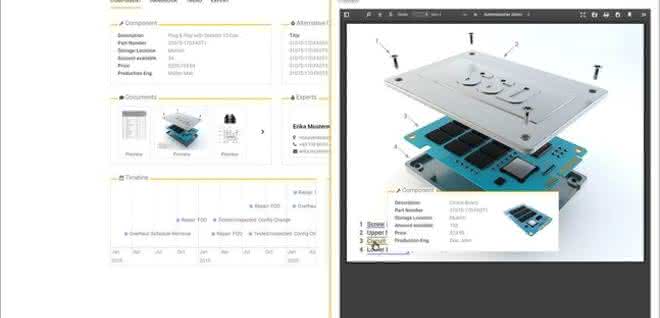
Without having to leave the view or start a new search, users also receive comprehensive detailed information on their search query, for example on a component (Interactive Exploded View).
Knowledge management based on artificial intelligence supports production companies in providing information from connected data sources. Parts lists are "brought to life" through the use of insight engines and can serve as an information hub for business-relevant decisions in the future.
By Gerald Martinetz, Mindbreeze
[1] https://www.gartner.com/en/documents/3961025/magic-quadrant-for-insight-engines


You might also be interested in
New loyalty program at Conrad
With its platform economy, Conrad Electronic enables simple and fast procurement from a single source and acts as a solution provider to make it as smooth as possible for business customers to cover their technical needs.
 read more...
Supply chains for injection molded parts
How to move tools successfully
Supply chains are coming under pressure, manufacturers are disappearing from the market, successors remain open - for purchasers in the plastics industry, this has long been no exception, but a daily reality. Companies that buy in injection molded...
read more...Integrated pneumatic lifting pin
A pneumatically operated, self-locking ball support pin enables seamless integration into robot and handling systems.
read more...Flexible lever solution for electromobility
With electromobility, the number of lithium-ion batteries that need to be moved, dismantled or tested during vehicle servicing, take-back campaigns or recycling is growing. However, weighing around 700 kg, these power storage units place high...
read more...Innovation for a strong SME sector
Small and medium-sized suppliers face tough national and international competition. These companies can achieve the required flexibility in production with digitalized manufacturing and automation solutions. Financing models and after-sales service...
read more...Small helpers with a big impact
Spring-loaded thrust pieces and ball lock pins
Whether cup holders, light housings or clamping devices, Halder develops and manufactures standard parts for almost every application and offers a range of around 13,000 standard parts, including spring-loaded thrust pieces, which are used in...
read more...VDMA takes over sponsorship of Intec
With a great response and more than 17,800 trade visitors from 42 countries, Intec was able to draw a very successful balance in mid-March. Together with the supplier trade fair Z, the trade fair duo made a strong contribution to ensuring that...
read more...Small and medium-sized enterprises
Innovation and partnership for a strong SME sector
Mobility, Data & Semiconductor, Aviation & Space - manufacturers in these and other key sectors are dependent on a functioning network of suppliers in many areas.
read more...Safely transported in one easy step
The new threaded lifting pins with handle from Erwin Halder are ideal for transporting or positioning light and medium loads quickly and easily. They are quick and easy to assemble and disassemble and offer a high level of safety and a robust design.
read more...