
AGVs on battery assembly lines
Established in e-mobility
The assembly of traction batteries for vehicles with hybrid or electric drives requires flexibility. Automated guided vehicle systems from DS enable production facilities to adapt to changing requirements. They communicate with plant components and higher-level systems and ensure productivity with optimum worker protection.
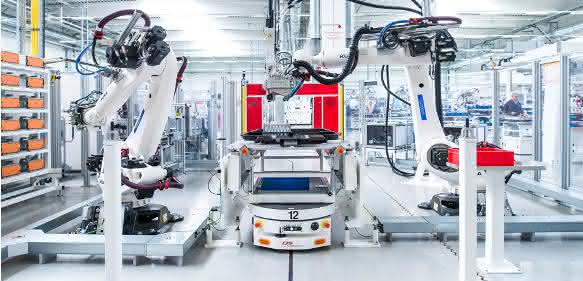
Electromobility is on the rise. The automotive industry offers its customers a growing portfolio of vehicles with hybrid or electric drives. Because they are aware of the role of traction batteries as a key component, almost all established car manufacturers are setting up production lines for the battery packs in their own plants or at subsidiaries. There, vehicle-specific traction batteries are created from supplied battery cells, control electronics, cooling systems and housings.
While fully electric series vehicles are already rolling off the production lines of car manufacturers, the technology for storing electrical energy in particular is constantly being developed further. In contrast to conventional starter batteries with their standardized sizes and form factors, the accumulator batteries for electric vehicles have complex, type-specific shapes. For reasons of space and weight, they are usually integrated into the floor assembly of the vehicle. They therefore have to be adapted in ever shorter cycles to new model generations of the cars for which they are intended.
Flexibility through FTS
"In contrast to classic drive components, car manufacturers still have little experience of how production volumes will develop. Today, this required flexibility can only be met by an AGV," says Kurt Ammerstorfer, Head of Sales, Product Management and Marketing at DS.
From preparing the base plate to fitting the cell blocks and battery management systems, making the electrical connections and attaching the cover, battery assembly usually takes place in ten to twelve stations. The overall level of automation is very high. Many stations are designed as closed robot cells, but numerous work steps are also carried out manually in between. Some stations also have multiple stations in order to parallelize processes that take longer than the usual three to five minute cycle time, such as the initial charging of the battery packs.
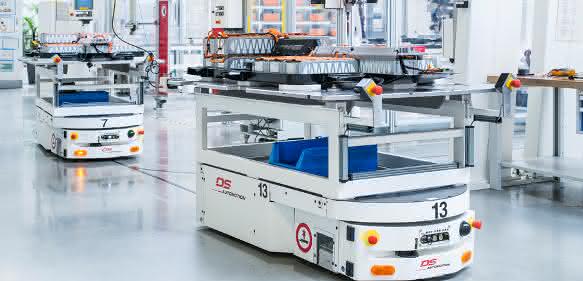
Conventional assembly lines with their fixed conveyor systems lack the necessary flexibility to react dynamically to the changing requirements of battery assembly. Here, it is particularly important to assemble even the smallest batch sizes economically. Automated guided vehicles from DS are already in use in numerous installations at car manufacturers. In the area of flexible assembly systems, these are mostly track-guided systems. Users see the fact that the Navios Trackguide control system is based on PLC technology as an advantage. As this is a de facto standard in the German automotive industry, its production and maintenance engineers are very familiar with this technology. The AGVs for battery assembly can therefore be seamlessly integrated into the overall automation processes.
The vehicles navigate along magnetic tapes or induction loops which, in addition to navigation, also serve to permanently recharge the batteries in the vehicles to avoid charging breaks. The superficially laid guideways and the ability to intervene in the control software also keep the AGV flexible, as they allow changes to be made to both the layout and the driving behavior at short notice.
Drive command via WLAN
There are companies that strive to implement a holistic approach in the sense of Industry 4.0 and therefore integrate the battery assembly systems into their general intralogistics. In such cases, preference is given to freely navigating systems for reasons of compatibility. Their Navios Freeguide control system calculates path sections, which it transmits to the vehicles, usually via WLAN, as quasi driving commands for the automatic execution of the desired tasks. These do not require any guidelines, as they aim at reference points - magnets embedded in the floor or laser reflectors on walls and shelves - to check that the route specified by the master computer is being followed. It continuously checks that the route targets are being met. The guidance control software is hierarchically positioned one level above the individual machine control systems. It communicates at eye level with MES and ERP systems, from whose information it derives the optimum movements.
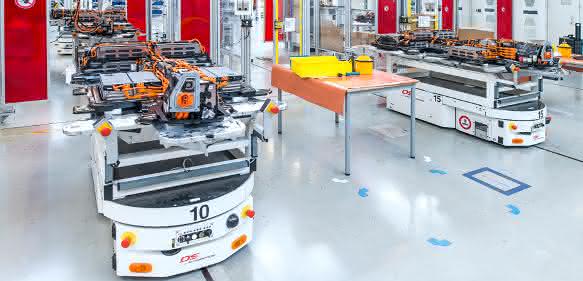
The automated guided vehicles from DS also communicate directly with other parts of the production plant. This allows them to enter the robot cells through the light curtains without triggering a safety violation and bringing them to a halt. This ensures maximum production efficiency and optimum protection for employees.
The very sparsely dimensioned aisles between the individual assembly cells require particularly maneuverable AGVs. "As a special feature, the AGVs in the production facilities for car traction batteries have to enter the cells in reverse, and often enough in a tight curve," says Kurt Ammerstorfer. "Thanks to our decades of experience with similar problems, especially in the automotive environment, we can guarantee the perfect functioning of this maneuver under all conceivable operating situations, even with track-guided systems." as


You might also be interested in
ebm-papst is growing again thanks to AI and data centers
ebm-papst returned to a growth trajectory in fiscal year 2025/26. Air Technology, data center applications, and artificial intelligence are driving revenue and investment.
 read more...
SPE on the Verge of a Market Breakthrough
Single Pair Ethernet (SPE) has moved beyond the conceptual phase and is increasingly being implemented in industrial settings. The focus here is not only on higher data rates and simplified cabling, but above all on the issue of system integration...
read more...More than 900 exhibitors already registered
Around six months before the start of the trade fair, more than 900 companies have registered for SPS 2026 in Nuremberg. The trade fair focuses on industrial AI, cyber security and digital transformation.
read more...Virtual PLCs in practice: How vPLCs make production systems more flexible and scalable
The increasing networking of IT and OT is fundamentally changing industrial automation. The IT/OT Integration Summit shows how modern technologies can make production environments more efficient, flexible and future-proof. The event will focus on...
read more...Sales growth in a turbulent market environment
Thanks to innovations and a focus on strategic industrial markets, Sick was able to moderately increase its sales in the 2025 financial year. In a turbulent market environment, the company was able to maintain its position and gain market share with...
read more...Siemens presents new AI agent
Siemens is launching 'Eigen Engineering Agent', an AI for automation technology. The solution is integrated into the TIA Portal, has been tested with over 100 companies and is designed to significantly accelerate engineering processes.
read more...Schaeffler keeps sales almost stable
Schaeffler generated revenue of EUR 23.5 billion in 2025 and increased EBIT before special items to EUR 936 million. At 266 million euros, free cash flow was significantly above the prior year and forecast. Net income remained negative due to high...
read more...Advancing artificial intelligence together
Helukabel is stepping up its activities in the field of artificial intelligence and is now a member of the IPAI. The innovation and collaboration platform for companies, research facilities, institutions and administration has set itself the goal of...
read more...New impetus for ifm sales
Two new positions were filled at ifm at the start of 2026: Markus Wolf becomes Managing Director Sales Germany, Sven Quant takes over the position of Central Managing Director in the Process Sensors division within the ifm Group.
read more...