

Modular robot cell from de Man
Compact robot cell palletizes various cartons
Stockmeier needed to stack 15 different types of cartons containing windshield antifreeze, differing in height, width, length and weight, on Euro pallets. The company opted for the MRZ modular robot cell from de Man.
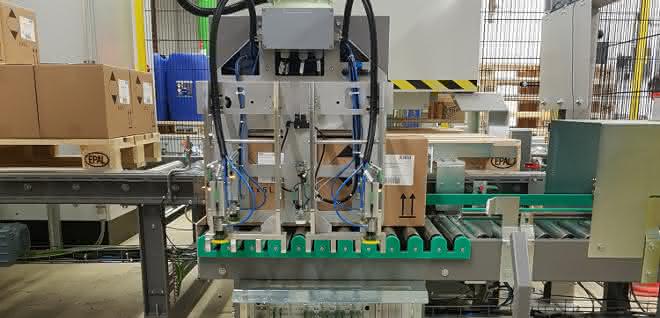
Stockmeier Chemie is one of the largest chemical distributors in Europe. The company offers industrial and specialty chemicals and also specializes in the development, production and distribution of cleaning agents for industrial and commercial use. At the main site in Bielefeld, the windshield antifreeze packed in cartons was to be palletized automatically. Stockmeier opted for the MRZ version 2.1 from de Man with a palletizing station and pallet conveyor technology within the cell plus an optional intermediate and pallet magazine. It achieves an output of 175 to 500 cartons per hour.
Continuous pallet feed
The item to be palletized is selected by the system operator on the HMI PC. Each article is assigned a specific packing scheme in which the packing sequence is stored. First, the pallet magazine, which is located above a pallet transfer unit, dispenses an empty pallet (Euro pallet). To fill the magazine, the pallets are placed on an infeed conveyor belt by a forklift and transported into the magazine.
The requested pallet is lowered from above onto the pallet transfer unit and is then positioned separately under the magazine. It now travels via the chain conveyor to the empty pallet station and is aligned on the left-hand side. If required, the conveyor system transports the pallet to the palletizing station, where it is stopped by a stopper and aligned in the direction of travel. The empty pallet space is immediately filled again to ensure a smooth palletizing process.
While the empty pallet to be palletized is running in, the robot fetches a bottom layer/intermediate layer - if stored in the packing scheme. These layers are made of inherently rigid cardboard and are stored in a layer pad magazine, which is filled manually. The robot gripper moves to a position above the layer pad magazine and then slowly down onto the magazine. Sensors detect when the gripper has reached the top cardboard. The robot saves this position so that it can move directly to the target when fetching the next layer pad. The search height is reset when the door is opened, as there is then a possibility that the magazine has been refilled.
Creating new packing schemes yourself
The cartons now enter the cell via a light conveyor system with an 800-millimetre tunnel as protection against interference and are palletized onto Euro plates by the robot - a Kawasaki CP 180L with four axes was used. The robot was placed on a platform by de Man in order to easily reach the maximum height of the packed pallet of 1,650 millimetres. As the cartons cannot be sucked up, they are gripped individually or in pairs using a fork gripper and placed on the pallet according to the packing pattern.
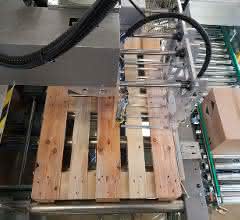
The gripper can handle cartons of flexible sizes up to a maximum of 400 x 300 x 350 millimetres. This means that all different product sizes are covered. While the robot is packing the cartons onto the pallet, the next cartons are already entering the cell. For the cartons with the highest production rate, the robot's fastest cycle time is six seconds per carton. If required by the packing scheme, an intermediate layer is placed between the individual layers.
The full pallets are finally conveyed out of the cell, transferred to a conveyor system from WST and transported directly to the warehouse. While the pallet is running out, the next empty pallet is already moving into the cell to ensure the shortest possible pallet changeover time. The system is supplied with 15 pre-installed packing schemes. Further packing schemes can be created by the customer himself in the de Man packing scheme generator after appropriate training.
An S7 1510SP-F is used as the central controller. It controls the fieldbus system (Profinet) and supplies the robot controller with data. For its part, the PLC receives product data and control data from the HMI, a PC with an SQL server as a database. The de-Man visualization is used as the user interface. A special feature of the system for Stockmeier: the touch screen measures a full 24 inches and makes it easier for the operator to recognize all the details of the system layout as well as to select the functions.
The operating elements are located directly on the main screen, giving the operator a quick overview of the status of all system parts and allowing complex components to be displayed in more detail.
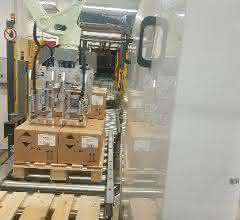
For safety reasons, the entire system is surrounded by a safety fence and access is via a safety gate, which must be requested. The safety interlock with guard locking only allows the safety door to be opened once the hazardous movements have been safely stopped. Trapped persons can leave the cell thanks to an emergency release. A light grid enables full pallets to be removed in automatic mode, but prevents unauthorized access to the system.
Standard and yet individual
The MRZ modular robot cell used is part of the M series from de Man. The automation specialist offers its customers a range of pre-planned modular robot cells for various applications: The MKA for erecting cartons, the MPZ for packing goods into cartons, the MRZ for palletizing and the MEZ for labeling cartons. All cells are controlled by the MFR material flow computer.
The M-series has a compact footprint, offers flexibility as well as high precision and speed. All cells can be individually adapted to specific requirements and expanded with options such as camera technology or additional conveyor lines. All products in the series can also be combined with each other to form a complete packaging line. as


You might also be interested in
ebm-papst is growing again thanks to AI and data centers
ebm-papst returned to a growth trajectory in fiscal year 2025/26. Air Technology, data center applications, and artificial intelligence are driving revenue and investment.
 read more...
SPE on the Verge of a Market Breakthrough
Single Pair Ethernet (SPE) has moved beyond the conceptual phase and is increasingly being implemented in industrial settings. The focus here is not only on higher data rates and simplified cabling, but above all on the issue of system integration...
read more...More than 900 exhibitors already registered
Around six months before the start of the trade fair, more than 900 companies have registered for SPS 2026 in Nuremberg. The trade fair focuses on industrial AI, cyber security and digital transformation.
read more...Virtual PLCs in practice: How vPLCs make production systems more flexible and scalable
The increasing networking of IT and OT is fundamentally changing industrial automation. The IT/OT Integration Summit shows how modern technologies can make production environments more efficient, flexible and future-proof. The event will focus on...
read more...Sales growth in a turbulent market environment
Thanks to innovations and a focus on strategic industrial markets, Sick was able to moderately increase its sales in the 2025 financial year. In a turbulent market environment, the company was able to maintain its position and gain market share with...
read more...Siemens presents new AI agent
Siemens is launching 'Eigen Engineering Agent', an AI for automation technology. The solution is integrated into the TIA Portal, has been tested with over 100 companies and is designed to significantly accelerate engineering processes.
read more...Schaeffler keeps sales almost stable
Schaeffler generated revenue of EUR 23.5 billion in 2025 and increased EBIT before special items to EUR 936 million. At 266 million euros, free cash flow was significantly above the prior year and forecast. Net income remained negative due to high...
read more...Advancing artificial intelligence together
Helukabel is stepping up its activities in the field of artificial intelligence and is now a member of the IPAI. The innovation and collaboration platform for companies, research facilities, institutions and administration has set itself the goal of...
read more...New impetus for ifm sales
Two new positions were filled at ifm at the start of 2026: Markus Wolf becomes Managing Director Sales Germany, Sven Quant takes over the position of Central Managing Director in the Process Sensors division within the ifm Group.
read more...