
Maintenance
Automation instead of over-maintenance
Digitalization has led to an optimization of processes in production companies. Nevertheless, a lot of data is still recorded manually in areas such as machine maintenance. ifm now relies on condition-based maintenance for the production of important components using store floor integration based on real data in order to record the individual wear and tear of tools.
The Essen-based company ifm electronic develops and produces highly specialized sensors for industry at locations in Germany, the USA, Singapore, Poland, Romania and India. The company employs 7,300 people worldwide and supplies customers from the packaging, automotive and food industries as well as machine tool manufacturers. IO-Link sensors are becoming increasingly important, particularly due to the progressive introduction of Industry 4.0, as they promise increased efficiency and cost savings thanks to their simple commissioning and the resulting transparency with regard to machine data.
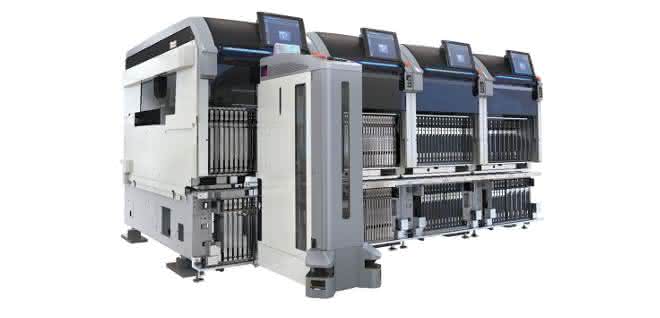
ifm produces IO-Link sensors at its plant on Lake Constance. The sensors are characterized by the fact that they not only measure, but can also aggregate and forward the information. They can therefore be used in a variety of ways in production plants. The most important element of the intelligent sensors is a circuit board that enables communication. The circuit board is manufactured using surface-mounted device (SMD) placement machines from Fuji. Regular maintenance of the placement heads guarantees consistently high quality.
Condition-based maintenance
Previously, the maintenance recommendations of the machine manufacturer were always adhered to in the factory. Over time, however, it became apparent that the maximum output - measured in terms of the number of picks per placement head - was not being fully utilized, resulting in unnecessarily high costs and high maintenance costs. "For this reason, we switched to condition-based maintenance and servicing, but had to realize that the net effect was very small because the performance limit of the placement heads could only be determined by time-consuming and regular checks of the counter reading on the machine," says Stefan Gessler, Head of Maintenance at ifm. In order to avoid the manual recording of data in the ERP system, which requires a lot of manpower and is also prone to errors, the company decided to switch to an automated solution.
The solution for vertical digitization from Siegen-based software manufacturer GIB - an ifm subsidiary - was ultimately chosen as the partner for implementing store floor integration (SFI). A sensor system in the machine measures the lifting and lowering speed of the respective pick head and automatically forwards the data to the ERP system. Once the maximum number of picks has been reached, a maintenance order is automatically created and the spare parts reservation is triggered. "For us, the big advantage of SFI was that we were able to use existing hardware and software. We didn't have to install any additional sensors, make any changes to the middleware or adapt the ERP system. Normal customizing functions ensure the connection from the store floor to the business process level," explains Matthias Marx, IIoT Consultant at GIB.
Real-time information and alerts
SFI is a software solution that collects sensor data from the middleware and forwards the information to the relevant areas in the ERP system. There, it is stored for later evaluation and serves as the basis for recommendations for action. This includes, for example, alerts for automatic purchase requisitions. For PCB production, this means that each placement head is recorded in the SAP system using a barcode. This means that the exact pick number of each head can be called up in real time. Depending on the individual degree of wear, the ERP system automatically suggests the replacement of the placement heads, which the maintenance technician can then carry out immediately. In this way, ifm avoids over-maintenance and premature replacement of components, which would otherwise cause unnecessary costs and consumption of resources.
"Maintenance and servicing have become easier for us to plan. We have been able to minimize downtimes and set-up times while ensuring high-quality production," sums up Stefan Gessler. "At the same time, the resource savings we have achieved mean we are taking a further step towards green production by operating more sustainably."
Tracking of the placement head
SFI has led to numerous improvements and more efficient machine utilization. Instead of manually entering the counter reading for picks made into SAP once a week, the movements of the placement head are automatically recorded and transmitted twice a day. Thanks to tracking, the production managers also know exactly where which tool is in use. Particularly positive for the production processes: the entire implementation, including process analysis and training, took just two weeks. The production downtime itself was minimal. In addition, the solution is not cost-intensive, meaning that the investment paid for itself within six months.
Companies often assume that large investments are necessary to implement automation and digitalization systems for Industry 4.0. However, even small solutions can have a major impact in certain areas without affecting ongoing operations in the long term. The implementation of SFI at ifm shows that a significant optimization of work processes can be achieved with comparatively little effort. An additional advantage of partial solutions such as this is that the training effort for employees is extremely low and the solution is widely accepted.


You might also be interested in
Predictive maintenance in retrofit
Predictive maintenance pays off. This is because early detection of impending failures means that systems can be serviced in a targeted manner before production downtime occurs. But how complex is it to integrate such a maintenance concept into an...
 read more...
Maintenance instead of replacement
The circular economy starts with the machinery
Sustainability in industry starts with machines, says our guest author from Deguma: How maintenance, modernization and the 5R strategy save resources, energy and CO₂.
read more...3D printing for unplanned requirements
The material fails and the machine suddenly stops? Then you need to take the right measures to be able to resume production quickly. Material failure in the form of faulty components or material wear in the frame are a risk for any production.
read more...High demands in terms of safety, application and robustness
Demanding work in the electrical trade and energy supply as well as smooth processes in production require innovative and customized measurement technology that scores points for safety, ease of use and resilience.
read more...Car meets e-bike: riding with lubrication-free polymer bearings
Studies show that the proportion of pedestrian and bicycle traffic is increasing in urban areas. With the JetBike, JetBike GmbH from Braunschweig presents a mixture of e-bike and car and relies on lubrication-free polymer bearings from Igus.
read more...Hydraulic hub for more efficient servicing
Bosch Rexroth presents a digital toolbox for service and maintenance. With a comprehensive range of digital services, the Hydraulic Hub simplifies and accelerates the service and maintenance of hydraulic products and increases machine availability.
read more...Arnold Umformtechnik expands after-sales...
Faster help with VR glasses
Arnold Umformtechnik is expanding the after-sales service for its machines to include digital remote services. The focus is on data security, simple operation and clear processes.
read more...147,000 euros per hour: high costs for German companies due to unplanned downtime
According to the "Value of Reliability" study, 67% of industrial companies in Germany experience unplanned downtime at least once a month. This costs the German economy 147,000 euros per hour. Nevertheless, reactive maintenance concepts are not...
read more...Maintenance starts with a maintenance planner
Legal requirements stipulate that machines and systems must be serviced regularly. The maintenance work serves to ensure occupational safety and economic efficiency.
read more...