
Aluminum profiles in ice
Vegetables for astronauts come from Antarctica
Fresh fruit and vegetables for astronauts - that is the aim of the Eden ISS project. A greenhouse with special systems for growing plants has been set up in the Antarctic for this purpose. Right in the middle: Item profiles including connection technology for a shelving system.
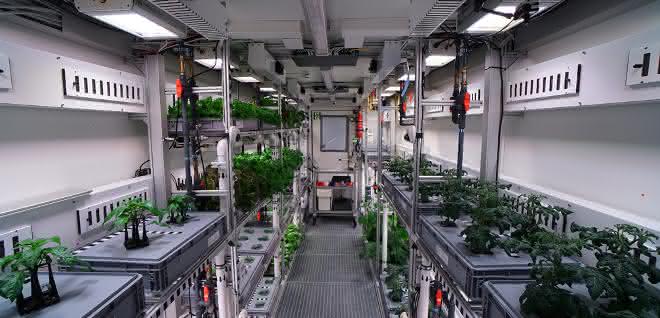
The research project in Antarctica serves as preparation for food cultivation on the International Space Station (ISS). Fourteen international organizations, universities, research institutes and companies joined forces in 2015 to form the Eden-ISS consortium to design and build a greenhouse for future planetary expeditions. It was led by the Institute of Space Systems, which has been developing concepts for space missions at the DLR site in Bremen since 2007.
Together, the project partners designed a mobile test facility consisting of two six-metre-long containers. To set up the containers, the institute used Item components from the MB Building Kit System, among others. "We have been working with Item products at our institute in Bremen for a number of years and have had very good experiences so far," says one of the project managers from the DLR Institute of Space Systems. "The assembly of laboratory equipment is simple and easy to understand - practically all of our employees can work with the system without long training phases."
For the greenhouse in Antarctica, the institute constructed a shelf made of aluminum profiles and matching connecting elements with 21 levels. Each shelf offers space for two plastic boxes arranged next to each other, in which the vegetable and fruit plants grow. "We are currently cultivating around 200 plants," reports the DLR project manager. "So far, we have mainly harvested lettuce, cucumbers and tomatoes - on average between four and five kilograms of vegetables per week." While the plants are in one container, a service area for laboratory work with supply systems and a workstation has been set up in the second container.
Transportation through several climate zones
Since the start of the project in 2015, there have been different variants for the superstructures inside the container. "We set up 90 percent of the containers at DLR in Bremen and finally transported them to their destination after a three-month test phase," explains the project manager. "The containers contained some sensitive systems, such as LED lamps, which were exposed to great risk on such a journey through several climate zones with frequent reloading. We therefore placed high stability requirements on the racking system."
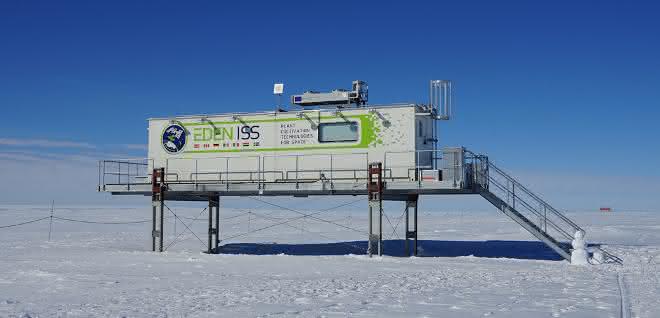
Item offers a solution for this: the profiles and connections enable permanently strong and stable constructions - even under high loads. As a result, measuring systems and other technical equipment arrived safely at their destination in the ice after the long journey from Bremen via Cape Town to Antarctica and remained undamaged. The two containers were assembled and connected to each other on a weatherproof platform approximately 400 meters south of Neumayer Station III in January 2018.
Components used ensure stability
The shelving system is attached to both sides of the container and consists mainly of Series 6 aluminum profiles and corresponding automatic connection and bracket sets. Compared to welded systems, this variant is lighter but at the same time robust. The strong hold is achieved by the preload in the flanks of the aluminum profiles, which is generated when the profile connections are bolted together. The design thus offers reliable stability for the duration of use. The anodized surfaces do not oxidize and are easy to clean. item trunking profiles with matching item cover profiles are used for laying cables and hoses. This keeps the cables safe and protected.
DLR also uses an Item SystemMobil as a work trolley. A lightweight and sturdy frame, combined with three load-bearing trays and an ergonomically positioned push handle, ensures that all the equipment required for growing the plants is mobile. The robust transport trolley can also be moved without tipping when loaded. With additional holders for tools and other accessories, this work trolley can be flexibly adapted to the respective areas of use and work processes. Thanks to its compact design and smooth-running castors, it can be easily moved forwards and backwards in the narrow aisle between the two shelves.
The researchers also rely on the Item modular systems for the service area in the neighboring container. The fact that Item has numerous sales partners in several countries proved to be an advantage. "The service and work area is an interface, as our partners from Italy and Canada, for example, contributed their own systems," says the project manager. "Because the project participants from the different countries also relied on the Item components, we were able to simply combine the individual systems and components in Bremen in advance. This made our work much easier." as


You might also be interested in
Helu makes its first trade fair appearance under a new brand name
Helu Kabel will be presenting itself as Helu for the first time at Hannover Messe 2026, showcasing system solutions, Heluchain cables and new industrial luminaires.
 read more...
Strategic realignment with brand relaunch
In future, Helukabel will trade as Helu
The Helukabel Group is parting with part of its name: in future, the company will only operate under the Helu brand. With this step, the specialist for electrical connection technology is underlining its strategic development from a classic cable...
read more...Modular plant construction for corrugated board
Insight into the production of corrugators at BHS Corrugated: Automated, modular and equipped with Helukabel components.
read more...Best quality for the steel
Conditions in the steel industry are harsh and inhospitable. The machines used must be able to withstand the demanding environmental conditions in order to deliver the best quality at all times.
read more...If the standard cable is not sufficient
Lapp offers cables for countless applications - but not for all of them. From time to time, the developers have to modify a standard cable or develop a special cable.
read more...Slight decline in sales, strong investments
The Lapp Group has not been spared from the weakening global economy. However, the company only recorded a slight loss in the past 2024 financial year.
read more...Electrical connection technology
Cables and wires for industrial automation
Heukabel offers system solutions for cable routing from a single source. The subsidiary EKD Systems specializes in tailor-made cable drag chains made of steel, stainless steel and plastic, which are used in moving machines and systems as well as in...
read more...Lapp relies on Ultramid from BASF
Mobile charging of electric vehicles
The automotive industry is currently undergoing the biggest transformation in its history. The boom in battery electric vehicles in particular is presenting the industry with major challenges. Lapp, as a supplier of cables and connection...
read more...Cable handling application
At this year's Motek, ArtiMinds Robotics is showcasing a robot-based automation solution for the sensor-assisted assembly of flexible cables in connector housings.
read more...