

Beverage production
NSK rolling bearings save 10,874 euros in maintenance costs
A British soft drinks manufacturer experienced premature bearing failures on an automatic bottle labeling system. By switching to NSK deep groove ball bearings with non-contact seals and lifetime lubrication, the service life of the bearings was increased by a factor of 52.
The beverage manufacturer's management asked the NSK experts to visit the site to get an idea of the bearing installation situation and make recommendations that would extend the service life of the bearings. This is because the automated labeling system, which places a flexible plastic sleeve around the bottles, is of great importance within the production process. The deep groove ball bearings therefore had to be replaced weekly to avoid unplanned downtime.
The operator of the sleeve system suspected that the powder layer on the inside of the sleeves was initially the cause of contamination and subsequently of the bearing failures. However, NSK's analysis revealed that it was not a case of contamination. Rather, the cause was of a completely different nature.
After examining six failed bearings as part of the AIP program ("Added Value Program"), the NSK specialists discovered that residual magnetism in the bearing was the reason for the regular failure. This magnetism acted like an eddy current brake. It was caused by the handling of the sleeve: the foil tube is opened and pulled over a device. The bearings are located on a guide unit that is held in position by magnets. This enables the rollers to guide the plastic film correctly.
The identification of residual magnetism as the cause was the result of a process that began with the disassembly and analysis of the failed bearings. All bearings were found to have a very shiny surface on the outer ring of the bearing, indicating faulty rotation and slippage of the bearing in its seat.
Residual magnetism and rough raceway surface
Another characteristic of the failed bearings was a slightly rough raceway surface, with scoring in some areas. Although this appearance is typical for bearings with a metal cage, it was more pronounced than one would expect. Apart from these defects, however, the bearings were in good general condition. There were few signs of contamination ingress or other major sources of damage on the surfaces of the rolling elements and running surfaces.
The NSK experts identified magnetism as the cause of the failure by analyzing the ambient conditions. The magnets are located in close proximity to the bearings on the guide unit. They caused a polarization between the balls and the cage on one side and the races on the other. This explains the unsteady bearing rotation that the operator had noticed, as well as the damage that had occurred. According to the results of the analysis, there was also a lack of lubricant, which then led to metallic contact between the rolling partners and thus to additional wear.
The plant operator then initially checked whether it was possible to arrange the magnets at a greater distance from the bearings. However, this proved to be unfeasible and he asked NSK for a proposal to improve the situation.
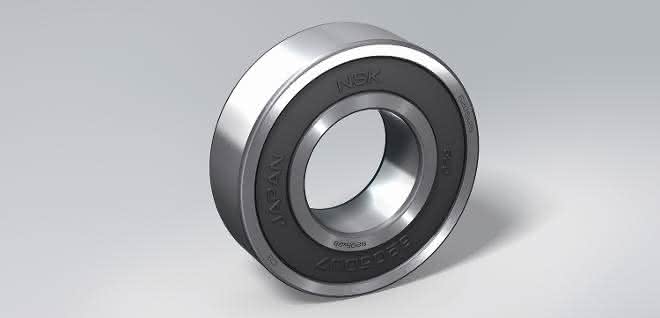
This proposal was to use a contactless sealed and lifetime-lubricated deep groove ball bearing with a plastic cage, which reduces the build-up of magnetism and polarities. These properties are offered by an NSK miniature deep groove ball bearing in size 627 with a plastic cage made of polyamide resin (T1X), increased internal clearance (C5) and a double-sided cover washer (ZZ) or contactless sealing washer (VV).
The solution was put into practice - and led to a considerable increase in bearing service life from one week to one year. This means an annual saving of €10,874 in costs for replacement bearings and assembly work. as


You might also be interested in
Plagiarius 2024 negative prize
On January 26, 2024, the Plagiarius campaign awarded its dreaded "Plagiarius" negative prize for the 48th time to manufacturers and retailers of particularly brazen counterfeits and fakes.
 read more...
Ivalua honors winners of the Generative AI...
AI-supported "add-ons" for buyers within 48 hours
Ivalua, provider of cloud-based spend management solutions, announced the winners and innovations of the first Generative AI Innovation Cup. The competition took place in December 2023. It was open to all Ivalua partners and employees - more than...
read more...Efaflex celebrates 50 years of high-speed...
The emphasis is on "fast"
Since day one, Efaflex has wanted to use new technologies as early as possible and drive progress in the industry. This year, the family business is celebrating its 50th anniversary under the motto "Fast Forward".
read more...Security of supply even during power outages
In the winter of 2022, Germany was worried about energy shortages. The drugstore retailer dm did not paint any horror scenarios, but nevertheless saw the possibility of controlled, temporary, regional power cuts (brownouts).
read more...Safety technology in mechanical engineering
Modules with new functions
Euchner's product highlights at EMO 2023 include the communication-capable solenoid interlocks.
read more...Transforming the paper industry towards climate neutrality
Together with partners from industry and research, Voith is developing a project for the optimization of energy and material flows in paper production. The aim of the research project is to develop a digital framework that enables effective process...
read more...Up to 95 percent less flue gas thanks to direct extraction
The requirements for occupational safety measures and safety technology are also constantly increasing in welding technology. The Technical Rules for Hazardous Substances (TRGS) stipulate that welding fumes and harmful substances must be extracted...
read more...Competitive advantages with large machines
Whether 3D-printed components for machines and systems, prototypes or aids for design: additive manufacturing is almost indispensable for modern companies in mechanical and plant engineering and automation if they want to play in the premier league.
read more...Transport technology from the modular system
Many transport tasks can be realized with the help of linear technology. Pre-configured solutions are available to simplify the interaction between the linear unit, motor, gearbox and controller. This minimizes the effort required for research and...
read more...