

Gas struts
Cushioning - always different!
Design of gas struts. Gas struts have to meet complex requirement profiles. Modern gas spring systems from Suspa are designed from the ground up to be precisely matched to individual performance characteristics in order to ensure maximum functionality in the application.
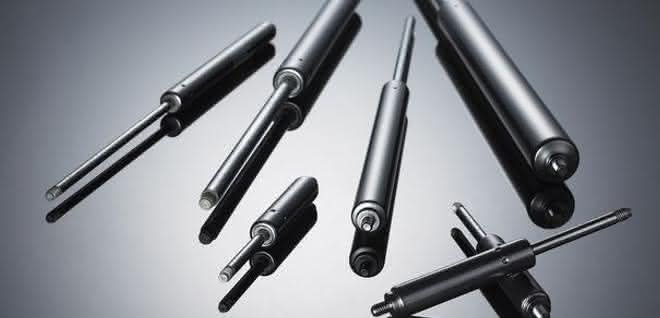
The individual design of gas springs is more important than ever, says Suspa. The decision criteria according to which gas springs are designed for their specific application include installation space requirements, damping characteristics, specific force support and opening or holding ranges that a gas spring must fulfill in a specific application. Characteristic of their versatility is the almost individual adjustability of the spring force, independent of the spring travel, combined with comparatively low installation space requirements.
Flat or linear spring characteristic
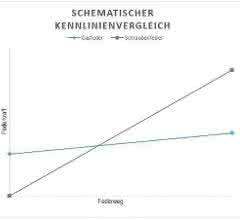
Gas springs are usually characterized by a flat spring characteristic curve, highly variable forces with the same dimensions, determinable extension speed and damping properties. A classic compression spring, on the other hand, has a linearly increasing characteristic curve. In order to obtain a spring force, the compression spring must first be compressed, i.e. preloaded. As gas springs are preloaded systems, the spring force F1 is available in the fully extended state compared to a classic compression spring. This is made possible by the nitrogen pre-filled pressure tube. Inside a gas spring, the filling pressure acts on both surfaces of the piston. Since this is firmly connected to the piston rod, the piston surface on the piston rod side is reduced by the cross-section of the piston rod. This results in a differential force on the piston, which acts in the direction of extension. The magnitude of the force (F) is equal to the product of the filling pressure (p) and the cross-sectional area of the piston rod (A). The following formula therefore applies: F = p x A.
Gas springs have to lift, lower, dampen or tilt different loads. The more than 1,500 different gas spring variants in the Liftline series can handle extension forces of between 50 and 2,500 newtons. In modern flap applications, for example, they are used in combination with spiral springs. This combination capability opens up further potential for individualization.
Supplementary systems extend the range of applications
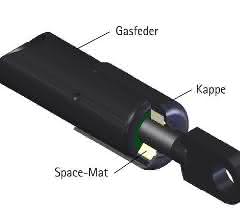
There are applications in which the piston rod of the gas springs should not be installed pointing downwards as usual, but upwards. Under these conditions, the piston rod could be insufficiently lubricated when extending and retracting. Space-Mat solves this problem for gas springs that have to be installed with the piston rod pointing upwards due to the application. Gas springs fitted with Space-Mat can be installed with the piston rod pointing upwards without causing increased wear on the piston rod seal. In addition, the service life of the gas spring is increased, especially when used in technically demanding environments, such as in dirty and dusty conditions. This ensures constant lubrication of the piston rod and seal during extension and retraction of the spring.
The Hydroline hydraulic valve system, which is also installed in the gas spring, was developed to meet the market demand for infinitely adjustable applications. It increases the ease of use of end applications, enables stepless adjustment within a defined stroke range and a hydraulic support. These basic functions are perfected in the lockable gas struts of the Varilock series. The user not only receives a gas spring that can be locked continuously, but also an intelligent system that has many special and additional functions, such as the automatic Time Reset (TR) system, the Easy Switch (ES) that can be switched on and off, the automatic extension system (Over Ride, OR), the comprehensive operating management system (Comfort Release CH / CL) or the Anti-Shock System module (AS).
Customizable damping characteristics
Kitchen cabinet doors and flaps or hand luggage flaps in aircraft are kinematic challenges that gas springs with specialized performance characteristics master. In this area, aesthetics and appearance are important; they are reflected in the acceleration and deceleration during the opening, closing or tilting process and express a visual, haptic and technical value. In order to realize such performance profiles, a configurable spring characteristic is required that provides adequate, individual damping characteristics and can change the adjustment speed over the stroke. With Soft Stop technology, a standard has been developed that controls the exact insertion, extension and end position damping. It is based on customizable damping characteristics that can fully meet individual requirements.
Gas struts are designed for a service life of 50,000 load cycles. During this life cycle, they are subject to natural wear. As a result of the piston rod being pushed in and out, a certain amount of friction occurs despite lubrication. The seal is a key component; it ensures that the gas spring functions perfectly and maintains the prefilled gas pressure in the pressure tube.
"In-house piston rod production
Another key component is the piston rod. It is subject to all environmental influences that occur during use. These have an effect on the piston rod surface and the seal and therefore influence the overall service life of the gas spring. For this reason, Suspa manufactures the piston rods in-house. Knowing and controlling piston rod manufacturing processes has a positive effect on the quality and service life of the piston rod and therefore the entire gas spring. Sophisticated finishing is also important. Finishing processes such as nitriding or chrome plating make piston rods resistant and have a positive effect on quality and service life.


You might also be interested in
Ergonomics and manpower on machine tools
By combining proven industrial gas springs and electromechanical actuators, heavy covers can be moved more comfortably, quietly and efficiently: an international supplier is optimizing the ergonomics of its production facilities.
 read more...
ACE TUBUS structural dampers protect compact sliders
The requirements in automotive manufacturing in terms of product quality, precision and durability are high. Design engineers at voestalpine Camtec GmbH have therefore opted for structural dampers from ACE to protect compact slides.
read more...Facilitating COVID-19 diagnosis and care with ACE gas springs
Especially during the corona pandemic, intensive care physicians need images of the condition of infected patients' lungs quickly. Mobile X-ray machines are one of the most effective medical aids in diagnostics. When Wuhan was hit by the first wave...
read more...X-ray devices for Covid-19 diagnosis
ACE gas tension springs in use in Wuhan
During the corona pandemic, intensive care physicians need images of the condition of the lungs quickly. Mobile X-ray machines are among the most effective medical aids. In Wuhan, the Wandong company was able to deliver X-ray equipment quickly,...
read more...Press clean
New stainless steel gas struts from Norelem are available in addition to the regular steel models. The piston rod is made of stainless steel 1.4305, the pressure tube of stainless steel 1.4301.
read more...ACE gets Winter Olympians fit
For the Winter Olympics in Pyeongchang, the athletes in ski cross and ski jumping have rehearsed and optimized their starts thousands of times. To this end, ACE supplied components for start training to German and Austrian Olympic training centers.
read more...Starting aids for Winter Olympians
ACE Schockdämpfer has supplied components for start training to German and Austrian Olympic training centers in ski cross and ski jumping. In two cases, existing designs were optimized with the help of the Langenfeld-based company.
read more...Dampers for luggage compartments
Well cushioned above the clouds
Suspa has developed dampers with overload protection for overhead compartments in passenger aircraft. The Softline dampers are already in use in almost 300 aircraft from a major aircraft manufacturer.
read more...Smart teamwork
Suspa modules can be used to create different variations of sit-stand workstations. Depending on space requirements and individual needs, four different table bases can be built from modular components: Fix Frame, Vari Frame, Team Frame and Big...
read more...