
Components for start training
ACE gets Winter Olympians fit
For the Winter Olympics in Pyeongchang, the athletes in ski cross and ski jumping have rehearsed and optimized their starts thousands of times. To this end, ACE supplied components for start training to German and Austrian Olympic training centers.
In ski cross, the first few meters are often decisive for the race. This is why the start phase is rehearsed over and over again. In the summer months, a starting machine that looks like a bed frame on wheels is used for this purpose. A 36-kilogram sled is pushed backwards by the training skier. There were two problems during initial tests at the Austrian Olympic base in Innsbruck. The sled crashed into the end position with full force, causing damage to the structure. And a second person had to help hold it so that the training device did not become independent.
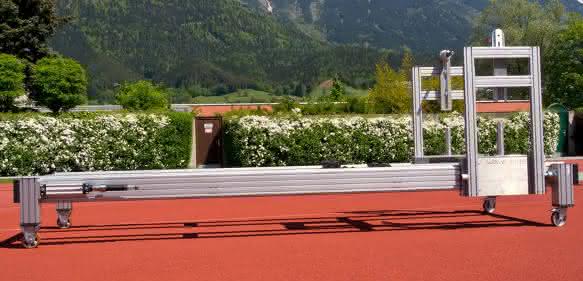
At this point, ACE shock absorbers were switched on. To calculate the kinetic energy to be absorbed, speeds of eight and ten meters per second were assumed. With a moving mass of 36 kilograms, this resulted in support force values of around 38,000 Newtons at ten meters per second and around 25,000 Newtons at eight meters per second. Based on this calculated energy, two ACE industrial shock absorbers of type MA4575EUM were used to protect the end positions, each of which can absorb 1,300 Newton meters per stroke and therefore offers sufficient safety reserves. This applies for many years, as the dampers of the Magnum family are normally at home in automation, handling tasks and rotary modules and are designed for high cycle rates. However, if a change is necessary, it is easy because ACE provides its damping solutions with a wide range of suitable accessories and connection parts.
Start bar optimized for ski jumpers
ACE's large selection of DIN-standardized accessories also proved to be an advantage for training on the ski jumps at the Hinterzarten ski club. At this German Olympic training center, it is important to use the ski jumps one after the other and with a safe distance. The take-off length must also always be adapted to the jumpers' abilities and the weather conditions. In order to achieve similar distances, the approach length and the resulting speed at the end of the take-off serve as balancing elements.
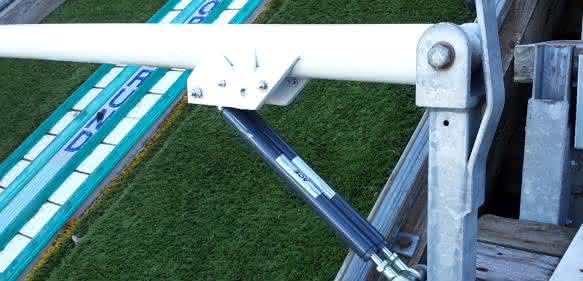
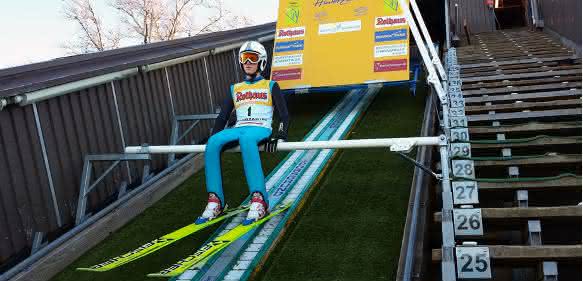
For this purpose, there are various start gates with four mobile start beams at the inrun tower in Hinterzarten. During training, these beams are mounted or inserted at different start gates, i.e. for different inrun lengths. In the basic position, the beam arm is upwards. To enter the inrun, the jumper pushes the beam arm down into the counter-holder. When the jumper sets off, the relieved beam arm is returned to the starting position by gas pressure springs. The inrun is thus quickly free again for the next athlete who wants to start from a starting beam mounted further up.
This system makes training operations much easier; manual lifting or moving of the beams is no longer necessary. In this case, the solutions from ACE replace products from another manufacturer that are too susceptible to damage. Two GS-22-200-EE-200N industrial gas springs are used for each start bar. Designed with an extension force of 200 newtons, filled, delivered and installed accordingly, they require hardly any muscle power from the athletes when closing the take-off bars, allowing them to conserve their energy before the jump, which requires a great deal of concentration, precision and speed. as


You might also be interested in
Free online tools from ACE in practice
In many companies, digitalization and the lean management approach are seen as a welcome slimming cure. How digital progress is simplifying design processes is demonstrated above all by solutions designed from the user's perspective. Configuration...
 read more...
ACE small shock absorbers secure wheelchair test bench
The demands on the quality and functional safety of wheelchairs are high. This also applies to the test series carried out by manufacturers during the development or further development of models. As part of their training, three mechanical...
read more...E-scooter with customizable damping
The startup Scuddy has significantly improved the flexibility, performance, customizability and ergonomics of its second-generation foldable e-scooter of the same name - thanks in part to damping technology from ACE.
read more...ACE vibration dampers: protected against vibrations step by step
Autonomous driving - what is still being perfected for road traffic is already part of everyday life when it comes to transporting materials from the warehouse to assembly. In fact, manufacturer-independent special kits for converting commercially...
read more...Key factor: energy efficiency
Sumitomo Drive Technologies, together with Invertek Drives and the Lafert Group, will be presenting its complete drive solutions for automation and Industry 4.0. Visitors to the stand will learn how they can achieve their sustainability goals and...
read more...ACE structural and crash dampers: Safety on the road 7
The seventh axis is used in manufacturing and production systems to make robots more agile and increase their reach. As an additional traversing axis, this linear axis brings robots quickly into the workspace or guides them precisely to parallel...
read more...Mechanical and plant engineering
Incoming orders in November: economic dampener takes effect
In the final months of 2022, the various economic downturns were also reflected in the order books of the mechanical and plant engineering sector.
read more...Safe protection for handling systems
Small shock absorbers protect linear axes in the semiconductor industry.
read more...ACE TUBUS structural dampers protect compact sliders
The requirements in automotive manufacturing in terms of product quality, precision and durability are high. Design engineers at voestalpine Camtec GmbH have therefore opted for structural dampers from ACE to protect compact slides.
read more...