
EU research project Selsus
IEF-Werner develops self-optimizing linear axis
IEF-Werner has built a demonstrator for the EU research project Selsus in which an intelligent toothed belt axis permanently monitors its own condition and performance and analyzes wear. It also communicates with other components via a cloud connection and can therefore keep production running if there is a risk of failure.
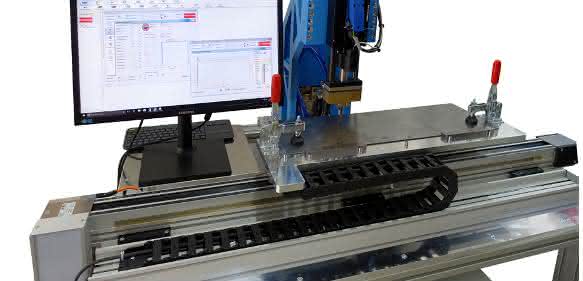
Sudden machine downtimes in production are a nightmare for companies. The longer the disruption lasts, the more expensive it ends up being. It also affects manufacturers' delivery reliability and reduces their competitiveness. "These are usually relatively minor defects or signs of wear," explains Ulrich Moser, Head of Marketing at IEF-Werner from Furtwangen in the Black Forest. "However, if these are not recognized in time, the degree of wear increases and the machine or component no longer works precisely. At some point, it will fail completely."
What if it could independently monitor its status, recognize problems and weak points and inform the responsible employee in good time? Or even better: if it could rectify the effects of problems itself or communicate with other components? Production would continue without expensive machine downtimes and service technicians could schedule maintenance measures in good time. Wear and tear could be reduced and the service life of the components significantly extended. The automation specialist has been working on precisely this topic as part of the EU research project Selsus, which was led by the Fraunhofer Institute for Manufacturing Engineering and Automation IPA in Stuttgart.
The project is called "Health Monitoring and Life-Long Capability Management for Self-Sustaining Manufacturing Systems", which describes the ability of machines and components to monitor and optimize themselves to a certain extent and thus maintain production. The IPA scientists worked together with partners from industry and science on a technology that uses intelligent software and sensor networks to detect weak points and signs of wear at an early stage and thus predict failures. Selsus was funded by the European Commission with almost 5.4 million euros.
Selcomp - the intelligent unit
"With the ability to optimize themselves, the components in production lines no longer perform an isolated task. Instead, they are a dynamic, versatile and specialized part of a structure of intelligent work cells," explains Ulrich Moser. As part of the project, these logical units are called Selcomps: They collect, store and analyze process data. As autonomously operating systems, they are therefore able to evaluate their own condition and performance and recognize the degree of wear and tear without external influence.
But how can such components be designed? "To find out, we developed our own Selcomp from a toothed belt axis and installed it in a demonstrator," says Moser. IEF-Werner deliberately opted for the linear unit because it has proven itself in numerous handling tasks. Driven by a servo motor, it works efficiently and cost-effectively. The integrated guide can also be used in slightly contaminated environments and the guide elements work almost maintenance-free for up to 10,000 kilometers. With this component, the toothed belt enables high acceleration and speeds with short cycle times. For the construction of a collaborative demonstrator, the axis was mounted on a stable frame on which an intelligent welding unit from partner HWH is also integrated. The HWH-Selcomp consists of a welding controller and welding gun - with sensors for measuring temperature, current, voltage and force. This exemplary scenario represents the widely occurring application of a moving component in cooperation with a production process.
High demands lead to wear
"The data specified by the manufacturer regarding the service life of a machine component are usually only guide values that can vary greatly during use," explains Moser. Different loads, such as those caused by rapid starting and stopping, can lead to abrasive, adhesive or fatigue wear on the contact surfaces of the slides and guideways or in the drive bearings. Accuracy continues to decrease and the risk of failure increases. To ensure that the axle can always run in optimum condition, it was necessary to pinpoint the exact points where wear occurs. The developers initially installed additional sensors. "This enabled us to identify critical points in the motor and carriage bearings, among other things," explains Moser. After extensive tests, the IEF technicians realized that the necessary information could not be collected with additional sensors alone. It is easier and, above all, more cost-efficient to do this by indirect determination on the basis of known data, such as the motor current.
The task now was to develop a powerful model that would calculate the practical service life of the timing belt axis from the permanently collected data. "To solve this task, we worked closely with the ICT provider Hugin Expert," says Moser. The Danish company specializes in Bayesian networks - a mathematical method that can be used to calculate the probability of a certain event or condition occurring. This method takes into account several variables and the possibilities associated with them, for example that a certain cable subject to high stress will break in the near future.
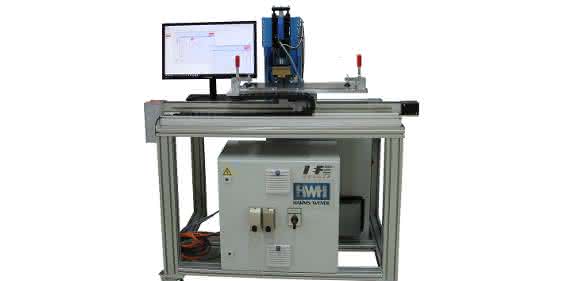
In order to process this flood of data securely, IEF-Werner sent it to the Selsus cloud as part of the project. "The values that our Selcomp calculates with this model are accurate to within plus/minus ten percent," says Ulrich Moser happily. If this technology is integrated into the timing belt axis, the display on the control unit shows the user the service life of the component and suggests the next maintenance date.
Selcomps together
IEF-Werner went one step further in this project: the intelligent toothed belt axis should not only react to its own status, but also to the external welding unit. In the test setup, the two Selcomps work: first the linear axis positions the welding plate, then the welding process takes place. "We interconnected both units wirelessly using the Representational State Transfer (REST) web service and also sent the data from the welding unit to the Selsus cloud," says Moser. Before the process starts, both components register with data such as type designation, date of manufacture, stroke or even their serial number. Dynamic data is then added during operation. With this information, the timing belt axis can react autonomously to the welding unit and adjust control parameters so that production operates at the optimum point in terms of efficiency.
"We offer users many practical advantages with our newly developed technology," says Ulrich Moser. "But most importantly, if they adhere to the service measures recommended by the timing belt axis, we guarantee our customers up to 30 percent longer component service life." The development is still in prototype construction. "However, our aim is to offer this pioneering solution as an option for all our linear axes," says Moser. as


You might also be interested in
Helu makes its first trade fair appearance under a new brand name
Helu Kabel will be presenting itself as Helu for the first time at Hannover Messe 2026, showcasing system solutions, Heluchain cables and new industrial luminaires.
 read more...
Strategic realignment with brand relaunch
In future, Helukabel will trade as Helu
The Helukabel Group is parting with part of its name: in future, the company will only operate under the Helu brand. With this step, the specialist for electrical connection technology is underlining its strategic development from a classic cable...
read more...Modular plant construction for corrugated board
Insight into the production of corrugators at BHS Corrugated: Automated, modular and equipped with Helukabel components.
read more...Best quality for the steel
Conditions in the steel industry are harsh and inhospitable. The machines used must be able to withstand the demanding environmental conditions in order to deliver the best quality at all times.
read more...If the standard cable is not sufficient
Lapp offers cables for countless applications - but not for all of them. From time to time, the developers have to modify a standard cable or develop a special cable.
read more...Slight decline in sales, strong investments
The Lapp Group has not been spared from the weakening global economy. However, the company only recorded a slight loss in the past 2024 financial year.
read more...Electrical connection technology
Cables and wires for industrial automation
Heukabel offers system solutions for cable routing from a single source. The subsidiary EKD Systems specializes in tailor-made cable drag chains made of steel, stainless steel and plastic, which are used in moving machines and systems as well as in...
read more...Lapp relies on Ultramid from BASF
Mobile charging of electric vehicles
The automotive industry is currently undergoing the biggest transformation in its history. The boom in battery electric vehicles in particular is presenting the industry with major challenges. Lapp, as a supplier of cables and connection...
read more...Cable handling application
At this year's Motek, ArtiMinds Robotics is showcasing a robot-based automation solution for the sensor-assisted assembly of flexible cables in connector housings.
read more...