
Reichelt Elektronik on voice assistants
Voice - the user interface of the future?
Voice assistants such as Siri, Alexa and Google are becoming increasingly popular. There is even speculation that voice technology is becoming the user interface of the future. Is that really the case? Frank Gerwarth, Product Manager for voice assistance systems at reichelt elektronik, explains the challenges of voice technology.

Whether it's Amazon, Apple, Google or Microsoft, every major player in the tech industry wants to lay claim to the highly competitive voice assistant market. The annual increase in sales figures clearly shows that the technology is becoming increasingly relevant to us. There is even speculation that voice technology is becoming the user interface of the future.
Frank Gerwarth, Product Manager at reichelt elektronik, asks whether we will still need physical input devices to operate a computer or other electronic devices in the future and what challenges voice assistance technology will have to overcome to achieve this.
History & further development of the user interface:
A closer look at the development of user interfaces for computers and applications reveals that the operation of technical devices is increasingly being adapted to our human interaction: While computers were initially so abstract in their use that they could only be operated by experts, this changed with the introduction of compact PC systems and new input and output devices. The first computer mouse made desktop computers accessible to a much wider audience in 1968.
The current development of touchscreens goes one step further: they already respond to natural gestures such as tapping or swiping. Is it not a logical consequence that voice should be the next step on the ladder to even more intuitive use and control of electronic devices and applications? The result would be a mixture of augmented reality, gestures and voice commands to help us control devices even more easily.
Challenges with language technology
Challenge 1: Security concerns
Simply speaking instead of entering data into the device via touchscreen is far more intuitive and usually faster for the consumer. However, users still have a balancing act to perform: On the one hand, there is a great desire for the digital assistant to provide real assistance and make everyday life easier - and for this to happen, it needs to understand the user well. To ensure this, however, it is necessary for the user to disclose information about themselves, which the voice assistant processes with the help of artificial intelligence in order to learn from it.
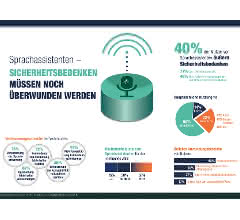
However, many users are reluctant to disclose this information as they suspect security concerns with voice assistants. This was confirmed by a study conducted by OnePoll on behalf of reichelt elektronik in March 20191. Even among those who already use a voice assistant, a significant proportion (40%) have security concerns - a full 77% of them say that they are particularly worried about the storage of their data. None of the current models are mature enough to address these concerns.
Challenge 2: Overcoming gender prejudices
Alexa, Siri, Cortana - the best-known and most popular voice assistants all have female voices and are perceived as female. According to a recent UNESCO report, this reinforces outdated role models in their role as ever-patient, submissive helpers who unquestioningly follow all commands. It is highlighted as particularly precarious that the voice assistants usually react indulgently or even flirtatiously to sexual innuendo or insults.
Here it becomes clear that artificial intelligence is by no means neutral, but is strongly influenced by the data with which it is trained. As a result, man-made prejudices and discrimination are transferred to the digital assistant. Manufacturers are therefore faced with the major challenge of reducing existing gender bias in their systems in order to ensure equality and offer a good user experience for all users, regardless of gender.
Challenge 3: Use in public places
Another difficulty that has not yet been fully discussed is the use of a voice user interface in public spaces such as trains or restaurants. One critical aspect in such a scenario is that bystanders could overhear the voice input. As a result, personal information would not only be passed on to the addressee, but to everyone in the immediate vicinity.
Another point that plays a role in the enforcement of voice as an input mode is the aspect of noise pollution. If, for example, an entire train compartment were to speak loudly to its voice assistant instead of typing or swiping on a smartphone or tablet, there would be an immense increase in noise levels.
Challenge 4: Speech recognition
In recent years, language development has improved many times over and manufacturers are working feverishly to continuously advance the technology. Nevertheless, the word recognition rate is still not 100%.
It also becomes difficult if the person tries to speak to the voice assistant in a dialect. This impression is confirmed by consumers. A full 75 percent of respondents state that they are not convinced that their input will be understood correctly.
Voice technology is mainly used in smart homes and cars:
Even if the use of voice assistants as a user interface is predicted, there are still a few hurdles to overcome for the user to perceive this as a real enrichment. Nevertheless, voice systems are getting better and better and are conquering more and more areas of life.
A big advantage over typing is that your hands are free. This is also the reason why voice input has mainly been used in the smart home sector to date. Another area that is currently being conquered is the car. The advantage here is obvious: the driver can have the messages read out to them and operate the assistant with further voice instructions - while their hands remain on the steering wheel.
It can be concluded from this that voice assistants are currently gaining ground wherever we are usually busy with other things or need both hands for a particular activity. The operation of technology is almost becoming a minor matter. It is unlikely that they will completely replace smartphones in the near future, but they have the potential to fundamentally change the way we interact with technology.


You might also be interested in
Gateway with improved fault diagnosis
Schmersal is launching a new version of the SD gateway for its SD bus. According to the group, users benefit in particular from the improved fault diagnostics that the new SDG Fieldbus Gateway enables.
 read more...
AI trends for engineers: where is the journey heading?
According to Gartner, companies that have adopted AI engineering practices have a competitive advantage: by 2026, they could outperform their competitors by around 25 percent in terms of the number and time required to operationalize AI models....
read more...Industrial-grade version of the Raspberry Pi
"The more performance, the more use cases"
The new version 4 of the open source IPC "Revolution Pi" (RevPi) from Kunbus is set to be launched as an industrial-grade version of the Raspberry Pi in mid-2023.
read more...Digital assistance systems make manual production easier
Increasing productivity in the face of a shortage of skilled workers and a growing number of product variants is a challenge for many medium-sized industrial companies. Software-based assistance systems such as elution two assembly from Elabo offer...
read more...Platform for hydrogen and fuel cells
Around 500 companies presented their solutions for the production, transportation, infrastructure, storage, refuelling and consumption of hydrogen at the Hannover Messe.
read more..."Using DC technology consistently"
The DC-Industrie2 project recently came to an end and the follow-up project, ODCA, has been launched. In an interview with Andrea Gillhuber, Dr. Hartwig Stammberger and Dr. Jan Stefan Michels spoke about the potential of DC technology and its...
read more...Artificial intelligence in Germany
AI arrives in the industry
At the start of the Hannover Messe, Microsoft's Head of Germany Marianne Janik called for greater use of artificial intelligence (AI) in Germany.
read more...Feinmess Suhl at the Control 2023
High-precision testing equipment and monitoring systems
At the Control international trade fair for quality assurance, Feinmess Suhl will be presenting innovations in the field of test equipment for product measurement and systems for test equipment monitoring.
read more...Continuously developing innovations
In the run-up to the Hannover Messe, Andreas Mühlbauer spoke to Oliver Winzenried, CEO of Wibu-Systems, about the innovations the company is presenting in Hannover and the technological trends at the trade fair.
read more...