
Blockchain in the industry
Block by block towards the future

Blockchain is currently back at the top of the agenda for many industrial companies. The potential impact of this technology, which makes revolutionary upheavals possible, is being discussed. Blockchain is often compared to the internet revolution. The internet revolutionized the entire communications industry with the TCP/IP protocol. Similar upheavals are expected from the blockchain with its consensus protocol. While data on the internet is stored and managed in databases on individual servers, in a blockchain each network participant has its own copy of the data - a distributed database.
The blockchain principle makes the intermediary function of banks, stock exchanges and insurance companies superfluous, as it generates trust through technology: every transaction is cryptographically secured and the network nodes involved decrypt and confirm it. A mathematical process ensures the security of the blockchain, in which data is stored in blocks. It cannot be deleted or manipulated because each new block is cryptographically secured and is also available in countless copies. No block can be forged. The technology also uses smart contracts - programs that are themselves stored in a distributed blockchain and are just as immutable. They can communicate directly with smart objects via the Internet of Things (IoT) and implement actions automatically.
Data trading and documentation benefit
A blockchain can also be set up for specific participants. Each new data record is confirmed by all authorized participants in the network. A closed blockchain like this is ideal for transferring data or documenting processes, for example in the field of intellectual property. Offices and authorities could use blockchain to manage their registers such as land registers, pension entitlements or residents' files - where data security is a top priority - in order to simplify processes.
When a process is mapped in the form of a blockchain, it is also highly efficient and transparent for all parties involved. Compared to established technologies, blockchain not only saves time but also costs for personnel and intermediaries, as it allows users to link the transfer of values with the processing of contracts and standardize and automate the contractually structured transfer processes in the same breath.
Potential for a great future
The efficiency gains that can be realized with the help of blockchain technology are fueling the hype surrounding its disruptive potential. It is a basic technology that could replace established solutions because it provides secure, fast and standardized services while reducing costs and risks.
However, 95% of the envisaged use cases are better, cheaper or easier to solve without blockchain, which is why an in-depth review of the application scenario is a critical success factor. Nevertheless, the technological hurdles can be overcome with a technically valid design in terms of blockchain performance and throughput.
The special thing about blockchain is that it combines several concepts, each of which represents a paradigm shift in itself. Overall, the changes that this entails are far ahead and in many respects contradict the usual decision-making processes in management. For this reason, change management and, in particular, constant communication to all those involved are of great importance. In the manufacturing industry, blockchain is likely to play a major role in supply chain management, including plagiarism protection and counterfeit protection, as well as in more elaborate concepts such as smart manufacturing. In the pharmaceutical sector, multi-stage supply and distribution chains are already being handled via blockchain, and counterfeit protection, including the involvement of regulatory authorities, can also be realized with the new technology. There are many use cases here that could also serve as a model for industry.
Blockchain use in industrial companies
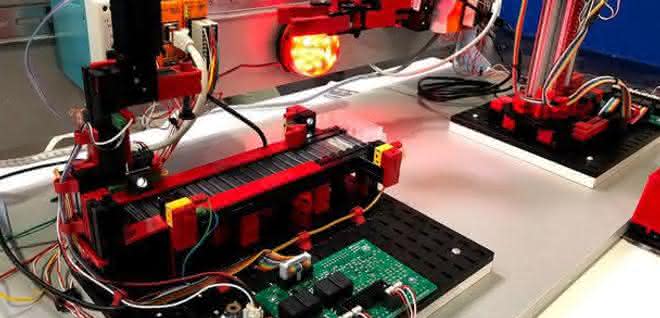
A good example of the great potential of blockchain can also be seen in international cooperation in the automotive industry: if, for example, a wing mirror is produced in a supplier factory in East Asia, it stores all the production data directly. The encrypted data blocks are stored decentrally on computers around the world and enable the data of the so-called "digital shadow" to be read out at any time - regardless of where the component is located. The blockchain provides various data - from the tolerance values achieved during production, the energy consumed during production and important environmental parameters such as temperature and humidity to information on when, where and by which machine the part was manufactured. All this data is delivered to the car manufacturer's factory in Germany together with the exterior mirror itself.
Higher quality and early detection of problems
The use of blockchain in production brings with it several disruptive functions and benefits:
Tolerance values: Production tolerances are used specifically for subsequent further processing.
Digital shadow: production data is securely stored digitally and can be used later. The machine on site, which processes parts such as the exterior mirror from the example, automatically reads the data stored in the blockchain and adapts further processing accordingly.
Smart assembly: Goods are assembled intelligently based on the production data of the individual parts, thereby achieving higher production quality. For example, a carrier element with a negative manufacturing deviation can be combined with a mudguard with a positive deviation.
Elimination of intermediate or incoming inspections: Intermediate producers can rely on measurement data from the upstream producer and do not have to take their own measurements. As the blockchain records and authenticates all relevant information and transactions, it is no longer necessary for the car manufacturer to get to know its suppliers abroad in person in order to do business with them. Order placement, quality control and invoicing can be automated via the blockchain.
Proof of origin and production: Components are clearly traceable via the blockchain - as are their partially individual production conditions.
Error/anomaly detection: Problems in production can be detected at an early stage, even at the level of individual parts. Countermeasures can be taken in good time before all or part of production has to be stopped or destroyed. This saves the producer material, time and energy. This is a huge factor, especially in the tightly scheduled industry. The entire production process can be precisely tracked and traced via the blockchain, which would not be easily possible with normal database systems.
Acceptance of blockchain not yet uniform
Many of the large industrial companies already have their sights firmly set on the benefits of using blockchain, while smaller companies are generally more skeptical. In addition to the automotive sector, blockchain is already in high demand in the chemical and pharmaceutical industries in particular, as there are a large number of potential applications. With this in mind, a number of innovative companies are currently developing small prototypes in order to keep pace with developments and benefit from the advantages of blockchain: Decentralization, trust and security - big steps towards the future for almost all industries.
Stefan Gössel, Leadvise Reply and Stephan Noller, Ubirch / am
Background: Bitcoin and the blockchain

The digital currency Bitcoin is considered the classic blockchain application par excellence. Bitcoin is not a physical currency and is not managed by a central institution. Open source software generates bitcoins using a defined mathematical formula (mining). As Bitcoin and its transactions are based on the blockchain, it is considered tamper-proof.
The Bitcoin blockchain is a decentralized database. All transactions are stored here in linked "blocks" and can therefore be traced at any time, although the Bitcoin movements cannot be assigned to a real person. Each transaction is stored in a new block and the chain is updated throughout the network at the same time. In addition to security, the blockchain offers the following advantages for Bitcoin: Transparency of transactions, high speed through peer-to-peer networking, low costs and ease of use.


You might also be interested in
Sustainability Through Simulation
Digital material selection reduces CO2 emissions by 40 percent
The use of digital material simulations can significantly reduce CO₂ emissions during the development and manufacturing of components. A real-world project by Schunk and Cadfem demonstrates how data-driven material selection can yield savings of up...
 read more...
From ERP System to AI Platform
RNA, based in Aachen, manufactures up to 2,000 custom-designed feeding systems annually and handles all order processing through a central ERP platform.
read more...Cybus Brings in Siemens Executive Stefan Schwab to Lead the Company
The Hamburg-based software provider Cybus will have a dual leadership structure going forward: Stefan Schwab will join co-founder Peter Sorowka as co-CEO.
read more...Artificial Intelligence for the Physical Space
Alibaba Expands Qwen Model Family with a Robotics Suite for Physical AI
Alibaba is expanding its Qwen model family with a robotics suite for Physical AI. The three models—for manipulation, navigation, and simulation—are designed to assist autonomous robots with complex tasks in real-world environments.
read more...5 Challenges for AI Projects in Manufacturing
Manufacturing companies have high hopes for AI. IFS highlights the five most common reasons why AI projects fail.
read more...Implementing Manufacturing Software: 5 Practical Tips
To remain competitive in the market in the future, more and more companies are considering digitizing their CNC manufacturing processes. The right software solutions can make process knowledge transparently accessible and significantly reduce the...
read more...AI automation specialist reorganizes...
Generation change at Insiders Technologies
After almost 30 years at the helm, Werner Weiss is handing over the management of Insiders Technologies. Andree Albrecht takes over the management after a transition phase.
read more...Intelligent brownfield networking
Many industrial companies are struggling with established plant structures and proprietary interfaces. Stefan Klaus' presentation will show in a practical way how brownfield environments can be efficiently networked with open technologies and made...
read more...Factory-X in practice
How can set-up processes in highly variant production be automated efficiently? Markus Benndorff from soffico shows how Factory-X, industrial data rooms and modular architectures create new possibilities for flexible production concepts.
read more...