
Visual Perception System
Visual perception system controls robots
The 3D visual perception system Viper was developed to equip industrial and service robots with visual perception. All object recognition and classification tasks are shifted to a processor of the embedded vision system, and the computing capacities of the robot processor remain reserved for robot navigation.
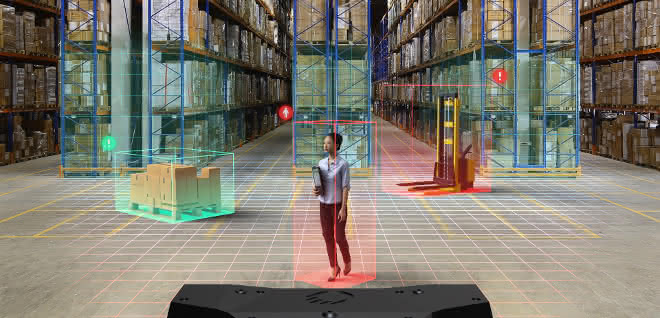
For a long time, machine vision technology was known for its complexity in development and integration. Even today, many machine vision solutions still require special skills or support through sometimes expensive integration services, for example when implementing image processing in robotics applications. However, in the context of Industry 4.0 and increasing automation, there is a growing demand for standardized and affordable machine vision solutions that are easy to integrate and improve the perception capabilities of industrial robots. Furthermore, such systems are also a prerequisite for conquering new fields of application outside the factory floor, which are usually summarized under the term "service robotics". Significant progress has been made in this area over the last ten years, for example with unmanned aerial vehicles (UAVs) such as drones and unmanned ground vehicles (UGVs), which have achieved a significantly higher degree of autonomy through the use of complex algorithms and sensors. The integration of computer vision systems has also been accelerated by the increasing miniaturization of components, which has made embedded vision systems possible in the first place. However, truly reliable systems with "seeing robots" still face major challenges, such as the detection, classification and avoidance of obstacles.
In recent years, graphics processors (GPUs) have become significantly more powerful and affordable. The CUDA technology developed by Nvidia enables the versatile use of embedded systems that were previously unable to perform computationally intensive tasks in near real time. The Lithuanian company Rubedos specializes in mobile robotics solutions and has made use of Nvidia technology in the development of its 3D visual perception system Viper specifically for vision-based, independently acting robotics applications. As a result of several years of research and development, Rubedos has developed algorithms that provide the robot with an awareness of its environment and thus enable the robot to navigate independently, including 3D object recognition and classification of objects into categories.
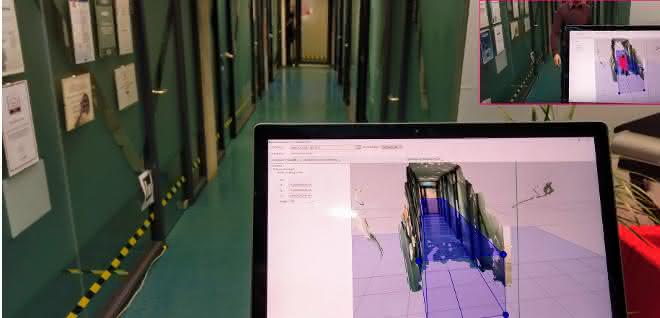
The Viper system is a combination of 3D sensor technology and a flexible computing unit. It consists of a synchronized pair of commercially available 2D sensors, an embedded GPU computer platform integrated on the customer-specific carrier plate with all relevant industrial interfaces and carefully coordinated basic software. The latter was designed in such a way that it can be expanded using standard modules or customized Perception modules. These modules are also known as "Perception Apps", as they are available like in a smartphone app store and are easy to integrate. This software basis forms the most powerful function of Viper: it allows a captured 3D image to be additionally interpreted and qualified in the Viper system depending on the application. Only the image data relevant for the evaluation can be passed on to the host system. For example, the original 3D image can be analyzed and converted into the laser scan signal used by the robot. This converts the segment of the 3D image volume defined by the user into a 2D LiDAR signal representation almost in real time. Another use case is pallet space detection. Here, Viper can only output the relevant 3D coordinates of the pallet after it has been detected in front of a self-propelled forklift truck.
At the heart of Viper's 3D recognition is a passive stereo camera that captures synchronized images with a specific offset and uses fast on-board computing to reconstruct a 3D image of the surroundings as a point cloud. The stereo vision system with two 3.4 MP low-light cameras continuously measures the depth of the surroundings in 3D with a depth image rate of up to 40 Hz over distances of up to 50 meters. The reliable capture of the third dimension makes the 3D computer vision system immune to negative environmental factors that can usually affect 2D systems, such as a lack of lighting or contrast and the variable distance to the object of interest.
Viper first corrects image disparities using methods such as real-time lens correction, filtering, image equalization and other image error corrections, thus relieving the onboard processor of low- and high-level image processing tasks. In addition, there is sufficient power in the system to run local machine learning processes such as neural networks and process stereo image data. Viper uses such an approach, for example, to recognize people and calculate their relative 3D position in the image. This enables intelligent functions on the mobile robot platforms, such as a "follow the human" function. It can also be used to trigger an alarm if a human enters the predefined safety-critical zone, for example. To enable this functionality, the user activates one of Viper's extension modules, such as the Perception app "Follow-me". The app then combines the ability to recognize people (2D) and measure distance (3D) to inform the host system of any change in distance to the visually registered person. The mobile robot can thus slow down, brake or accelerate depending on the situation, thus enabling a "virtual distance line". In addition to tracking people, the app can also track other types of objects or special tags such as ArUco tags. The latter makes it possible to arrange a convoy of several UGVs (unmanned ground vehicles) that follow each other, while the foremost UGV follows a person.
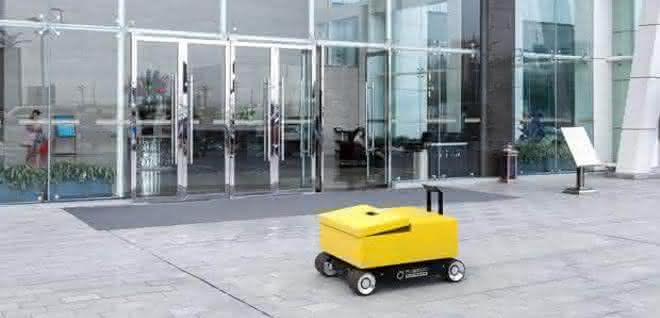
One of the key developments in Viper is the application of the Semi-Global Block Matching (SGBM) stereo matching algorithm optimized by Rubedos for the Nvidia Jetson family of embedded systems. Since speed is a crucial criterion in the application of vision-guided robotics, the configuration of the algorithms focuses on the speed aspect of stereo matching and treats accuracy as a secondary consideration wherever necessary. However, Viper allows to change the default configuration of the "speed" preference or to replace the preset stereo matching algorithm with a user-defined algorithm. This flexibility makes Viper an interesting stereoscopic vision tool for all robotics solution developers. As standard, Viper is available as a stand-alone, IP-protected and bolt-on system from "Eyes" and "Brain" for mobile robots. In addition, an OEM version is available for solution developers looking to seamlessly integrate Viper into their system design. With a weight of less than 250 grams and a power consumption of less than 10 watts, the OEM kit offers the same Perception features as the standalone version. However, the OEM kit is better suited for smaller UGVs and UAVs such as professional drones, which usually have a lower power and payload capacity.
With all these features, the Viper system enables intelligent automation with a turnkey set of hardware and embedded computing. It can be used in a variety of applications to equip industrial and service robotics with visual perception.
Linas Vaitulevičius, Rubedo Sistemos, and Andreas Breyer, Vision Communications / ag


You might also be interested in
Filtration and sound attenuation in circuits
In liquid or air circuits, filter housings and silencers protect measuring devices, ensure particle-free vacuum and pneumatic systems, keep cooling circuits clean and reduce noise.
 read more...
KSS ultrafine filtration for grinding oils
Modular concept for pure oil
In order to grind economically, reliably and with the highest quality, extremely clean grinding oils are required. Filter manufacturer Vomat offers the metalworking industry high-performance and customized concepts for the filtration of cooling...
read more...Up to 95 percent less flue gas thanks to direct extraction
The requirements for occupational safety measures and safety technology are also constantly increasing in welding technology. The Technical Rules for Hazardous Substances (TRGS) stipulate that welding fumes and harmful substances must be extracted...
read more...Everything accurate in switch cabinet construction
To ensure smooth work processes, tools for processing enclosures and housings must function flawlessly and reliably. Häwa rounds off its punching range with the Multi-Press 500.
read more...Cooling and temperature control units
Hygienic packaging sells safely
In few industries are the requirements for hygiene in the production process as strict as in the food sector - the health of consumers has top priority. This results in enormous challenges for all machines and components involved, especially in...
read more...Efficient and sustainable
Rotary screw compressors are the reliable backbone of industrial compressed air generation. The innovative CSD/CSDX series from Kaeser Kompressoren with its numerous features produces them efficiently and saves energy costs. This also reduces theCO2...
read more...Healthy air during welding
Welding produces fumes and gases that are hazardous to health. Extraction is necessary to comply with the occupational exposure limits and is even mandatory when welding high-alloy steels.
read more...Wire mesh filters in medical technology
In hardly any other industrial development sector are the demands placed on products as high as in medical technology. After all, human lives depend on the performance and reliable quality of medical devices.
read more...Energy efficiency and sustainability in the smallest of spaces
With the StingR ultra-fine filter system, Lehmann-UMT has created a solution for the energy-efficient and precise treatment of fluids during tool grinding for extended tool life and high tool quality.
read more...