
Automated guided vehicles
AGVs at the Mercedes-Benz truck assembly plant
In vehicle assembly lines, the appropriate components are transported to the respective assembly steps using track-guided transport systems. Mercedes-Benz Türk relies on driverless intralogistics solutions from Kuka at its truck assembly plant in Aksaray.
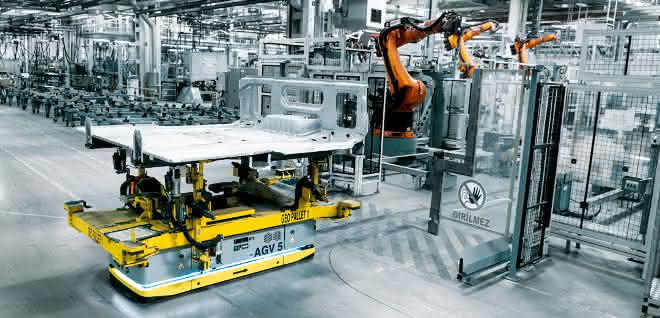
At the Mercedes-Benz Türk plant in Aksaray, a finished Actros or Arcos vehicle rolls off the production line every 8.9 minutes. The monthly truck plant is one of three operated by the commercial vehicle manufacturer. Since the plant was founded in 1986, around 275,000 trucks have already left the factory, customized according to customer requirements. In order to meet the quality requirements and the wide range of variants in truck production and at the same time keep to delivery times, Daimler relies on modern automation technologies.
Flexible industrial production
At the Mercedes-Benz Türk plant in Aksaray,automated guided vehicles (AGVs) from Kuka are therefore used to assemble the various truck cabs. These are omnidirectional, mobile platforms of the type KMP 1500, which connect the individual assembly sections with each other. The former conveyor solution with track-guided AGVs has thus given way to a modern intralogistics solution with freely navigating, mobile platforms. "The AGVs integrate perfectly into the Daimler assembly plant line," says Robert Vogel, Kuka Key Account Manager for Daimler. "With the intralogistics solution, we were able to fulfill our customer's wishes for more flexibility and versatility. We are very proud of this." In addition to the flexible intralogistics solution, Kuka also integrated other system technology in the truck production facility in Aksaray. For example, the 35 Kuka robots manufacture the cab of the driver's cab by automated resistance spot welding, stud welding, as well as assembling and gluing the windshield, and also handle the component handling on the cab.
Daimler has been relying on Kuka's established and flexible intralogistics solution for two years now. A total of seven freely navigating, mobile KMP 1500 platforms connect the individual production stations in the assembly line. Whether body floor, interior structure of the truck cab or truck cab without roof: the KMP 1500 driverless transport vehicle is capable of transporting a weight of 1,500 kilograms. Once they arrive at the respective process station, the AGVs load at the same time as the assembly processes in the plant. The loading stations for the AGVs were integrated directly into the process stations using floor loading plates. This saves time and makes the AGVs ready for use around the clock.
Efficient use of space and maximum process reliability
The new driverless transport system from Kuka ensures efficient use of space, maximum process reliability in all production stages and maximum variant diversity in the assembly of the truck cab. 360-degree safety monitoring ensures that the KMP 1500 is always intrinsically safe in any driving position, whether transverse or longitudinal, turning or diagonal. Depending on the direction and speed, the KMP 1500 detects employees or other obstacles and can react immediately. The AGVs thus make their way safely and dynamically from the truck underframe assembly to the assembly of the truck side, front and rear walls. The truck cab without roof is thus transported along the most efficient route through the assembly line.
Versatile and scalable production
Production must be flexible and adaptable to ensure short response times while maintaining the highest quality. With different models and customer requirements, a flexible production and intralogistics solution is crucial. The key component for versatile production is the KMP 1500 mobile platform. The AGV navigates through the production facility on a virtual road network. To do this, it uses the existing measurement data from its personal safety scanners and odometry using the Kuka.NavigationSolution software. Lane guidance or navigation elements are therefore superfluous. The advantage: production expansions or adjustments are easier and faster to implement.
According to documents from Kuka


You might also be interested in
Professional gluing and repairing
The handy Series 3 hot glue guns from Steinel impress with their innovative technology and new design. In addition to the corded Gluematic 3011, the Mobileglue 3011 cordless hot glue gun is suitable for mobile work.
 read more...
Double piston pump and proportional valve
High-precision gluing of folding boxes
Thanks to their sustainability, cardboard packaging is increasingly replacing plastic packaging. An important production step in the manufacture of folding boxes is the high-precision gluing of the cardboard blanks.
read more...Bonding and lubricating - precise dosing
Jet valves from Vieweg lubricate and grease electromechanical switches and bond and seal electronic components. More and more customer-specific solutions are being used.
read more...Cobot-supported automation for everyone
TQ has been offering industry-proven robotics solutions for years. Together with the collaborative robots from Franka Emika, powerful robot-supported automation tools are created for industry, trade and much more.
read more...This is how it becomes a shoe
A young Bavarian company has developed a robot cell for shoe manufacturers using several Schunk quick-change systems.
read more...Efficient and cost-optimized automation of production systems
Hirata offers complete turnkey systems as well as the partial automation of individual production steps: palletizing, assembly, measuring/testing, gluing/potting, laser marking, etc.
read more...Optimum robot programming
Robotics is moving towards simple programming and installation. In practice, there are many alternative methods and approaches.
read more...Efficient and cost-optimized automation of production systems
Hirata offers complete turnkey systems as well as the partial automation of individual production steps: palletizing, assembly, measuring/testing, gluing/potting, laser marking, etc.
read more...Robot technology for railroad applications
Speed into automated production
The completely renewed KR Cybertech nano series from Kuka provides robot technology for railroad applications with high performance in the low payload class.
read more...