
Fieldbuses and interfaces
Smart networking with ASi profile cable
The digital future has long since begun in mechanical and plant engineering. ASi-5 as a standardized fieldbus for the first level of automation and IO-Link as a fieldbus-independent interface for communication at field level are technologies that can be used to network sensors, actuators and control systems intelligently and efficiently. The ASi profile cable also significantly reduces wiring costs.
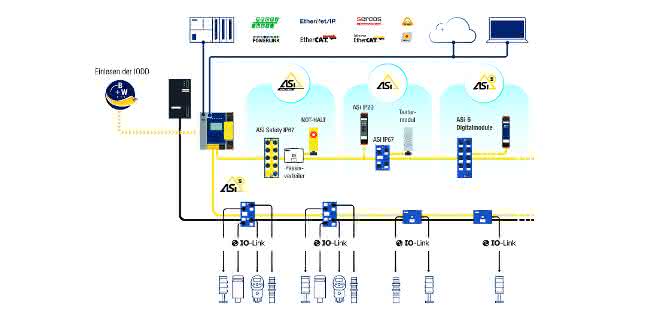
Technological innovations are successful when they manage to overcome previous limitations and open up new possibilities without a lack of economic viability hindering market entry. All of this applies to ASi-5. The innovative fieldbus standard for the first level of automation offers short cycle times and a high data bandwidth. ASi-5 therefore allows "big data" to be transferred at high speed - making communication or control-related "minutes of thought" a thing of the past. On the one hand, this allows applications with very high dynamics to be solved and, on the other, ASi-5 proves its worth as a wiring technology for smart field devices, such as intelligent sensors and actuators with an IO-Link connection. Safety is also an integral part of ASi-5 - safety-related, smart field devices use the same infrastructure as non-safe sensors and actuators. And finally, ASi-5 is compatible with ASi-3 - an important aspect for many machine and plant manufacturers. Solutions with ASi-3 have therefore not suddenly become worthless, but can be cost-effectively expanded and upgraded with ASi-5 if required.
Whether ASi-5 throughout or as an add-on - the Bihl+Wiedemann portfolio guarantees a high degree of calculable cost-effectiveness in every case. One reason for this is the comparatively inexpensive components. ASi-5 devices such as the modules with integrated IO-Link master for connecting IO-Link devices or the self-configuring I/O modules are generally cheaper than Ethernet fieldbus modules or IO-Link hubs, which are used in other solutions. The company also offers a finely graduated range of products, starting with a 1-port IO-Link master for IO-Link, for example. ASi-5 is therefore not only transparent in terms of communication, but also in terms of costs for each input and output.
IO-Link as a partner for ASi-5 in digitalization
IO-Link is a fieldbus-independent interface for the efficient point-to-point integration of intelligent and communication-capable sensors and actuators. While the integration of such smart field devices still causes discomfort in many places - for example due to cable lengths of a maximum of 20 m or the expensive connection of a single device via Ethernet-based fieldbus modules with four or eight IO-Link master ports - the combination of IO-Link and ASI-5 is the dream pair for collecting IO-Link signals in the field thanks to Bihl+Wiedemann's finely graduated product portfolio. This is no coincidence, as the ability to collect data from intelligent devices with IO-Link even more efficiently in the field and to transmit it at high speed, even with large data widths, already played a decisive role in the design of ASi-5. ASi-5 and IO-Link therefore complement each other perfectly. There is no need to run Ethernet right into the machine. The only interface of the ASi application to TCP/IP is the ASi-5/ASi-3 fieldbus gateway - an advantage that should not be underestimated from a security point of view. In addition to a web server, OPC UA is also on board as a diagnostic channel as standard - for direct communication of sensor data, measured values or control variables to the cloud.
Apart from that, what makes the IO-Link integration at Bihl+Wiedemann so special? Firstly, the user experience. IO-Link devices can be integrated wherever they are needed. IO-Link devices from all manufacturers can be connected to the ASi-5 modules with integrated IO-Link master, provided they meet the specifications of the IEC 61131-9 standard. The software suites from Bihl+Wiedemann make integration particularly easy, for example by quickly calling up the IO Device Description (IODD) of the IO-Link devices, through graphical support for sensor parameterization or through the live view of the existing devices. It allows ASi modules and IO-Link devices to be easily addressed and inputs and outputs to be parameterized and monitored live.
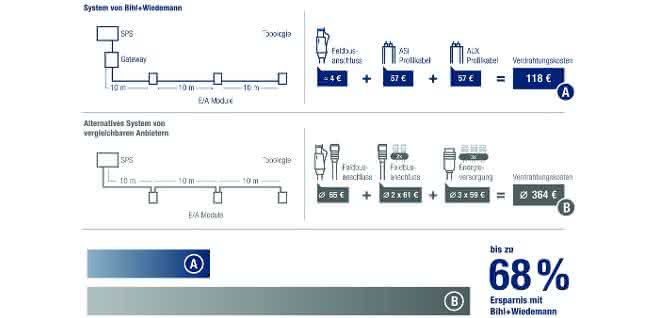
Convenient integration is one aspect, the cost side is the other. Thanks to IO-Link integration at Bihl+Wiedemann, considerably more IO-Link masters can be integrated per Ethernet node - with significantly more IO-Link devices, the integration costs per device are reduced. In addition, switches and pre-assembled cables are no longer required. And thanks to the OPC UA server integrated in the gateway, there are no additional costs for the cloud connection either. The user only invests in the IO-Link ports that they actually need.
ASi profile cable for low-cost connection
Cost efficiency also prevails when it comes to cabling - thanks to ASi profile cables and integration-friendly penetration technology for all participants. Exemplary cost comparisons show that wiring with ASi profile cables can be up to around 70 percent cheaper than a typical fieldbus round cable installation and provide more energy at the same time.
There are various reasons for the savings achieved with ASi profile cables. Participants can be connected to the unshielded, two-core cable wherever they are needed with virtually no installation effort and no risk of polarity reversal. The connection is made using penetration technology - without different pre-assembled connection cables, without plugs, without T-pieces. Each of the two cable cores is contacted at least twice and therefore as securely as possible. The topology - tree, ring, star or line - can be freely selected and adapted at any time. And for applications in which powerful IO-Link devices or energy-intensive drive solutions need to be supplied or the control signals need to be separated from the auxiliary power, special profile cables are available for 24 or 48 V power supply, which offer the same installation and cost benefits. ASi-5 as a data channel for the integration of IO-Link can thus be installed easily and inexpensively in the field.
Thomas Rönitzsch, Bihl+Wiedemann / am


You might also be interested in
Helu makes its first trade fair appearance under a new brand name
Helu Kabel will be presenting itself as Helu for the first time at Hannover Messe 2026, showcasing system solutions, Heluchain cables and new industrial luminaires.
 read more...
Strategic realignment with brand relaunch
In future, Helukabel will trade as Helu
The Helukabel Group is parting with part of its name: in future, the company will only operate under the Helu brand. With this step, the specialist for electrical connection technology is underlining its strategic development from a classic cable...
read more...Modular plant construction for corrugated board
Insight into the production of corrugators at BHS Corrugated: Automated, modular and equipped with Helukabel components.
read more...Best quality for the steel
Conditions in the steel industry are harsh and inhospitable. The machines used must be able to withstand the demanding environmental conditions in order to deliver the best quality at all times.
read more...If the standard cable is not sufficient
Lapp offers cables for countless applications - but not for all of them. From time to time, the developers have to modify a standard cable or develop a special cable.
read more...Slight decline in sales, strong investments
The Lapp Group has not been spared from the weakening global economy. However, the company only recorded a slight loss in the past 2024 financial year.
read more...Electrical connection technology
Cables and wires for industrial automation
Heukabel offers system solutions for cable routing from a single source. The subsidiary EKD Systems specializes in tailor-made cable drag chains made of steel, stainless steel and plastic, which are used in moving machines and systems as well as in...
read more...Lapp relies on Ultramid from BASF
Mobile charging of electric vehicles
The automotive industry is currently undergoing the biggest transformation in its history. The boom in battery electric vehicles in particular is presenting the industry with major challenges. Lapp, as a supplier of cables and connection...
read more...Cable handling application
At this year's Motek, ArtiMinds Robotics is showcasing a robot-based automation solution for the sensor-assisted assembly of flexible cables in connector housings.
read more...