
Harting interface
Power, data and signal for autonomous vehicles
Swiss automotive manufacturer Rinspeed presented its new Metrosnap concept car at the Consumer Electronics Show (CES) in Las Vegas. The manufacturer is once again relying on a specially designed interface from Harting to supply the vehicle with power, data and signals.

Harting is taking the next step for the mobility concepts of tomorrow with the Rinspeed Metrosnap. The Harting module supports the driver in using the vehicle quickly and flexibly for different tasks, whether for passenger transportation or goods logistics.
Like its predecessors Snap and Microsnap, the Metrosnap consists of two elements, the moving skateboard as an optimized electric vehicle and the so-called pod, which can be flexibly changed for different tasks.
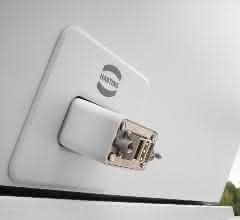
Communication, signal transmission and power supply must always function smoothly between these two elements. As soon as the pod and skateboard are securely connected, the connectivity link between the two elements is established automatically. Power, signal and data then flow, taking into account the special requirements of a mechanical connection.
Rinspeed has relied on Harting solutions in the recent past. In the last two years, a fast-charging solution from subsidiary Harting Automotive has been supplying Rinspeed vehicles. Harting Automotive has long been at home in the automotive supply industry market and has recently seen a sharp rise in demand for e-mobility solutions. The company develops and produces charging equipment for electric and plug-in hybrid vehicles.
Rinspeed and Harting have been working together successfully since 2016: The Mica was installed in the Etos vehicle for independent emission and condition monitoring. In 2017, Harting supported the Rinspeed Oasis car with another component from the Mica ecosystem, the Minimica. In 2018, Harting provided the fast-charging technology for the Snap. Last year, the Microsnap was charged with the fast-charging push. as


You might also be interested in
Harting kooperiert mit Perfact
Harting weitet sein unternehmerisches Engagement aus und ist ab dem 31. Dezember 2019 Partner des Software-Entwicklers Perfact in Herford.
 read more...
AutoID spricht OPC UA
2016 hat AIM-D in Kooperation mit der OPC Foundation einen neuen Kommunikationsstandard für AutoID-Geräte herausgebracht. Es zeigte sich, dass dieser Standard von vielen Geräteherstellern über das gesamte AutoID-Spektrum angenommen wird.
read more...Vorstand Uwe Gräff verlässt Harting
Gräff, Vorstand Neue Technologien und Entwicklung der Harting-Technologiegruppe, hat Ende September das Unternehmen im gegenseitigen Einvernehmen verlassen.
read more..."Implementation often takes too long"
IT and OT are growing together. Martin Ruskowski, CEO of the SmartFactory-KL technology initiative, explains in an interview why Germany is lagging behind despite good concepts and how real projects are paving the way to the smart factory.
read more...From Theory to the Factory Floor
IT and OT are converging, thereby laying the foundation for the smart factory. Only through seamless data integration can AI, digital twins, and flexible production processes become a reality. Why IT/OT convergence is becoming a competitive...
read more...Spectra Launches 5G RedCap Router for Industrial IoT Applications
With its new 5G RedCap routers, Spectra is expanding its portfolio to include a mobile communication technology for industrial applications designed to bridge the gap between traditional 5G and established IoT standards such as LTE-M and NB-IoT.
read more...Integration Meets Reality
OT meets IT – the two worlds are meant to converge, data is meant to flow, and production is meant to become smart. Yet the reality in industry often remains stubbornly contradictory: while systems have long been technically interconnected, they...
read more...Software at the heart of modern production
In an interview with Andreas Mühlbauer, Ulrich Huggenberger, Managing Director and CEO of Xitaso, explains why software architectures, modular control systems and networked data models are crucial for the production of the future. He explains the...
read more...How measured values are turned into decisions
Systems constantly generate measured values - but many of them disappear into systems that nobody actively uses. The problem is not the amount of data, but how it is collected. Only when information is available without detours and converges in a...
read more...