
IT/OT Convergence
From Theory to the Factory Floor
IT and OT are converging, thereby laying the foundation for the smart factory. Only through seamless data integration can AI, digital twins, and flexible production processes become a reality. Why IT/OT convergence is becoming a competitive advantage.
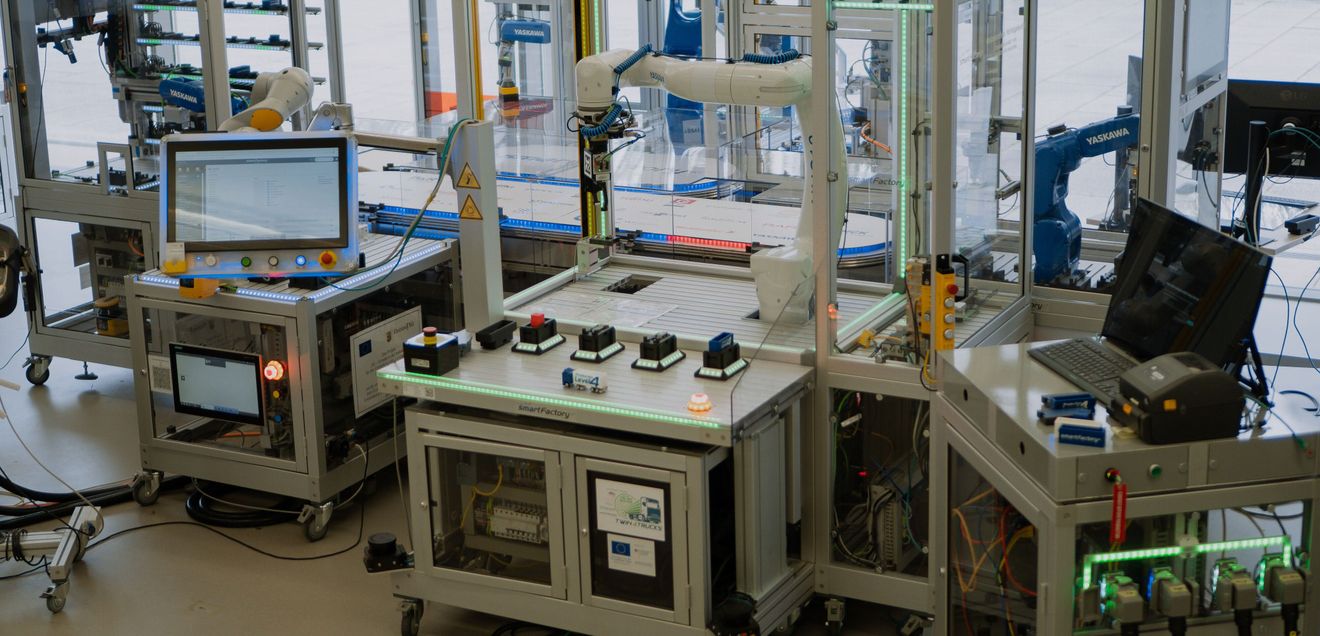
IT/OT convergence—that is, the integration of the operational technology (OT) layer with the information technology (IT) layer—is crucial for remaining competitive. Without it, modern production technologies such as artificial intelligence, software agents, or digital twins would not be possible at all. This is because their full potential—such as flexible plants and intelligent control systems—can only be realized when seamless data flow between OT and IT is ensured. Many factories already generate enormous amounts of data, which is often isolated within individual plants, machines, or PLCs. When seamless data flow from field systems to IT systems is ensured, companies can:
- Use production data in real time—for example, to track order progress or dynamically adjust production processes—
- Detect downtime faster through automatic analysis of error messages,
- automatically monitor quality with greater transparency,
- Analyze energy and resource consumption.
When IT systems are directly linked to production, processes can be controlled more effectively. This enables, for example, automated production planning, faster changeovers, and less scrap through improved quality monitoring. In addition, it allows for predictive maintenance and optimized material flows. The result is higher equipment efficiency and lower costs.
Markets are changing faster than ever due to smaller batch sizes, more frequent product changes, volatile supply chains, and rising customer expectations. Traditional, rigid production structures are reaching their limits. IT/OT integration enables software-defined manufacturing. In this approach, production processes are flexibly controlled and orchestrated via software rather than being hard-coded into machine and PLC logic. Additionally, modular plant concepts can be implemented: fixed plants are transformed into reusable, combinable production modules.
Many companies struggle with proprietary systems that suffer from a lack of interoperability or data silos. This results in high integration costs and limited scalability. Open IT/OT architectures enable standardized interfaces and improved data availability. In addition, dependence on individual vendors is reduced, and digitalization strategies become more sustainable.
The Open SmartFactory Architecture
The question remains: How can companies master IT/OT convergence? This is where SmartFactory-KL’s Open SmartFactory Architecture comes into play. It is a blueprint that demonstrates how the seamless integration of IT and OT can work. Its implementation enables end-to-end data utilization from the shop floor to the cloud and into the connected world of data economies, such as Manufacturing-X. The architecture is a clearly structured, three-tier model that systematically maps the complex functional layers of a modern factory. The goal is to assign functions, interfaces, and responsibilities for vertical integration and horizontal scalability. The architecture is adaptable for anyone, as it is open source. These layers are:
- the OT layer with physical production. This is where data acquisition and process execution take place
- the IT/OT integration layer with edge components and controllers. This is where secure, high-performance communication, data aggregation, preprocessing, and control take place. Field data is converted into other standardized data formats, and IT systems access this data
- the IT level with enterprise and cloud applications. This is where planning, optimization, and data-driven decision-making take place
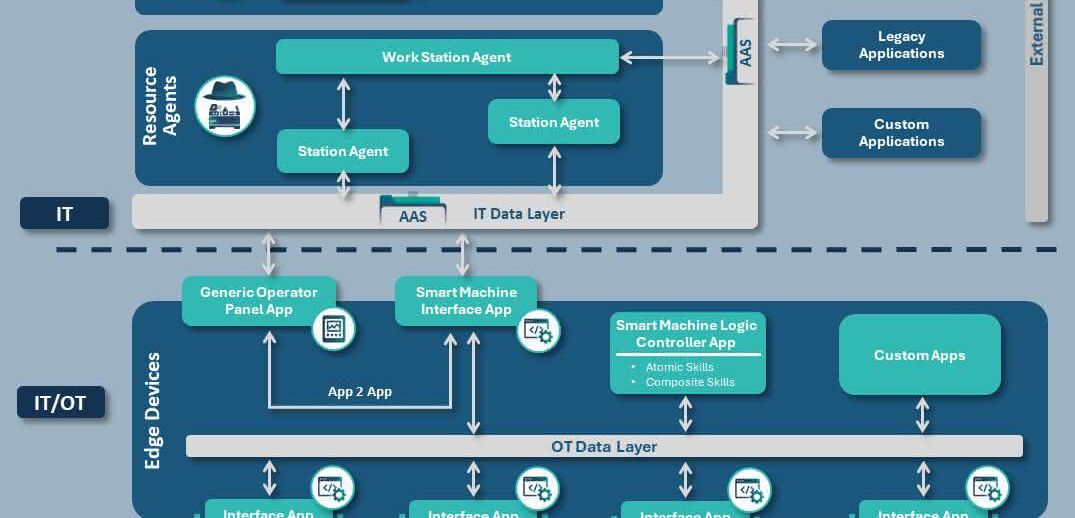
In addition, there are the IT and OT data layers. The IT data layer (Corporate Data Space) enables the aggregation of corporate data from internal and external sources using centralized interface concepts such as the Asset Administration Shell (AAS) as a standardized digital twin. The OT data layer (Real-Time Communication Bus) is an interface that provides access to all field data and enables the implementation of standardized interfaces for skills in OPC UA.
Companies that build their production systems on the Open SmartFactory Architecture enjoy numerous benefits. The modular and decoupled system architecture ensures a high degree of flexibility, as it enables a greater variety of product variants and faster adaptation to new market requirements. At the same time, efficiency increases: Shorter commissioning times and fewer sources of error are made possible by uniform skill interfaces and the use of standardized user interfaces. Furthermore, secure data exchange across organizational boundaries—for example, in data rooms—as well as the use of connectors foster greater data sovereignty and trust. “AI readiness” is also improved, as the semantic description of the data enables AI applications to analyze information more efficiently and make more informed predictions. In addition, there is a high level of investment protection, as existing applications (legacy systems) can be seamlessly integrated by converting them into AAS-compliant formats, provided an AAS-compatible interface exists. Last but not least, a strategic approach to knowledge and data supports knowledge preservation by maintaining the digital knowledge foundation and equipping future workforces with appropriate software.
Implementation in the Model Factory
This architecture is used, for example, in the SmartFactory-KL model factory, the Phuket Production Island. The Phuket Production Island integrates hardware and software solutions from SmartFactory-KL’s partners and tests their interoperability. These include the OT layer with field devices and robots, an internal multi-agent system, skill-based controllers, and SmartFactory-KL’s Corporate Data Space for production and product data and for connecting existing applications. For interfaces and protocols, SmartFactory-KL relies on established community standards, including OPC-UA and AAS.
Larissa Theis, SmartFactory-KL


You might also be interested in
5 Challenges for AI Projects in Manufacturing
Manufacturing companies have high hopes for AI. IFS highlights the five most common reasons why AI projects fail.
 read more...
HIMA Is Growing Despite Challenging Markets
The HIMA Group will increase its revenue to 190.5 million euros in 2025. International business, digitalization, and partnerships are driving this growth.
read more...International Federation of Robotics
U.S. Robotics Industry Sees Double-Digit Growth
In the U.S., sales of industrial robots rose by 11% compared to the previous year: 38,000 units were newly installed in 2025. This significant recovery is driven by robust growth in the food industry and other non-manufacturing sectors. However, the...
read more...In-house exhibition Bielefeld 2026
How DMG Mori thinks about the factory of the future
DMG Mori will be showcasing turning and milling expertise, automation solutions and additive manufacturing along the Machining Transformation (MX) at the Bielefeld 2026 in-house exhibition.
read more...Benoît Thooris takes over the presidency
Benoît Thooris takes over the management of UniversalAutomation.Org and the organization expands its Board of Directors with two new members.
read more...Five security risks and how companies can protect themselves
Physical AI in industry: NTT DATA explains five critical security risks in sensor technology, AI models and networking as well as suitable countermeasures.
read more...Vertiv and Nvidia link physical infrastructure with digital twins
Digital twins instead of a flood of documents: Vertiv integrates 'SmartRun' into 'Nvidia Omniverse DSX' to accelerate the planning and implementation of AI factories.
read more...From sensor to intelligent system
Sensors, measurement technology and artificial intelligence are merging to form intelligent systems. From June 9 to 11, 2026, Sensor+Test in Nuremberg will showcase the most important trends in a changing industry.
read more...AI automation specialist reorganizes...
Generation change at Insiders Technologies
After almost 30 years at the helm, Werner Weiss is handing over the management of Insiders Technologies. Andree Albrecht takes over the management after a transition phase.
read more...