
Ideas and innovations
On new paths into the future
Future-oriented, digital production processes are driving technological progress, and Lapp has introduced a new innovation management strategy to develop and support them in a targeted manner.
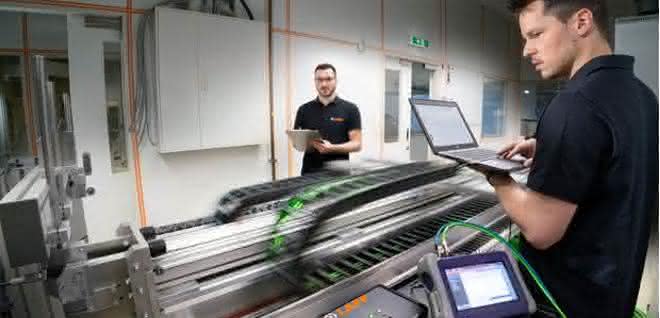
With predictive maintenance, machine and system failures can be avoided by continuously collecting and evaluating operating data and taking appropriate measures in good time. On this basis, components can be replaced at the optimum time and maintenance intervals can be closely aligned with actual requirements. Lapp is also developing systems for predictive maintenance. After all, even the most robust cables can sometimes fail. Not to forget: If a cable is replaced during routine maintenance when it is not actually necessary, this drives up costs unnecessarily. Lapp has therefore developed a system that monitors data cables and calculates their ageing and expected remaining service life from changes in their transmission properties. The recorded data is compared with the information on the ageing properties of cables that Lapp has researched, documented and stored.
During development, the engineers at Lapp initially focused purely on technical feasibility, explains Guido Ege, Head of Product Management and Development. "Nobody asked themselves which customers would need it and how much they would be prepared to pay for it." At the Hannover Messe, it became clear that the solution was meeting with demand. Now they want to "develop a suitable business model with pilot customers," says Ege.
New process supports innovation
With "Innovation for Future", Lapp has developed a new process for its innovation management specifically for this purpose. The new approach primarily supports the development of radical, disruptive innovations that cannot be optimally managed using the tried-and-tested stage-gate process. This is because with stage-gate, the management sets targets that have to be achieved step by step. A key element of such processes is, among other things, the assessment of potential sales and profit opportunities.
But this can become a problem: The greater the change that can accompany an innovation, the less clear the opportunities that arise from it. There may not yet be any concrete business cases if the developers are entering completely new territory. In such a case, the project would not be able to start at all as part of a stage-gate process. This is why "Innovation for Future" creates targeted scope for the development of new technologies and business models that have so far only existed as ideas that are not very concrete.
Nevertheless, Lapp has defined three requirements that must be met before the start of an "Innovation for Future" project. Despite all the freedom, they should provide a certain structure and objective. Firstly, the innovation team must develop a technical solution. Secondly, it must talk to at least one potential customer. And finally, thirdly, the team must create a business model canvas in advance in which all nine elements of the stage-gate process are completed.
One major change in the new innovation process is the role of management. Previously, managers were informed about the development status at defined intervals and then decided how to proceed. Now they are specifically involved as idea providers and supporters - in other words, enablers. For example, they establish network contacts for the innovation team and approve the financial and time budget. Guido Ege clarifies: "Stage-Gate is not dead". On the contrary, Stage-Gate is part of the "Innovation for Future" process and is still the method of choice when it comes to step-by-step innovations, such as the development of a new cable type based on a predecessor product.
Ethernet for IoT applications
The second innovation presented by Lapp, Single-Pair Ethernet, is a good example of this. The background to this is the rapid increase in the number of data connections in the factory of the future. This is because more and more systems and machines are currently being equipped with sensors, keyword IoT. They generate data that is needed for predictive maintenance, among other things. However, it is often small amounts of data that emanate from such sensors, such as pressure and temperature values.
A fast Cat.6A cable is completely oversized for such a low data rate. Single-pair Ethernet cables therefore only have one pair of wires instead of the usual four. This makes these cables thinner and cheaper. And they can still transmit up to one gigabit per second. This is completely sufficient for many applications. Single-pair Ethernet is neither the basis for a generally new business model nor is it new technological territory. It is a consistent further development of existing lines in order to meet changing requirements. The stage-gate innovation process was therefore exactly right here. as


You might also be interested in
Helu makes its first trade fair appearance under a new brand name
Helu Kabel will be presenting itself as Helu for the first time at Hannover Messe 2026, showcasing system solutions, Heluchain cables and new industrial luminaires.
 read more...
Strategic realignment with brand relaunch
In future, Helukabel will trade as Helu
The Helukabel Group is parting with part of its name: in future, the company will only operate under the Helu brand. With this step, the specialist for electrical connection technology is underlining its strategic development from a classic cable...
read more...Modular plant construction for corrugated board
Insight into the production of corrugators at BHS Corrugated: Automated, modular and equipped with Helukabel components.
read more...Best quality for the steel
Conditions in the steel industry are harsh and inhospitable. The machines used must be able to withstand the demanding environmental conditions in order to deliver the best quality at all times.
read more...If the standard cable is not sufficient
Lapp offers cables for countless applications - but not for all of them. From time to time, the developers have to modify a standard cable or develop a special cable.
read more...Slight decline in sales, strong investments
The Lapp Group has not been spared from the weakening global economy. However, the company only recorded a slight loss in the past 2024 financial year.
read more...Electrical connection technology
Cables and wires for industrial automation
Heukabel offers system solutions for cable routing from a single source. The subsidiary EKD Systems specializes in tailor-made cable drag chains made of steel, stainless steel and plastic, which are used in moving machines and systems as well as in...
read more...Lapp relies on Ultramid from BASF
Mobile charging of electric vehicles
The automotive industry is currently undergoing the biggest transformation in its history. The boom in battery electric vehicles in particular is presenting the industry with major challenges. Lapp, as a supplier of cables and connection...
read more...Cable handling application
At this year's Motek, ArtiMinds Robotics is showcasing a robot-based automation solution for the sensor-assisted assembly of flexible cables in connector housings.
read more...