
Fast configuration of machines
Small batch sizes with skill-based production
Individualized products in small batch sizes are increasingly determining everyday production. This increases the time required for work preparation and commissioning. Skill-based production focuses on these times and reduces them considerably. In this way, it helps to save costs and become faster and more efficient.
Skill-based production offers various advantages for flexible production. It enables machines to be configured quickly and easily. RPTU Kaiserslautern is working on a test system that operates according to this principle.
Jörn Peschke is Principal Key Expert at Siemens and active in the Industry 4.0 platform. He describes skill-based production as a production system in which the capabilities of individual machines or software are described as skills. "A number of characteristics can be described or defined that make up a skill. These include the fact that it is an encapsulated functionality in a production system that can be described in such a way that machines can evaluate it, for example using semantics."
Specifically, this is described using a plastic block that requires a hole. Its "required capability": getting a hole. Machines with "offered capabilities" are now sought on the store floor or in the data room that could technically produce this hole. This could be a milling machine or a drilling machine, for example. They have the skills of milling and drilling and would have the ability to produce a hole. In the next step in our example, the operator is offered machines for his hole production. They are given further information, such as how long the machine would take for the work process, how much it costs to operate or how much energy it will consume. The operator can now select the ideal machine and start production of the hole.
Each machine according to its capabilities
Hole production is encapsulated as a function under the skill. Let's assume a drilling machine is to drill the hole. Your drilling skill consists of so-called atomic skills, which must be processed in a specific order. First, the correct tool with the right diameter must be selected and the desired position on the plastic block must be selected. Then drilling begins at the specified rotational speed to the desired drilling depth. The data available in CAD is automatically transferred to the machine so that it can start work. The parameters are accepted and the machine can start work.
Skill-based production in the application
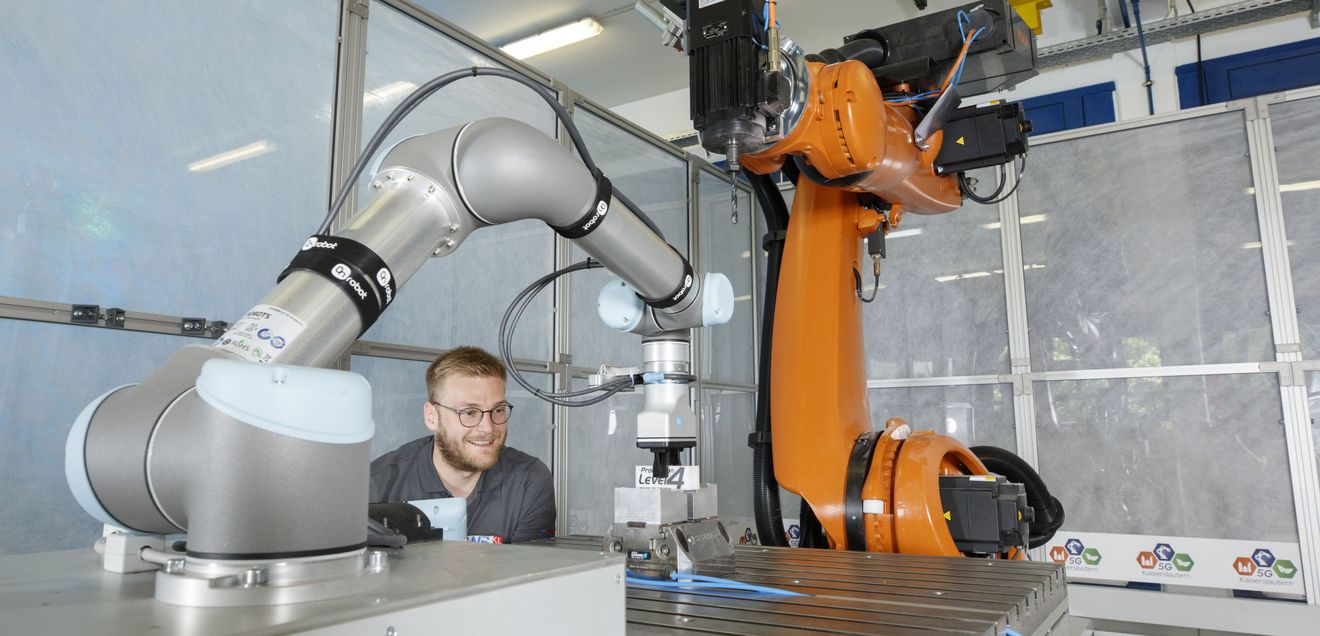
Andreas Wagner is doing his doctorate on the subject of skill-based production. He explains the advantages using a practical example and talks about a colleague who works as a designer for special machines. When he builds a new machine and wants to attach a sensor, for example, he needs a special bracket to screw on or an adapter plate. Of course, there are hundreds of brackets in the company's PLM database, but usually none of them fit or fulfill the desired purpose exactly. A new bracket then has to be designed. "The entire work preparation process then has to be run through again. He has to create a CAM program, select tools, specify the feed rate and spindle speed for the machine. This whole process is very time-consuming." This is where skill-based manufacturing comes into play, which Andreas Wagner has implemented with the_Milos production island and demonstrates how it can work. After all, only one small thing needs to be changed in CAD. Once the angle has been drawn using the existing CAD template, the new parameters can be transferred directly to the machine. "The machine then selects a tool itself, chooses the feed rate and spindle speed, and the entire work preparation process can be eliminated," explains Wagner. The cost reduction is obvious.
Skill-based production is also based on the ability of an asset to describe itself. This makes it possible for machines in networks to know about their own and all existing skills. The skills of a machine are of course also described in the manual. But reading them is time-consuming. The aim is to make knowledge about the machine more readily available. The asset administration shell (AAS) is suitable for this. It is a prerequisite for skill-based production. The VWS is a central location where, ideally, all information about an asset, such as a product or a machine, is available. It can share its information with others, for example with networked machines. The VWS forms the "transition from the static data model to the living system in real production, to the simulation model, to the digital twin," explains Prof. Martin Ruskowski, who is supervising the project at RPTU Kaiserslautern.
In shared production, companies work together in data rooms to produce efficiently, sustainably and resiliently. The biggest hurdle here is the secure sharing of data with one another as a prerequisite for value-adding cooperation in networked systems. The described capabilities are offered as services in data rooms, for example as machine capacities or software solutions for rent.
Shared Production Kaiserslautern
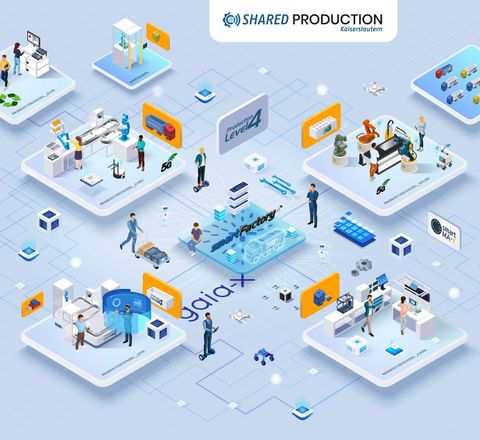
Shared Production Kaiserslautern works with several production islands, which represent companies that produce an individually configurable model truck in distributed roles - exemplary for a complex product. This is made up of several components. In the demonstrator ecosystem of the SmartFactory Kaiserslautern (SFKL), the administration shell is being tested, as well as AI methods and the collaboration of machines from different manufacturers. Andreas Wagner's production island_Milos is part of the ecosystem and takes on the role of a supplier. Other production islands carry out assembly tasks, produce components or check quality. A manual workstation is also integrated. Capability, skills and services are tested according to the so-called CSS model of the Industry 4.0 platform.
Skill-based engineering is made possible by communication technologies such as OPC UA, the introduction of IT paradigms into the OT world, such as encapsulation and virtualization, more powerful and comprehensive simulation frameworks and the improved availability of computing power. Open source solutions are available for many of these required technologies, which is further boosting development.
Ingo Herbst, Head of Communications & Press Spokesman SmartFactory Kaiserslautern


You might also be interested in
Producing battery cells flexibly and sustainably
The industry needs more and more battery cells. However, their production in gigafactories consumes enormous amounts of energy. In addition, the large production lines are very inflexible. A possible alternative has now been successfully tested at...
 read more...
Octoplant: Production safety 4.0
"On our private cell phones, it is common practice to back up our apps and photos. In production, it's even more essential - and it's still not done everywhere," explains Stefan Jesse, Group Co-CEO at AUVESY-MDT. But how can this problem be solved?
read more...Classification of component poses
Machine learning in feeding technology
The Institute of Assembly Technology at Leibniz Universität Hannover is developing a machine learning framework for classifying component poses in an aerodynamic feeding system.
read more...Interaction between assistance systems and HRC
New forms of work are in demand. The transformation of processes within the industry towards more digitalization gives companies the opportunity to make their workflows faster, safer and more individual.
read more...The rise of ransomware-as-a-service
Until about ten years ago, cyberattacks that could (almost) ruin companies or even endanger human lives existed only in science fiction. However, as the capabilities and internet connectivity of modern physical production systems have increased to a...
read more...Strong together
The Institute of Assembly Technology at the University of Hanover is working on the collaboration of several mobile robots for the assembly of large components.
read more...Robot tool for more efficient heating systems
Together with the Chair of Production Systems (LPS), Schmöle is developing a new process for manufacturing spiral finned tubes for heat exchangers. In addition to an ergonomic improvement for the employees, the manufacturing process is to become...
read more...Networked planning, intelligent production
Today more than ever, companies need to reconcile economy and ecology. In order to stay ahead of the game, planning and processing must be even more comprehensively networked in S&OP.
read more...System development and commissioning
Virtual commissioning with the DT
A structural model of the digital twin and end-to-end data management enable faster and more efficient system development and commissioning.
read more...