
Workflows
Interaction between assistance systems and HRC
New forms of work are in demand. The transformation of processes within the industry towards more digitalization gives companies the opportunity to make their workflows faster, safer and more individual. The ideal of batch size 1 with any number of variants is no longer a utopian dream, but a realistic goal.
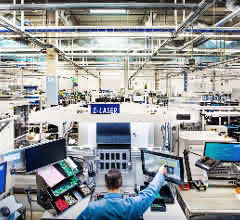
In addition to complete automation, the collaboration between man and machine is emerging as a path that offers future-oriented companies enormous advantages. This is because the interaction of the strengths of employees and technical systems leads to more efficient work processes, greater safety and lower costs.
To date, there has been a relatively clear distinction between physical and digital assistance. On the one hand, there are systems that support workers with information and provide assistance through instructions. On the other hand, there are robotic systems that provide physical support and carry out work that is difficult, dangerous or tiring for humans. However, as development progresses, this boundary is becoming blurred. Genuine collaboration between humans, robots and assistance systems is possible - and is on its way to becoming one of the defining models in manufacturing.
Forms of human-robot collaboration
Cooperation between humans and robots varies in intensity. A distinction is made depending on the degree of cooperation:
- Coexistence: Man and machine work side by side, but not together. Both carry out their work independently of each other and perform different tasks.
- Cooperation: Man and machine work together on a process step, but perform different tasks at different times.
- Collaboration: Humans and robots work together directly. Both perform work on the same component at the same time and support each other.
The aim of current developments is efficient and safe collaboration between humans and robots. However, most of the systems in use to date tend to fall into the area of cooperation. Work on a workpiece is either spatially or temporally separated in order to ensure the necessary safety.
Assistance systems and collaboration
Assistance systems are a key technology for remaining competitive in the future, especially for manual production. Interest in the technology is correspondingly high. A study by the Fraunhofer Institute for Industrial Engineering surveyed 144 companies at the end of 2019 about their current or future use of digital assistance systems. Almost all managers want to use such support for workers. However, digital colleagues were only actually in use at around a third of the companies surveyed. A huge potential that is still far from being exhausted almost three years later.
Assistance systems use sensors to support workers in their work and provide them with various forms of assistance in order to speed up or simplify individual production steps or minimize the number of errors. They make use of various types of feedback (visual, auditory or sensory) and guide the employee through the entire production process.
Modern digital assistance systems also have interfaces to other smart factory applications and can evaluate data from other components. For example, the information from a torque screwdriver flows into the process. This allows its correct use to be checked and subsequently confirmed. Complete integration into production lines and production systems is even possible without any problems.
Smart Klaus as an interface between humans and robots
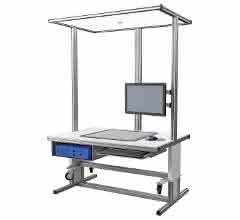
The Smart Klaus assistance system from Optimum datamanagement solutions GmbH already offers these functions today. Its capabilities place it on the borderline between digital and physical assistance. This is because the system has the ability to directly and indirectly influence the production process. Visual and acoustic feedback is used to identify successful and faulty work steps. This gives the employee the opportunity to react directly to errors and rectify the indicated problem.
In addition to the inspection function, Smart Klaus is also able to actively support the production process. Thanks to a camera and advanced image processing software, the system recognizes individual components as well as complex workpieces - in real time and regardless of position. Further information on the recognized component is immediately available on a screen and the necessary work steps are displayed.
A laser system provides additional orientation and marks the positions of drill holes or soldering points directly on the workpiece. CAD files are also available to the worker directly on the screen for better spatial orientation.
Man and machine hand in hand
The future of assistance systems lies in the full integration of technology into the entire production process. The smart factory is comprehensively networked. All sensors and systems provide information that influence each other and ultimately ensure that production is sustainably accelerated and improved.
One step on this path is the complete combination of digital assistance systems, robotic components and human work. This is where the technology found in Smart Klaus plays a crucial role. As the interface between the various players in a workplace, these systems have the task of sorting and processing incoming information and feeding it back into the work process.
In future, assistance systems and robot technology will therefore be able to work hand in hand. Workers can thus be relieved even more specifically, the number of errors can be further reduced to almost zero and production efficiency can be steadily increased.
Wolfgang Mahanty is Managing Director of Optimum datamanagement solutions.


You might also be interested in
Fraunhofer IOSB Opens Humanoid Robots Lab
The Fraunhofer IOSB is opening a Humanoid Robots Experience Lab in Karlsruhe, Lemgo, and Ilmenau. Companies and organizations can use these facilities to test potential applications for humanoid robots and develop pilot projects.
 read more...
Artificial Intelligence in Manufacturing
Trumpf and IPAI Are Expanding a European AI Network for Industry
The high-tech company Trumpf is an official partner of the IPAI AI network in Heilbronn. Together, the partners aim to exchange experiences, develop new AI applications for industrial use, and advance the development of artificial intelligence in...
read more...Case Study: Networked Manufacturing Platform for Toolmaking
Using a networked manufacturing platform, Escha GmbH & Co. KG, a manufacturer of industrial fastening technology, has comprehensively modernized its toolmaking operations.
read more...Barcelona Declaration on Robotics and...
Robotics Associations Adopt Global Automation Strategy
The global robotics industry is stepping up its collaboration. The associations AER Automation, A3, IFR, and VDMA Robotics + Automation have formed a long-term alliance by signing the “Barcelona Declaration on Robotics and Automation 2026.” The...
read more...Jane Heffner is the new president of the International Federation of Robotics
Jane Heffner is the new president of the International Federation of Robotics. Adrien Brouillard has been appointed vice president of the global federation.
read more...Greater Transparency in the Robotics Market
RoboFinder Launches as an Independent Comparison Platform
Launch at Gitex Europe: 'RoboFinder' aims to bring more transparency to the professional service robotics market. In this interview, founder and CEO Brian Engels discusses market potential, challenges, and the goals of the new platform.
read more...Artificial Intelligence for the Physical Space
Alibaba Expands Qwen Model Family with a Robotics Suite for Physical AI
Alibaba is expanding its Qwen model family with a robotics suite for Physical AI. The three models—for manipulation, navigation, and simulation—are designed to assist autonomous robots with complex tasks in real-world environments.
read more...International Federation of Robotics
U.S. Robotics Industry Sees Double-Digit Growth
In the U.S., sales of industrial robots rose by 11% compared to the previous year: 38,000 units were newly installed in 2025. This significant recovery is driven by robust growth in the food industry and other non-manufacturing sectors. However, the...
read more...Development Collaboration for Humanoid Robotic Hands Launched
Schunk is entering into a new development partnership with Robert Bosch Robotics. Their shared goal is to develop an industrial-grade robotic hand that can be integrated into various humanoid robot systems.
read more...