
Sustainability
Networked planning, intelligent production
Today more than ever, companies need to reconcile economy and ecology. To stay ahead of the game, S&OP (Sales and Operations Planning) planning and processing must be even more comprehensively networked. Corresponding models are now ready for use in production environments. The following article shows exactly how.
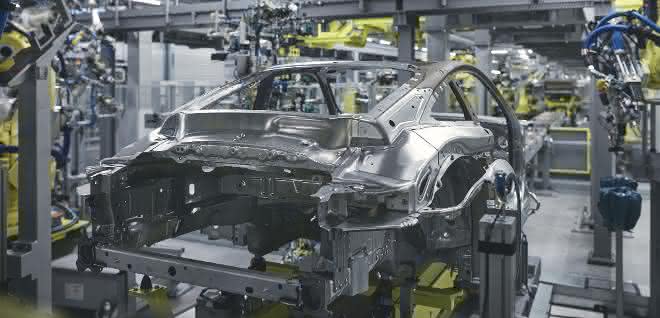
Sustainability and climate-neutral production are issues for the entire industry against the backdrop of legal regulations and the simple need to counteract the climate crisis. Beyond hardware and software, this affects all levels of value creation, i.e. all systems that manage and control processes. The aim is to produce and transport intelligently and to use limited raw materials sensibly - in other words, to reduce the amount of packaging and waste or to organize it in such a way that the materials remain recyclable. For companies, however, cost pressure, shareholder value, financial stability and efficiency in all areas remain framework conditions and require an adaptation of planning and control processes as well as the methods and systems used.
Production and logistics are efficient when processes and production programs are stable. Production planners and logisticians do not want to be constantly rescheduling, arranging special trips and readjusting as little as possible. When production processes are stable, there are few special activities, which otherwise often cause additional energy requirements and additional transportation routes with increasedCO2 emissions. However, today's world requires a high degree of agility and flexibility in order to respond to permanent changes. Production and logistics must be able to react quickly to changing conditions, highly volatile demand and sensitive supply chains. These often occur at the interface between planning and execution, as planning does not work with the same level of detail, the same factors or the same methodology as execution.
The key to competitive climate-neutral production lies in networked planning and execution processes that optimize themselves through feedback and that counter the high number of planning parameters with uniform planning objects.
Fast control loops with standardized planning objects
Porsche plans to use the potential of standardized planning objects to break up the previous linear process and transform it into a more dynamic model. Although this contains the same modules from the "Prepare", "Plan" and "Execute" process steps, it allows feedback and therefore adjustments to the production program. This is done, for example, in response to capacity bottlenecks or in optimization loops with the aim of optimizingCO2 fleet emissions or analyzing and optimizing programs with regard to expected sales and costs.
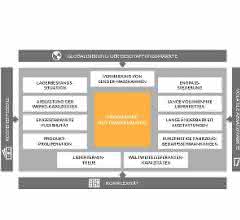
The challenge with such an approach is to take into account the multitude of distributed information such as capacities, technical product information such as emission values, the framework values of the original planning, commitments to the markets, sales probabilities of the products in the markets, historical change frequencies or even change flexibilities. As this information is linked to the customer or production order in the fulfillment process, it makes sense to try out an approach that also relies on orders in the medium to long term. This makes it easier to project control methods into planning, allows a smooth transition from planning to execution and ensures that the planning objects can combine all information.
The planning order
The central planning object in the concept is the planned order, a fully specified and buildable vehicle configuration that can be loaded into a planning production program and thus also allows material requirements to be derived. The planned order represents the customer requirement, the parts requirement via the parts list and secondary information such as theCO2 value or key figures such as the expected order stability or flexibility in a data record. It may also include monetary information such as value or contribution margin for further detailed planning. Because it looks like a real order, the planned order can be scheduled in production systems, broken down into parts requirements and ultimately replaced by real orders during processing. This has never been done before and thus closes the gap between planning and processing, because processing with all real objects can be simulated and anticipated in planning.
The total of all planned orders for the year 2023, for example, includes the planned values for production in this year. All these anticipated customer orders are created in a planning production program. The aim is for the digital twins to come as close as possible to a corresponding number of actual orders - thanks to the control loop, every change leads to a recalibration and adjustment of the plan and processing.
The methodological challenge here is to generate this planned order pool automatically on the basis of a large number of given framework conditions, restrictions and target values. This is done in a two-stage order generator, which in step 1 determines technically buildable valid product configurations with all their planning parameters and in step 2 dices an ideal order pool based on these configurations and transfers it to the planning production program. These elements form the core components of the new IT.
The configuration generator
The configuration generator generates the planned order candidates using data from various sources that take constraints and reasons for exclusion into account. To do this, it works with the help of a Bayesian network, i.e. artificial intelligence methods that, together with powerful IT, ensure that the configuration proposals - samples - are generated very quickly and in very large numbers. These buildable vehicle configurations form a huge pool of potential orders with configurations, time validity, information on buildability and price.
In addition to the usual criteria for each vehicle, such as order data, vehicle structure and prices, the configuration also includes sustainability criteria such as theCO2 footprint for each configuration, depending on the weight, among other things. It could also provide packaging information or other attributes that are all geared towards sustainability. Thresholds can define fleet emissions (grams per kilometer) to best meet customer needs and comply with federal government regulations for lowerCO2 emissions.
The software: S&OP and the Mix Optimizer
Long-term planning over a period of up to ten years contains information that goes far beyond the core business with economic aspects such as cost coverage and profitability. It also includes ecology, technology and logistics. In collaboration with its partner Flexis, Porsche's approach to the model is to relate these factors to the product and to link geographical aspects to the supply relationship between nodes in a network: Where is what sourced? Where is what delivered? Which transportation routes are the most efficient?
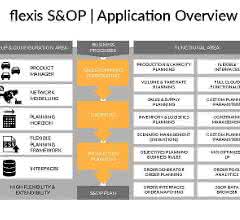
The Mix Optimizer, which was developed by Flexis, takes in various information, such as classic settings from volume and option planning. For example, only a certain number of a vehicle model can be built in a plant. Supplier capacities that were secured months or years in advance are also limited accordingly; stock levels are also included. If a planner now wants to calculate an ideal mix for a market and a product, he uses the Mix Optimizer to select the product (vehicle type, model year), the market and the period for which he wants to calculate an order pool. This process was already common ten years ago. In the new system, the target criteria (CO2 footprint, probability of sale, profitability, flexibility and stability) are added. The planner can weigh these criteria against each other, adjust them and decide to what extent the planning should be adhered to. If ecological aspects are not sufficiently taken into account in the vehicle mix for a certain planning period, the planner can change them and set up a "greener" production program.
To do this, the mix optimizer derives various scenarios from a large number of configuration proposals. Production targets and constraints are parameters that the mix optimizer mathematically optimizes and evaluates. Based on objectives such as stability in production or improvements in sustainability, it develops scenarios that the production planner evaluates and transfers to the operational level. The optimizer selects a scenario with aCO2-optimal program in order to meet the sustainability criteria in the best possible way.
The model with planned order, virtual and operative production program, configuration generator and mix optimizer has the potential to sustainably change the production method in the direction of planning and execution processes, taking into account classic business management and ecological aspects. The goal of combining economy and ecology in a modern production method can thus be achieved.
Simon Dürr, Project Manager Dr. Ing. h.c., F. Porsche AG, Customer Order Management, and Robin Hornung, Managing Director Flexis Consult


You might also be interested in
Robotics and autonomous order picking
Locus Robotics acquires Nexera Robotics and expands autonomous warehouse logistics
Locus Robotics takes over Nexera Robotics and may have taken a decisive step towards truly universal warehouse automation. A new gripping technology should now make possible what was previously considered difficult to automate.
 read more...
How bridging steps, stairs and catwalks are changing processes in production and logistics
At Logimat 2026, Munk Günzburger Steigtechnik will be showcasing modular bridging steps, stairs, platform and walkway systems for production, warehousing and logistics. With online configurators, distances can be efficiently shortened, processes...
read more...Highly automated warehouse for...
SSI Schaefer implements highly automated warehouse for CERP in France
SSI Schaefer and CERP are building a highly automated logistics center for pharmaceutical logistics in Wissous with shuttle storage, A-Frame, robotics and WAMAS software.
read more...Start of construction for new production hall
Mayr Antriebstechnik invests in its home base and internationally
Mayr Antriebstechnik strengthens location and international logistics: Construction of a new hall in Mauerstetten - parallel expansion of the plant in Poland as a logistics hub.
read more...Conveyor systems that adapt
Modern conveyor systems must reliably transport different product sizes, shapes and materials. The new modular product system from Kipp offers flexible, modular solutions for this: Adjustable side guides ensure precise alignment and gentle...
read more...Focus on sustainability and AI at the trade fair
With more than 120,000 square meters of exhibition space, LogiMAT 2025 will once again occupy all ten halls of the Stuttgart exhibition grounds. From March 11 to 13, global players, medium-sized companies and start-ups will provide an overview of...
read more...Workstation system for shipping and logistics
With Sintro Packing, Karl is launching a workstation system that is designed to meet the specific requirements of shipping and logistics. It is characterized by modular adaptability and ergonomic efficiency.
read more...Deutsche Messe announces Robotics Award
On the occasion of Hannover Messe 2025, Deutsche Messe is once again presenting the Robotics Award after a break of several years. Prizes will be awarded for robot-supported automation and logistics solutions. Companies and institutions from Germany...
read more...Micro motors as the driving force behind intralogistics
Suitable transport structures in intralogistics are a prerequisite in all industries in order to withstand competitive pressure in the future. The basis for this is comprehensive automation, which would be inconceivable without an armada of powerful...
read more...