
Industrial PCs
All tools on board
The advantages of edge applications are well known. However, a traditional PLC cannot pre-process the data locally. IoT applications can be easily implemented with edge PCs including pre-installed software tools.

There is currently increasing discussion as to whether edge computing is suitable for industrial use. The concept involves a decentralized computing infrastructure that is located close to the data source. Edge computing solves the challenges of cloud computing for the manufacturing industry because the cloud applications are relocated to the applications. In office IT, cloud computing has already established itself in many applications.
Many of these areas of application - such as data analysis and storage - are also relevant for the manufacturing industry, i.e. operational technology (OT). In this environment, however, there are a number of challenges in terms of data protection and security, latency in information processing, data transfer rates and costs for computing power and storage space. Edge computing brings data processing closer to the machine and therefore closer to the data source. This relocation of the cloud application to the edge, i.e. the edge of the network, allows such problems to be overcome.
However, it should be noted that there is no single edge, but rather a range from machine-oriented edges to server-based solutions for entire production sites. The actual functionality of the Edge application also differs from application to application. Typical edge applications include data collection and compression, data (pre-)processing and analysis, the use of artificial intelligence and cloud connectivity. However, edge computing does not replace cloud computing, but complements it. Edge and cloud are therefore partners, although the distribution of tasks between the two solutions can vary depending on the application.
Openness as an essential basis
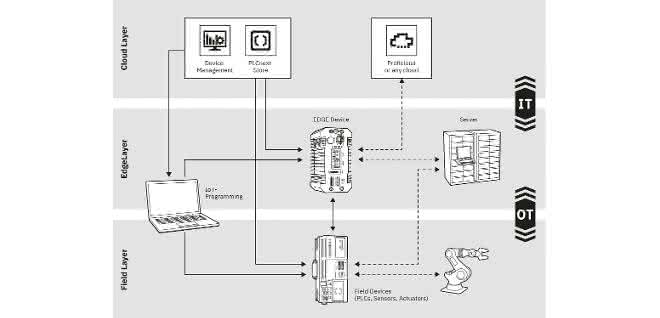
PLCnext Technology is an open control platform for industrial automation technology that is part of a complete ecosystem. The ecosystem is made up of the following components:
- PLCnext Control as robust hardware in the form of a PLC or an industrial PC to which an I/O system can be connected.
- The PLCnext Engineer engineering and configuration software, which supports IEC 61131-3.
- The PLCnext Store as a digital marketplace from which software relating to PLCnext Technology can be downloaded.
- The PLCnext Community, which is used to obtain information and share know-how about the ecosystem.
Thanks to the openness of PLCnext technology, any customer applications created in different programming languages can be integrated into the overall project. The openness and completeness of the ecosystem therefore creates the ideal basis for edge computing in the manufacturing environment. PLCnext already offers numerous advantages:
- The integration of various programming languages reduces the development time.
- The most widely used OT communication protocols in the production environment, such as OPC UA, Profinet or Modbus TCP, are already supported by the hardware.
- A professional cloud and multicloud connection is possible via cloud couplers.
- The components are based on secure-by-design development in accordance with IEC 62443.
- Customer-specific and open source software can be easily integrated into the overall application.
- New apps can be easily uploaded to the controller via the PLCnext Store.
Pre-processing of most sensor data
The market for edge programmable devices is currently under development. While most vendors provide edge-ready hardware, they lack the integrated software tools needed to create a ready-to-use programmable edge device. That's why Phoenix Contact 's Edge PCs are equipped with pre-installed software tools and designed to make IoT applications easy and comprehensive to implement. Thanks to pre-installed software tools such as Node-Red, a local Time-Series database and the uncomplicated connection to many cloud systems - for example the Proficloud from Phoenix Contact, Amazon Web Services, Microsoft Azure or Google Coral - with special nodes, the implementation of IoT applications proves to be very simple.
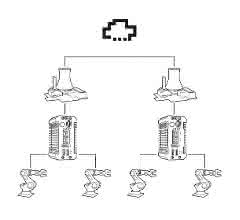
The edge PC connects the IT and OT layers. Data processing takes place at the edge of the network instead of sending large volumes of data to a cloud, where the data then has to be processed and evaluated. The aim of processing data locally and in advance on the edge PC reduces the bandwidth utilization of the network while ensuring faster execution. As a result, delay times can be reduced. However, a traditional PLC cannot pre-process data. Therefore, Phoenix Contact is currently developing Edge PCs that sort and pre-process much of their sensor data at the point of origin.
Integration of external applications
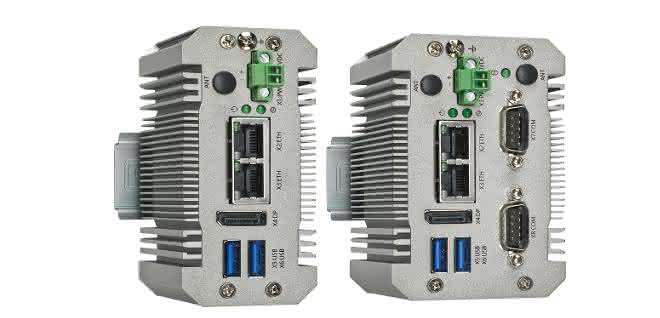
The new Edge PCs combine the robustness of a tried-and-tested industrial PC with the openness of PLCnext technology. The devices, which are equipped with an Intel Celeron N3350 dual-core processor, offer numerous interfaces. These include two Ethernet, two USB and one display port as well as two serial RS232/RS485 interfaces. With a working memory of 2 or optionally 4 GB and a flash memory of 32 GB with an optional 128 GB m.2 SSD, applications that place high demands on computing power and storage space can also be developed.
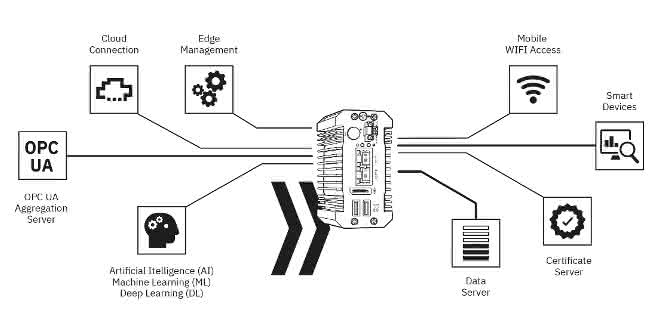
A user interface, which can be called up via a web server or locally via the display port, allows access to the many functions of the Edge PC. The integrated TPM chip (Trusted Platform Module) ensures the integrity and security of communication. The user can easily integrate customer-specific applications and third-party applications into the solution via the PLCnext Store digital marketplace. In addition, support for Docker or Portainer enables intuitive implementation and management of containers and volumes. Thanks to the consistent use of user interfaces and graphical programming environments, users can easily develop and use their edge application.
Reduce bandwidth requirements and latencies
One of the aims of an edge application is to reduce the bandwidth of the network by processing the data locally and, at the same time, to ensure faster execution and therefore a shorter delay time. Such an application cannot be implemented with a traditional PLC. However, the user initially configures the Edge PCs in the familiar PLCnext Engineer engineering environment. Data can be collected from all common communication protocols - such as OPC UA, Modbus TCP/RTU or Profinet - and easily stored in the InfluxDB database with existing nodes in Node-Red. The data can then be visualized and managed using the Chronograf graphical user interface. It can be summarized, rules can be set and alarms can be initialized. The possibilities seem endless and adapt perfectly to the user's requirements. Due to the large number of nodes and the use of MQTT, connecting the edge PCs to the cloud is easy to implement. Daniel Korte, Technology Manager PLCnext Technology, and Daniel Mantler, Product Manager HMI/IPC, both Phoenix Contact


You might also be interested in
ebm-papst is growing again thanks to AI and data centers
ebm-papst returned to a growth trajectory in fiscal year 2025/26. Air Technology, data center applications, and artificial intelligence are driving revenue and investment.
 read more...
SPE on the Verge of a Market Breakthrough
Single Pair Ethernet (SPE) has moved beyond the conceptual phase and is increasingly being implemented in industrial settings. The focus here is not only on higher data rates and simplified cabling, but above all on the issue of system integration...
read more...More than 900 exhibitors already registered
Around six months before the start of the trade fair, more than 900 companies have registered for SPS 2026 in Nuremberg. The trade fair focuses on industrial AI, cyber security and digital transformation.
read more...Virtual PLCs in practice: How vPLCs make production systems more flexible and scalable
The increasing networking of IT and OT is fundamentally changing industrial automation. The IT/OT Integration Summit shows how modern technologies can make production environments more efficient, flexible and future-proof. The event will focus on...
read more...Sales growth in a turbulent market environment
Thanks to innovations and a focus on strategic industrial markets, Sick was able to moderately increase its sales in the 2025 financial year. In a turbulent market environment, the company was able to maintain its position and gain market share with...
read more...Siemens presents new AI agent
Siemens is launching 'Eigen Engineering Agent', an AI for automation technology. The solution is integrated into the TIA Portal, has been tested with over 100 companies and is designed to significantly accelerate engineering processes.
read more...Schaeffler keeps sales almost stable
Schaeffler generated revenue of EUR 23.5 billion in 2025 and increased EBIT before special items to EUR 936 million. At 266 million euros, free cash flow was significantly above the prior year and forecast. Net income remained negative due to high...
read more...Advancing artificial intelligence together
Helukabel is stepping up its activities in the field of artificial intelligence and is now a member of the IPAI. The innovation and collaboration platform for companies, research facilities, institutions and administration has set itself the goal of...
read more...New impetus for ifm sales
Two new positions were filled at ifm at the start of 2026: Markus Wolf becomes Managing Director Sales Germany, Sven Quant takes over the position of Central Managing Director in the Process Sensors division within the ifm Group.
read more...