
Modular production
How granular can it be?
Machine and plant manufacturers who pursue a modular approach are often particularly successful. Harting's mechanical engineering customers want to design the modularization of their products as efficiently as possible, with interfaces playing a central role in these concepts.
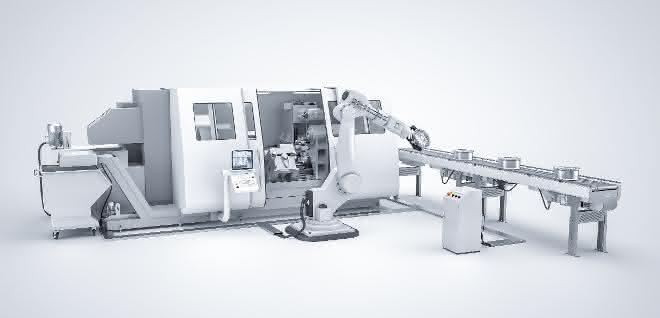
The principle of modularity is best explained using Lego building blocks. Countless objects can be created from a few basic building blocks and defined connecting elements. This approach has also become established in industry for products with a much higher degree of complexity and variability: Typical is the platform strategy of the automotive industry, according to which not only engines, transmissions and driving axles, but entire chassis are used as scalable modules for cars of different models, types and even brands. In industrial control and drive technology, too, systems such as PLCs, IPCs, HMIs and drive components can be customized from individual "slices" or several remote I/O blocks for the machine or system to be automated. They can be easily expanded or modified for further use.
It can be argued that the modularization of complex, industrially manufactured products can often only be successful, both technically and economically, because they are built in their thousands or even millions. But can a modularization approach also be successful if, at best, only a few hundred products of one type are built each year?
The answer has to be "yes". There is currently no alternative to modularization in mechanical engineering. According to the VDMA, standardization and modularization are aimed at a portfolio with less variance and complexity as well as an overall lower cost level, without reducing the breadth and individuality of the product range. In order to better understand the significance of this statement, some typical requirements in the manufacturing systems market are listed below.
What the market demands from production
What is required is a high degree of variability in the production systems, which makes it possible to manufacture a wider range of products, even in small to medium quantities. To achieve this, the systems must be scalable and offer options for subsequent expansion in terms of capacity and output. It is not "high-bred" systems for the production of components in large quantities that are in demand, but systems that can be used to flexibly manufacture different products in small to medium quantities.
In the B2B market, it is no longer enough to develop good products, sell them to operators and then wait for service and maintenance orders. TCO models, which were often used in the past to determine the profitability of investments, are increasingly being supplemented by LCC models (Life Cycle Costs). This allows new business concepts including maintenance, service and retrofit services to be offered very transparently. It also makes economic sense for OEMs to turn to benefit and service-oriented models.
For high-priced capital goods in particular, it is often much more economical for the user to expand existing machines or replace individual units or subsystems than to invest in a completely new acquisition. All these requirements can only be reconciled efficiently, both technically and economically, if the production systems are consistently modularized and networked and offered as smart systems in various expansion stages.
Based on experience with Harting customers, OEMs should first answer the following points positively when deciding on the pros and cons of the modular approach:
- The total estimated costs for a new end-to-end modular product group or family will be at most so high that they can plausibly be recovered within the usual time frame and assuming worst-case market development
- The technical challenges of the planned division of the machine or system into individual modules with transitions and interfaces should be assessed as generally feasible by all parties involved
- All operational functions involved in the future service provision process should be prepared to align their working methods with the modular concept of the machines
To what extent should a machine or system be divided into modules and what general approach is recommended? The genius of Lego building blocks lies in the connections between them. These determine the possible granularity of the division, but are also the limiting factor for the connection of components. The same applies to the interfaces of individual modules of a machine or system. The interfaces ensure that a system - a single machine as well as an entire production line - fits together harmoniously and functions perfectly. The core question of modularization is therefore: How do you separate the components of an overall system from one another?
Harting recommends the following procedure for defining the boundaries between the electrical and electromechanical power, signal, data and communication interfaces. First of all, the output system should be organized by function: Key functions that reflect the OEM's core competency; basic functions that span the entire system; and add-on or auxiliary functions. A certain amount of over-engineering in the machine modules, in which the company's own core competencies are bundled, is always an advantage and is therefore also recommended. The functions should then be combined into modules - but only as granularly as necessary.
The parts of the whole
In the next step, the functional relevance for the respective newly defined machine module should be assessed for all elements of the machine that cannot be further divided, such as sensors, actuators, HMI, drives that require electrical power, signal or data connection, and preferably graphically represented and assigned to a corresponding layer in the sense of the automation pyramid. In this process, all interfaces required for the connection of individual elements must be listed and assigned to the respective machine modules. The result is a matrix with all the planned modules of the future system. The hierarchical arrangement of the elements with associated interfaces, including their relevance for the machine modules, is also visible.
The advantage of such an approach is that it provides a basis for assessing feasibility, technical risks and the necessary design of interfaces. In addition, you create transparency for yourself by weighting the importance of the modules for the future system. All the groups involved as well as further specifications and steps for the development of the modules and processes can be derived from the list. The matrix view also helps in deciding to what extent the control of a modular machine or system should be designed centrally or decentrally.
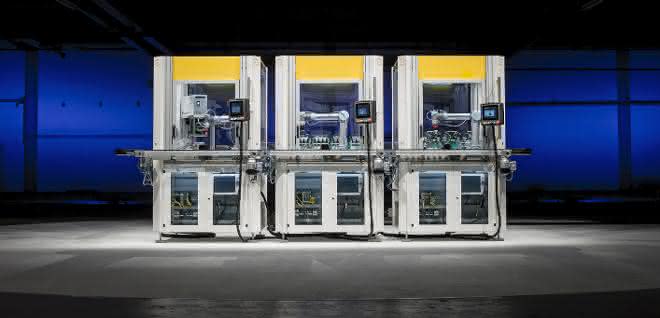
Harting's observations show that systems with a high variability of equipment in the key functions are more likely to be equipped with decentralized I/O systems if they have a large spatial extension. Combined structures are chosen for smaller, highly variable systems. In these systems, the key and basic functions are controlled centrally, while additional functions are controlled either centrally or decentrally, depending on their complexity. For smaller or simple systems with low variability, purely centralized control is technically simpler and makes more economic sense. When deciding on a structure, it should be noted that centralized systems generally incur lower costs for components and materials. However, the costs and resources required for both production and installation at the end customer are higher. Expansions and retrofits can also be more time-consuming and costly, and the same applies to service and maintenance.
A positive aspect from an OEM and end user perspective is that all modern control, drive and HMI systems make it possible to separate the physical level from the logical levels. This applies to particularly fast and precise processes as well as to highly sensitive safety-relevant or interlinked systems. The freedom provided by the modularization of production systems is decisively influenced by the interfaces. Harting offers solutions and products for all types of power, signal and data interfaces. These can be designed to meet the necessary requirements of the transmission path in a cost-optimized manner. They are scalable in terms of technical parameters as well as size and number on each machine module. The interfaces meet different requirements in terms of contacting, installation and protection class as well as material, and alternative transmission media such as fiber optics and compressed air can be integrated.
Save time and costs
Consistent modularization based on the targeted optimisation of all costs and service provision processes throughout the entire life cycle enables OEMs to manufacture machines according to the modular principle with significantly lower costs and time expenditure. At the same time, the strategy increases the scope for customer-specific configurations. Users also benefit from modularization, as they receive a cost- and requirement-optimized machine with a transparent design.
Harting provides solutions for all interfaces required in modern control, drive, HMI and communication technology for production systems. The company demonstrates this both in the systems of its own mechanical engineering subsidiary Harting Applied Technologies and in the smart factory pilot and demonstration system "HAII4YOU".
Jakob Dück, Global Industry Segment Manager


You might also be interested in
ebm-papst is growing again thanks to AI and data centers
ebm-papst returned to a growth trajectory in fiscal year 2025/26. Air Technology, data center applications, and artificial intelligence are driving revenue and investment.
 read more...
SPE on the Verge of a Market Breakthrough
Single Pair Ethernet (SPE) has moved beyond the conceptual phase and is increasingly being implemented in industrial settings. The focus here is not only on higher data rates and simplified cabling, but above all on the issue of system integration...
read more...More than 900 exhibitors already registered
Around six months before the start of the trade fair, more than 900 companies have registered for SPS 2026 in Nuremberg. The trade fair focuses on industrial AI, cyber security and digital transformation.
read more...Virtual PLCs in practice: How vPLCs make production systems more flexible and scalable
The increasing networking of IT and OT is fundamentally changing industrial automation. The IT/OT Integration Summit shows how modern technologies can make production environments more efficient, flexible and future-proof. The event will focus on...
read more...Sales growth in a turbulent market environment
Thanks to innovations and a focus on strategic industrial markets, Sick was able to moderately increase its sales in the 2025 financial year. In a turbulent market environment, the company was able to maintain its position and gain market share with...
read more...Siemens presents new AI agent
Siemens is launching 'Eigen Engineering Agent', an AI for automation technology. The solution is integrated into the TIA Portal, has been tested with over 100 companies and is designed to significantly accelerate engineering processes.
read more...Schaeffler keeps sales almost stable
Schaeffler generated revenue of EUR 23.5 billion in 2025 and increased EBIT before special items to EUR 936 million. At 266 million euros, free cash flow was significantly above the prior year and forecast. Net income remained negative due to high...
read more...Advancing artificial intelligence together
Helukabel is stepping up its activities in the field of artificial intelligence and is now a member of the IPAI. The innovation and collaboration platform for companies, research facilities, institutions and administration has set itself the goal of...
read more...New impetus for ifm sales
Two new positions were filled at ifm at the start of 2026: Markus Wolf becomes Managing Director Sales Germany, Sven Quant takes over the position of Central Managing Director in the Process Sensors division within the ifm Group.
read more...