
Plug connector
Fits into pasta production
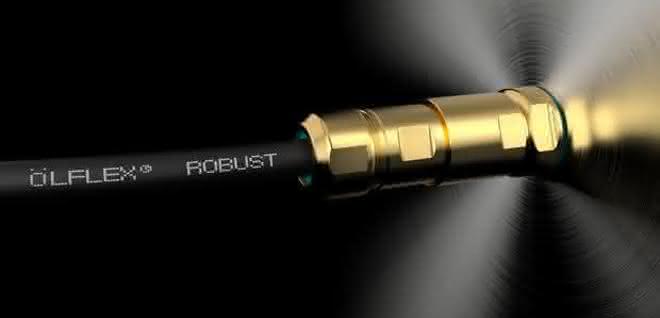
Hygienic design connectors. To minimize the downtime of its pasta drying machines, a manufacturer needed a plug-in connection solution instead of a screw connection. Lapp fulfilled this wish with a connector made from a special copper alloy.
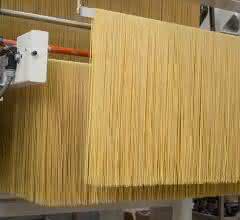
Pasta from the bag is a great convenience for many households when preparing meals, also because dried pasta can be kept for many years. This is because they are dried before packaging. This process takes several hours and is decisive for the quality and price of the pasta. Drying systems remove the water from the mass of water, wheat semolina and gluten. The rooms in which this takes place are up to six meters high and 20 meters long, and hot air circulates at up to 130 degrees Celsius.
Fans on the ceiling of the large drying container provide continuous heat. Their drives were previously hard-wired, with bare conductor ends screwed into terminals. An experienced electrician needs a few minutes to do this, less experienced ones take longer and may even mix up the wires. This is not so important when building a new system, but if a fan breaks down and has to be replaced, every minute is precious. In a large drying plant, one hour of downtime means a production loss of several tons of pasta.
A leading manufacturer of pasta drying systems has therefore decided to use plug connectors to connect the fans in future. However, standard connectors on the market could not withstand the chemical and thermal stresses. This is because the pasta evaporates lactic acid during the drying process, which can corrode the surfaces. Coated housings were not a way out: sooner or later, every coating was infiltrated and the less resistant base material was quickly eaten away.
Copper alloy
The manufacturer found what it was looking for at Lapp. Engineers from the specialist for integrated cable and connection technology solutions visited a drying plant in operation and drew up proposals for a new connection system for the fans. The connectors had to be robust enough to withstand the humid, acidic heat in the plant, but at moderate cost. This meant that standard solutions were out of the running, as they are not durable enough, as well as stainless steel connectors, which would be complex and too costly to manufacture. A stainless steel plug would cost three to five times as much. Plastic connector housings were also not recommended because the customer wanted to use speed-controlled motors in the future. This requires shielded connections and therefore connectors with metal housings.
Lapp's recommendation: a special copper alloy. It can withstand the required temperatures and acid and is still relatively easy to machine, meaning that the costs for the connector are not significantly higher than those of a standard product. The alloy also has excellent EMC properties and outstanding mechanical stability. Although the connectors are slightly more expensive than a standard product, they are significantly cheaper than the stainless steel alternative. "We developed the connector system together with the customer and tested it extensively for a year. In food production, every eventuality must be considered and tested," says Joachim Strobel, Product Manager for Epic connector systems at Lapp.
Smooth surface for more hygiene
When developing the Epic connector, Lapp engineers were guided by the principles of hygienic design, which means it has as few corners and edges as possible. The material has a very smooth surface from which dirt can be easily removed - even without a coating that could flake off and fall into the product zone.
Although the new connector was the focus of interest, the cables also have to withstand mechanical stress, lactic acid and heat. The choice fell on silicone cables from Lapp, which are resistant to vegetable and animal oils and fats and can withstand temperatures of up to 180 degrees Celsius. The seals in the connector are made of fluorocarbon rubber (FKM), a high-quality sealing plastic. Lapp recommends the use of pre-assembled cables and connectors to prevent errors during assembly.
The new connector with the patented plug geometry successfully passed the test run in a running production plant of the customer, so nothing stood in the way of technical approval. The connector will therefore be used on the fans in the next generation of drying systems. "The concept has potential for further applications in the food industry, and stainless steel versions of the connector are also conceivable," says Joachim Strobel. In contrast to the pasta drying systems, the manufacturers of many other food production systems do not even know which chemical substances affect the pipes, for example which cleaning agents are used for the machines. After all, subcontractors usually carry out the cleaning and do not always provide precise information about the cleaning agents used. The example of the pasta drying system shows this: Lapp engineers work together with the customer to find the right solution. as


You might also be interested in
Hebotec at the Hannover Messe 2025
Connecting consumers without tools
Additional robots, control cabinets, control panels or other consumers can be easily integrated into the EMC concept of an existing production line using the PAK 25 equipotential bonding terminal from Hebotec.
 read more...
Motion controller for small drives
Medium power range covered
Faulhaber has another housing-less and compact motion controller in its range, which is particularly suitable for integration in device construction and medical technology applications.
read more...Safe solutions for cable installations
From thick power cables to thin sensor lines, cables and lines must be routed safely through systems and machines. A challenge that should not be underestimated, explains Jörg Sokat, Head of Product Management at Pflitsch.
read more...Displacement measuring systems
Economic positioning
The integrated position measuring system IMS from Bosch Rexroth is now also available as IMS-compact for absolute measurement. The non-contact solution with magnetic measuring principle enables robust and economical position detection for linear...
read more...Economic positioning
The integrated position measuring system IMS from Bosch Rexroth is now also available as IMS-compact for absolute measurement. The non-contact solution with magnetic measuring principle enables robust and economical position detection for linear...
read more...Sensors with IO-Link for extruders
The melting pressure always in view
Macchi, a manufacturer of blown film extrusion lines, optimized its extruders for Industry 4.0 by integrating melt pressure transmitters with digital IO-Link output for precise recording of the melt pressure and magnetostrictive displacement...
read more...Vision with good visitor response
6505 visitors and 378 exhibitors attended the machine vision trade fair in Stuttgart.
read more...Würth Elektronik at the embedded world
Würth Elektronik, manufacturer of electronic and electromechanical components, is presenting itself as a partner to developers at embedded world. At stand 110 in hall 2, the company will be presenting its portfolio and the associated services.
read more...Die-cast electronics housing
CTX Thermal Solutions manufactures cost-effective die-cast housings in application-specific geometries.
read more...