
Industrial and building automation
Components become Industry 4.0-capable
Carlo Gavazzi is presenting new solid-state relays and optoelectronic sensors with modern communication interfaces at SPS. They enable faults to be detected in advance and are therefore suitable for preventive maintenance in the context of Industry 4.0.
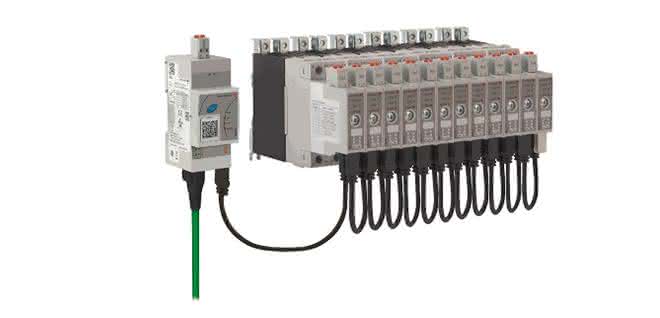
The NRGC-PN control unit can be used to control and monitor up to 32 interlinked RG_CM_N series solid-state relays or contactors. It has two RJ45 ports for the Profinet interface. Using the Profinet IO communication protocol, the switching processes of the solid-state relays can be controlled directly from the PLC and the real-time data from each solid-state relay can be recorded. The power specification from the PLC is converted directly into controlled full waves in the control unit, synchronized with the mains. This reduces the load on the PLC.
The switching process is resolved to a half-wave. This enables precise load control with maximum resolution. The current values for current, voltage, frequency, power, energy consumption and operating hours are available in real time. Diagnostic information relates to mains loss, load loss, load deviation and overtemperature, a short circuit in the load circuit of the solid state relay and the status of a solid state relay outside the set limit values.
Control and data acquisition via Profinet is suitable for all heating applications, especially for IR emitters, where fast switching behavior and reliable and precise temperature maintenance are crucial for the quality of the end product. Typical applications include plastic injection molding machines, PET blow molding machines, thermoforming machines, semiconductor manufacturing machines and glass production machines.
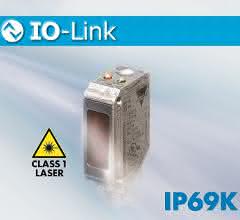
Miniature photoelectric sensor with IO-Link
The LD30 laser distance sensor is a class 1 laser device that uses laser time-of-flight (ToF) measurement to reliably detect even small objects at a distance of up to one meter. It enables two simultaneous physical measurements and has two physical switching outputs. Depending on the application, the photoelectric sensor can be used in "IO-Link" or "SIO" (standard input/output) mode. A process data variable representing the measured distance between the sensor and object is transmitted cyclically via the IO-Link interface.
Retrieving status and diagnostic information enables predictive maintenance and better planning of service and maintenance cycles. In addition, parameters such as scanning distance as well as time and logic functions can be easily configured and quickly adjusted, for example when changing products. The photoelectric sensor is available in an ABS plastic housing with protection class IP67 and dimensions of 30 x 10 x 20 millimetres, as well as a slightly larger version in a stainless steel housing with protection class IP69K. The sensors are equipped with a two-metre connection cable or an M12 connector plug and are suitable for all applications in which detection accuracy is required in the smallest possible size.
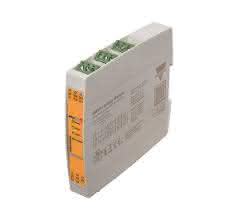
Safety modules in a slimline design
With a width of 17.5 millimetres, the new multifunctional modules save space in the control cabinet. In addition, the series with the five types SMS20, SMS31, SMSA31, SM2H21 and SME41 replaces the existing range with 36 devices. The SMS20 and SMS31 modules are used for emergency stop buttons, safety gate monitors, limit switches, non-contact safety switches, single beam safety light barriers and for leveling elevator cars. Safety gate monitors, limit switches and non-contact safety switches with antivalent output are the application area of the SMSA31 series modules. The two-hand modules SM2H21 and the extension modules SME41 complete the series of safety modules with instantaneous relay output. as
Hall 1, Stand 539


You might also be interested in
ebm-papst is growing again thanks to AI and data centers
ebm-papst returned to a growth trajectory in fiscal year 2025/26. Air Technology, data center applications, and artificial intelligence are driving revenue and investment.
 read more...
SPE on the Verge of a Market Breakthrough
Single Pair Ethernet (SPE) has moved beyond the conceptual phase and is increasingly being implemented in industrial settings. The focus here is not only on higher data rates and simplified cabling, but above all on the issue of system integration...
read more...More than 900 exhibitors already registered
Around six months before the start of the trade fair, more than 900 companies have registered for SPS 2026 in Nuremberg. The trade fair focuses on industrial AI, cyber security and digital transformation.
read more...Virtual PLCs in practice: How vPLCs make production systems more flexible and scalable
The increasing networking of IT and OT is fundamentally changing industrial automation. The IT/OT Integration Summit shows how modern technologies can make production environments more efficient, flexible and future-proof. The event will focus on...
read more...Sales growth in a turbulent market environment
Thanks to innovations and a focus on strategic industrial markets, Sick was able to moderately increase its sales in the 2025 financial year. In a turbulent market environment, the company was able to maintain its position and gain market share with...
read more...Siemens presents new AI agent
Siemens is launching 'Eigen Engineering Agent', an AI for automation technology. The solution is integrated into the TIA Portal, has been tested with over 100 companies and is designed to significantly accelerate engineering processes.
read more...Schaeffler keeps sales almost stable
Schaeffler generated revenue of EUR 23.5 billion in 2025 and increased EBIT before special items to EUR 936 million. At 266 million euros, free cash flow was significantly above the prior year and forecast. Net income remained negative due to high...
read more...Advancing artificial intelligence together
Helukabel is stepping up its activities in the field of artificial intelligence and is now a member of the IPAI. The innovation and collaboration platform for companies, research facilities, institutions and administration has set itself the goal of...
read more...New impetus for ifm sales
Two new positions were filled at ifm at the start of 2026: Markus Wolf becomes Managing Director Sales Germany, Sven Quant takes over the position of Central Managing Director in the Process Sensors division within the ifm Group.
read more...