
Communication networks in the factory
To keep the data flowing
Sensors, machines, robots, tools - everything in the factory communicates with everything else. Lapp provides the high-performance communication infrastructure. This includes cables that can be quickly assembled, robust switches and a number of other innovations.
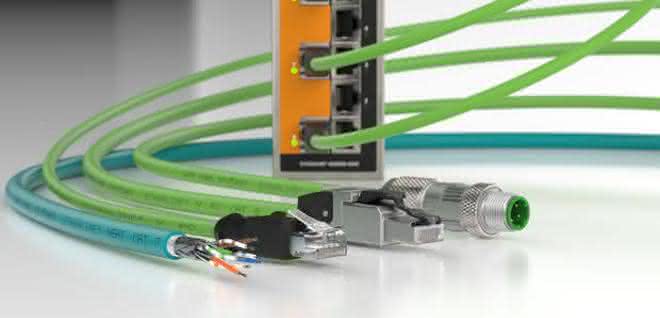
The automation pyramid is crumbling: In future, an order in the online store will trigger actions directly in the machine. And sensors in the machine will report to the ERP system if there is a risk of production downtime - this is very important for predictive maintenance as a new business model. One aim of these flat hierarchies in the factory is greater flexibility, keyword batch size one: every customer receives a customized product, but at the same cost as in mass production. To achieve this, the communication networks in the factory must become more closely meshed and more powerful. This applies to both active components such as switches and passive components such as cables. Lapp now also offers active components. "Wherever information, signals and electrical energy are transported from A to B, Lapp provides the right connection," promises Georg Stawowy, CEO of Lapp Holding.
Robust switches with top features
Profinet switches are a new addition to the industrial data communication portfolio, which the global market leader for integrated cable and connection technology solutions presented at Hannover Messe 2019 under the name Etherline Access. They are suitable for use in the widely used Profinet networks. The switches have four, eight or 16 ports, recognizable by the name abbreviations PNF04T, PNF08T and PNF16T. The switches from Lapp provide users with a compact, customized and, above all, robust solution for industrial applications. They meet Profinet Conformance Class B and prioritize Profinet telegrams. This enables the switch to distinguish whether the telegram is a request from the web, an FTP file transfer, a media stream or a Profinet telegram. If the transmission load is high, the switch can prioritize the important Profinet telegrams and prevent telegram delays from occurring.
The new switches join the Etherline Access Switches for industrial Ethernet, which Lapp introduced two years ago and which are available in several managed and unmanaged versions. A special feature is their short reconfiguration time, i.e. the time it takes for communication to be restored after an interruption. For these switches, this is only 20 milliseconds with 250 active components in the network. The switches are also fully equipped with modern diagnostic and redundancy procedures.
Everything from a single source
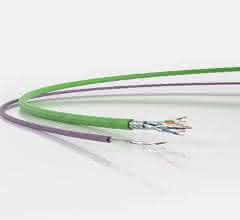
A major advantage of the new switches is the interaction with Lapp's cables, connectors and assemblies. There have been some interesting innovations there recently. For example Etherline PN CAT.6A Fast Connect. Compared to conventional cables, it is easier and quicker to assemble and install. The cable has a plastic cross on the inside that separates the four wire pairs, as well as a common shielding over an inner sheath. The shielding of the four wire pairs is therefore no longer necessary and the fitter does not have to remove a foil shield from each of the four wire pairs. To further simplify the work, Lapp supplies the right tool for assembling the Fast Connect cable. It optimally prepares the cable for connector assembly in a single work step, thus reducing the time required even further. The new shielding also promises a long service life.
Users do not have to make any compromises when it comes to transmission speed either. The new high-speed cable achieves ten gigabits per second, which is currently the maximum transmission rate for copper cabling in industrial environments. The cable conforms to the Profinet standard and is compatible with all Profinet cables from Lapp and other manufacturers and, of course, with the new Etherline Access Switches. It is also approved for the North American market (UL-certified). This makes it suitable for export-oriented customers in machine, plant and device construction who do not want to worry about approval on different continents.
The Etherline PN Cat.6A Fast Connect is available in seven versions: three for fixed installation (type A) with PVC sheathing (flame-retardant), with FRNC sheathing (halogen-free and flame-retardant) or with PUR sheathing (halogen-free, flame-retardant and with increased mechanical robustness). Two variants are suitable for flexible installation (type B) with a flame-retardant PVC sheath or halogen-free and flame-retardant FRNC sheath. There are also two variants for highly flexible use (type C) with PVC sheath or PUR sheath. In addition, Lapp offers four further versions with reduced dimensions for use in confined applications.
Saving on data lines
Ever higher transmission speeds are not necessarily the most important requirement for users. Another, as already mentioned, is ease of installation. This can be achieved by slimming down, for example by omitting three of the four wire pairs in an Ethernet cable. Such single-pair Ethernet cables are particularly suitable for connecting sensors. They are thin, light and fit into narrow gaps. And of course they are cheaper, both to purchase and thanks to the simpler installation, as the technician only has to connect two wires instead of eight. They are capable of one gigabit per second, which is more than enough for connecting sensors. Lapp has developed a range of cables for industrial applications under the name Etherline T1. The advantages: instead of four wire pairs, they only have one, which saves up to 75 percent time when connecting the wires - and of course a cable with two wires also costs less than one with eight. These cables are also thin, making them suitable for tight spaces. Lapp already has single-pair Ethernet cables in its range, but there is not yet a connector standard for single-pair Ethernet, which the company is currently developing together with other manufacturers and standardization bodies. as


You might also be interested in
Helu makes its first trade fair appearance under a new brand name
Helu Kabel will be presenting itself as Helu for the first time at Hannover Messe 2026, showcasing system solutions, Heluchain cables and new industrial luminaires.
 read more...
Strategic realignment with brand relaunch
In future, Helukabel will trade as Helu
The Helukabel Group is parting with part of its name: in future, the company will only operate under the Helu brand. With this step, the specialist for electrical connection technology is underlining its strategic development from a classic cable...
read more...Modular plant construction for corrugated board
Insight into the production of corrugators at BHS Corrugated: Automated, modular and equipped with Helukabel components.
read more...Best quality for the steel
Conditions in the steel industry are harsh and inhospitable. The machines used must be able to withstand the demanding environmental conditions in order to deliver the best quality at all times.
read more...If the standard cable is not sufficient
Lapp offers cables for countless applications - but not for all of them. From time to time, the developers have to modify a standard cable or develop a special cable.
read more...Slight decline in sales, strong investments
The Lapp Group has not been spared from the weakening global economy. However, the company only recorded a slight loss in the past 2024 financial year.
read more...Electrical connection technology
Cables and wires for industrial automation
Heukabel offers system solutions for cable routing from a single source. The subsidiary EKD Systems specializes in tailor-made cable drag chains made of steel, stainless steel and plastic, which are used in moving machines and systems as well as in...
read more...Lapp relies on Ultramid from BASF
Mobile charging of electric vehicles
The automotive industry is currently undergoing the biggest transformation in its history. The boom in battery electric vehicles in particular is presenting the industry with major challenges. Lapp, as a supplier of cables and connection...
read more...Cable handling application
At this year's Motek, ArtiMinds Robotics is showcasing a robot-based automation solution for the sensor-assisted assembly of flexible cables in connector housings.
read more...