
Cable materials
Small cable customer
Material expertise for cables and connectors. The following applies to cables and connectors: only if the materials are suitable for the application can the user be sure that the functions are correct. This is why all connection solutions are regularly put through their paces in Lapp's test centers.
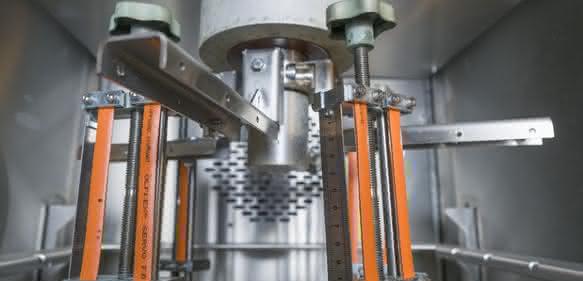
What material is a cable made of? Many people will say that it is made of copper on the inside with plastic around it for the insulator and the sheath. But it's not that simple. Two different plastics are often used for the sheath and insulator, and there are also many possible variations. The variety of materials is necessary because no plastic can cover all applications. The more specialized the application, the more specialized the material. And because that's not complicated enough, it's the same game with connectors. Here, too, several materials compete for the customer's favor. It's good if you know exactly what the application is and have a manufacturer with in-depth knowledge of cables and connectors.
Different requirements depending on the application
Lapp shows two examples that demonstrate how different the requirements can be: The food and beverage industry requires materials on which bacteria cannot take hold and which do not become soft when exposed to hot steam and aggressive cleaning agents. In buses and streetcars, on the other hand, they have to comply with strict fire protection standards. A single material does not cover this. The same applies to plugs, cable glands, seals and other accessories.
Where the risk of fire is high, the cores must be insulated with flame-retardant material. The easiest way to achieve good flame protection is to add halogens to the plastic. However, there is a catch: where people are present, for example in buses and trains, halogens have the disadvantage that they form toxic fumes in the event of a fire, which combine with the fire department's extinguishing water to form corrosive vapors.
Materials with synergy
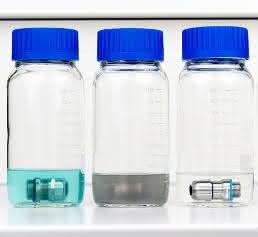
HFFR (Halogen Free Flame Retardant) plastics are non-toxic, but require an additive content of up to 60 percent, which can affect the mechanical properties of the plastic. A new alternative are so-called synergists, combinations of two substances that together provide better flame retardancy than either of the two starting materials alone. One example is a synergist made from aluminum trihydrate and silane compounds. When exposed to fire, aluminum trihydrate reacts to form aluminum oxide and water, an endothermic reaction that draws energy from the fire. It also forms a crust of burnt material that serves as a protective layer.
The sheath has no electrical function, it is intended to protect the inside of the cable from environmental influences such as abrasion, chemicals, cleaning agents, UV light, temperature and much more. Most cables have sheaths made of polyvinyl chloride or the very robust polyurethane (PUR). Its chemical bonds are among the strongest there are. This makes processing difficult, both in the manufacture of the cable and during assembly, because the sheath is difficult to cut. PUR is also flammable and expensive. A good compromise between the high resistance of PUR and the simple processing of PVC are the cable types Ölflex 408P and ÖLFLEX 409P, which have a PUR outer sheath and a gusset-filling functional layer of PVC that fills the empty space between the cores.
Smooth thanks to special TPE
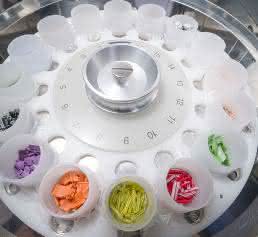
Almost all of these materials are unsuitable for the food industry. Lapp has developed a new sheath material made of special TPE for them. Microbes hardly find a foothold on the Robust cables from Lapp, and they are also easy to clean. The secret of the special thermoplastic elastomer is its smooth surface thanks to a sophisticated mixture of additives that fill microscopic gaps in the material and which do not wash out of the plastic matrix even during intensive cleaning with a steam jet.
When it comes to so-called cable system products such as cable/hose bushings or connector housings, the case seems clear: stainless steel is the material of choice, especially in the food industry. It does not rust and there is no coating that could flake off at some point. But the case is not that simple here either. The food industry in particular likes to use hypochlorous acid, which decomposes into hydrochloric acid and kills organic substances. Common V2A stainless steel is attacked by hypochlorous acid and is therefore not ideal for many applications in the food industry. For such cases, there is a more resistant alloy, V4A, which is also used for expensive Swiss wristwatches, among other things. It is extremely hard and can withstand knocks or cleaning with hard brushes.
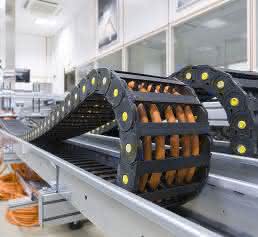
However, V4A is more difficult to machine, the untreated surface is rough and friction is high. It is therefore not possible to turn a screw made of V4A steel into a thread made of V4A; it would get stuck. Lapp subjects its V4A stainless steel products, for example the EHEDG-certified SKINTOP® HYGIENIC cable gland, to a special surface treatment that reduces friction. A smooth surface is also important to ensure perfect cleaning.
Stainless steel - not always the first choice
Stainless steel is uncommon for rectangular connectors because the hardness of the metal means that it cannot be machined in any meaningful way; it would have to be milled from a solid block, which would not be affordable. Lapp offers an alternative with the EPIC® ULTRA: the housing of the rectangular connector is made of nickel-plated die-cast zinc. This material is corrosion-resistant, for example in salt spray on oil drilling platforms or in the food industry. And it offers optimum EMC properties. Plastic housings, some of which are also resistant to acids and alkalis, have to pass muster when it comes to electromagnetic compatibility.
A critical point is always where metal meets metal, for example a cable gland on a control cabinet. This is where a seal is required that must have properties comparable to those of the materials used for the other components of the connectors or screw fittings in terms of temperature and media resistance. Fluorocarbon rubber (FKM) covers many requirements. It is resistant to weathering, ageing and ozone as well as chemicals and can withstand temperatures of up to 200 degrees Celsius. Ethylene propylene diene rubber (EPDM) is also suitable for moderate ambient conditions. FKM is not suitable for very cold environments; below minus 20 degrees it is better to switch to silicone, and silicone also has an advantage in hot environments.
No silver bullet
In Lapp's experience, many users only order expensive cable or stainless steel components because they do not know exactly what media they will come into contact with. Or users use standard products for cables and connectors and accept the fact that these have to be replaced frequently. There is no ideal solution, only a careful weighing up of all the advantages and disadvantages. The experts at Lapp know their products inside out and should always be consulted before a user decides on a - possibly unsuitable - variant. pb


You might also be interested in
Hebotec at the Hannover Messe 2025
Connecting consumers without tools
Additional robots, control cabinets, control panels or other consumers can be easily integrated into the EMC concept of an existing production line using the PAK 25 equipotential bonding terminal from Hebotec.
 read more...
Motion controller for small drives
Medium power range covered
Faulhaber has another housing-less and compact motion controller in its range, which is particularly suitable for integration in device construction and medical technology applications.
read more...Safe solutions for cable installations
From thick power cables to thin sensor lines, cables and lines must be routed safely through systems and machines. A challenge that should not be underestimated, explains Jörg Sokat, Head of Product Management at Pflitsch.
read more...Displacement measuring systems
Economic positioning
The integrated position measuring system IMS from Bosch Rexroth is now also available as IMS-compact for absolute measurement. The non-contact solution with magnetic measuring principle enables robust and economical position detection for linear...
read more...Economic positioning
The integrated position measuring system IMS from Bosch Rexroth is now also available as IMS-compact for absolute measurement. The non-contact solution with magnetic measuring principle enables robust and economical position detection for linear...
read more...Sensors with IO-Link for extruders
The melting pressure always in view
Macchi, a manufacturer of blown film extrusion lines, optimized its extruders for Industry 4.0 by integrating melt pressure transmitters with digital IO-Link output for precise recording of the melt pressure and magnetostrictive displacement...
read more...Vision with good visitor response
6505 visitors and 378 exhibitors attended the machine vision trade fair in Stuttgart.
read more...Würth Elektronik at the embedded world
Würth Elektronik, manufacturer of electronic and electromechanical components, is presenting itself as a partner to developers at embedded world. At stand 110 in hall 2, the company will be presenting its portfolio and the associated services.
read more...Die-cast electronics housing
CTX Thermal Solutions manufactures cost-effective die-cast housings in application-specific geometries.
read more...