

Air compressors
Compressor trio puts the pressure on
An old compressor was to be replaced at a special machine manufacturer. Instead of one large machine, three smaller screw compressors now work together in an energy-efficient manner.
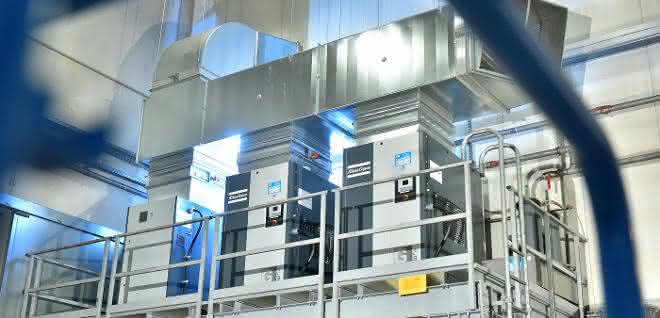
The company H.-H. Focke has been building special machinery since 1978. When the compressed air supply was due for renewal around two years ago, the Berlin-based company was looking for a tailor-made solution. This not only had to cover the fluctuating demand during the course of the day precisely, safely and efficiently, but also fit on a platform construction in the dispatch hall intended for the station. Atlas Copco 's individual concept was convincing and was implemented in 2018. Instead of the old speed-controlled 90 kW machine, three oil-injected screw compressors from the new GA+ and GA-VSD+ series now share the space on the compressed air platform. Two speed-controlled GA 45 VSD+ FF machines, each with an output of 45 kW, alternate weekly with a 37 kW GA 37+ FF with a fixed speed, which generates the base load. Together, the two compressors cover the average compressed air requirement, which is between 12 and 14 m³/min at an operating pressure of 7.2 bar. The other VSD machine is available for redundancy. The maximum volume flows of the twin combinations are 16.5 m³/min. If less power is required at the weekend than the GA 37+ FF alone can generate, it switches off and a speed-controlled GA 45 VSD+ takes over.
A higher-level ES 16 control system coordinates the interaction of the compressors and ensures that they always work at their optimum operating point. Weekly switching between the two VSD machines also takes place automatically. Thanks to the use of the control system in combination with the speed-controlled machines and a 5,000-liter buffer tank, the pressure fluctuations in the system are extremely low at ±0.05 bar.
Easy maintenance thanks to redundancy
At the same time, the new concept - away from one large machine and towards several smaller ones - has increased operational reliability. There was previously an outdated reserve compressor with an output of 75 kW. However, this alone could not cover the demand. As a result, maintenance work always had to be carried out at weekends. In addition, due to its size, there was no room for the machine on the compressed air platform; it was located in a separate room. "We were able to place all of our new compressors on the platform because they require a relatively small footprint," explains Operations Manager Detlev Gründer. "In addition to their energy efficiency and quiet operation, this was one of the reasons why we opted for Atlas Copco."
The factory-integrated refrigeration dryers also proved to be an advantage both in terms of space and the available redundancy. "Previously, our system always had a separate dryer, which required additional floor space," says Gründer. "And if it ever broke down, the whole system was down. Today, if one of the refrigeration dryers were to fail, the other two compressors could step in."
At the same time, energy consumption has fallen. "Thanks to the higher efficiency of the new compressors, we can now generate the required amount of compressed air with around ten percent less power consumption," explains the operations manager. In addition, the efficiency of the GA+ and GA-VSD+ compressors has also reduced the investment sum, as the machines in this series are subsidized by the Federal Office of Economics and Export Control (BAFA) by up to 40 percent. "Atlas Copco already recommended that we apply for the BAFA subsidy during the bidding phase and provided us with the necessary documents," praises Detlev Gründer. "The total investment of 118,000 euros was then subsidized by more than 20 percent."
Stephanie Banse, journalist in Hamburg / am


You might also be interested in
Predictive maintenance in retrofit
Predictive maintenance pays off. This is because early detection of impending failures means that systems can be serviced in a targeted manner before production downtime occurs. But how complex is it to integrate such a maintenance concept into an...
 read more...
Maintenance instead of replacement
The circular economy starts with the machinery
Sustainability in industry starts with machines, says our guest author from Deguma: How maintenance, modernization and the 5R strategy save resources, energy and CO₂.
read more...3D printing for unplanned requirements
The material fails and the machine suddenly stops? Then you need to take the right measures to be able to resume production quickly. Material failure in the form of faulty components or material wear in the frame are a risk for any production.
read more...High demands in terms of safety, application and robustness
Demanding work in the electrical trade and energy supply as well as smooth processes in production require innovative and customized measurement technology that scores points for safety, ease of use and resilience.
read more...Car meets e-bike: riding with lubrication-free polymer bearings
Studies show that the proportion of pedestrian and bicycle traffic is increasing in urban areas. With the JetBike, JetBike GmbH from Braunschweig presents a mixture of e-bike and car and relies on lubrication-free polymer bearings from Igus.
read more...Hydraulic hub for more efficient servicing
Bosch Rexroth presents a digital toolbox for service and maintenance. With a comprehensive range of digital services, the Hydraulic Hub simplifies and accelerates the service and maintenance of hydraulic products and increases machine availability.
read more...Arnold Umformtechnik expands after-sales...
Faster help with VR glasses
Arnold Umformtechnik is expanding the after-sales service for its machines to include digital remote services. The focus is on data security, simple operation and clear processes.
read more...147,000 euros per hour: high costs for German companies due to unplanned downtime
According to the "Value of Reliability" study, 67% of industrial companies in Germany experience unplanned downtime at least once a month. This costs the German economy 147,000 euros per hour. Nevertheless, reactive maintenance concepts are not...
read more...Maintenance starts with a maintenance planner
Legal requirements stipulate that machines and systems must be serviced regularly. The maintenance work serves to ensure occupational safety and economic efficiency.
read more...