
Compressors
Compressed air supply from Atlas-Copco in the burner
From Munich to Verona in three hours - Herrenknecht tunnel boring machines drive up the mountain at the Brenner Pass. Among other things, they are equipped with robust, oil-injected compressors from Atlas Copco. Because when compressed air is needed in the mountain, it has to be available one hundred percent of the time.
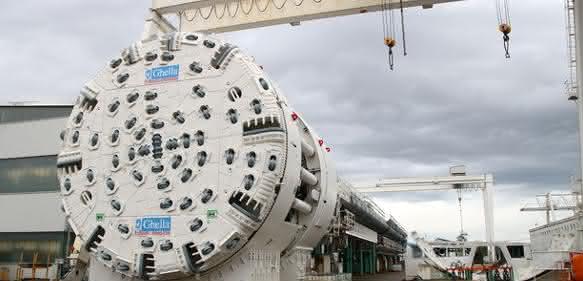
The "longest railroad tunnel in the world" is currently being built at the Brenner Pass: Italy and Austria have been building the base tunnel, which will be 64 kilometers long, since 2007. Including all access routes, the Brenner route is set to reach a world record length of 320 kilometers. The aim is to start rail traffic in 2026: Travelers from Munich will then be able to reach the Italian city of Verona in three hours, it is said.
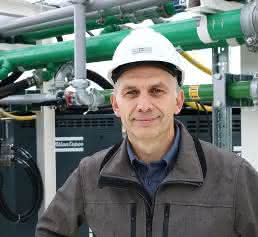
So many superlatives require top technological performance during construction. One of the most important pieces of equipment in the construction of the route is the tunnel boring technology supplied by Herrenknecht from Schwanau on the edge of the Black Forest. Three tunnel boring machines (TBMs) are already in use on the construction site and three more will be delivered in the near future. "The TBMs are moving factories in the mountain," explains Albert Feißt, Head of Fluid Technology at Herrenknecht. "The drill head rotates and breaks through the rock. The excavated material is transported back out of the tunnel via various conveyor belts." The rock is secured with internal formwork made of segments: "A remote-controlled manipulator, the erector, is used to place prefabricated segments of reinforced concrete," says Feißt. "These segments form a ring. The annular gap between the outer diameter of the segment and the mountain is filled with pearl gravel to embed and stabilize this freshly constructed ring." A lot of compressed air is needed to convey this backfill material, which is generated and called up by the Atlas Copco compressors traveling in the trailer.
Constantly on stand-by
The tunnel boring machine that will next be delivered to the Brenner Pass is still in Schwanau at the end of 2017. This mobile factory is around 100 meters long and the diameter of the drill head is around 10 meters. Nine screw compressors supply the compressed air required by the TBM. They are positioned at the end of the plant and equipped with an intake flap control system.
Herrenknecht uses modified oil-injected screw compressors from Atlas Copco's GA series, mostly with water cooling. Five GA 55 HE and four GA 90 HE machines are installed on the "burner system". As a rule, one is sufficient to provide the base load, i.e. to supply grease and water pumps, fittings with pneumatic drives or even pneumatic screwdrivers. The other eight compressors are suddenly activated when pearl gravel has to be blown behind the segments. "On average, we only use 10 to 15 percent of the total compressed air capacity," says Feißt. "But when the capacity is called upon, it has to be available one hundred percent." The compressors, which are constantly running in standby mode, must therefore be absolutely reliable.
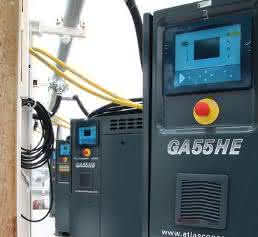
Especially for Herrenknecht, Atlas Copco has equipped the full-load idling compressors with mechanical volume flow control via dampers. This ensures that the air is supplied in the required quantity. "Thanks to the intake flap control, we were able to save on air receivers and thus solve a space problem," explains Feißt. Also for space reasons, the GA compressors for Herrenknecht have a more compact design than the standard series. Due to the harsh environment and the mine dust, the Atlas Copco experts have also installed heavy-duty intake filters to prevent dirt from entering the compressors. They also have a special controller for temperature management, as they are oversized in terms of performance. "We deliberately build 20 percent redundancy into all components of our TBMs, because everyone on the mountain must be able to rely on the safety and reliability of the machines used," emphasizes Feißt. Because the compressors are not regularly used to their full capacity, the oil they need for lubrication does not reach the required operating temperature. As a result, water would accumulate in the oil as it would not be separated out by the temperature. "The machines therefore have a special cooling water management system," says Feißt.
Components must be robust
The business with tunnelling machines is booming, and global urbanization is helping enormously: road, rail and water tunnels are needed in emerging countries as well as in Europe. "The focus is different every year," explains Josef Gruseck, member of Herrenknecht's Traffic Tunnelling management team. "Sometimes it's the Gotthard, then the Brenner, while major projects are underway in London, Paris or Doha. There is also a lot of construction going on in Asia." In Europe in particular, however, the investment backlog in the area of infrastructure projects is gigantic. ee


You might also be interested in
Plagiarius 2024 negative prize
On January 26, 2024, the Plagiarius campaign awarded its dreaded "Plagiarius" negative prize for the 48th time to manufacturers and retailers of particularly brazen counterfeits and fakes.
 read more...
Ivalua honors winners of the Generative AI...
AI-supported "add-ons" for buyers within 48 hours
Ivalua, provider of cloud-based spend management solutions, announced the winners and innovations of the first Generative AI Innovation Cup. The competition took place in December 2023. It was open to all Ivalua partners and employees - more than...
read more...Efaflex celebrates 50 years of high-speed...
The emphasis is on "fast"
Since day one, Efaflex has wanted to use new technologies as early as possible and drive progress in the industry. This year, the family business is celebrating its 50th anniversary under the motto "Fast Forward".
read more...Security of supply even during power outages
In the winter of 2022, Germany was worried about energy shortages. The drugstore retailer dm did not paint any horror scenarios, but nevertheless saw the possibility of controlled, temporary, regional power cuts (brownouts).
read more...Safety technology in mechanical engineering
Modules with new functions
Euchner's product highlights at EMO 2023 include the communication-capable solenoid interlocks.
read more...Transforming the paper industry towards climate neutrality
Together with partners from industry and research, Voith is developing a project for the optimization of energy and material flows in paper production. The aim of the research project is to develop a digital framework that enables effective process...
read more...Up to 95 percent less flue gas thanks to direct extraction
The requirements for occupational safety measures and safety technology are also constantly increasing in welding technology. The Technical Rules for Hazardous Substances (TRGS) stipulate that welding fumes and harmful substances must be extracted...
read more...Competitive advantages with large machines
Whether 3D-printed components for machines and systems, prototypes or aids for design: additive manufacturing is almost indispensable for modern companies in mechanical and plant engineering and automation if they want to play in the premier league.
read more...Transport technology from the modular system
Many transport tasks can be realized with the help of linear technology. Pre-configured solutions are available to simplify the interaction between the linear unit, motor, gearbox and controller. This minimizes the effort required for research and...
read more...