
Robotics
Path planning for batch size 1
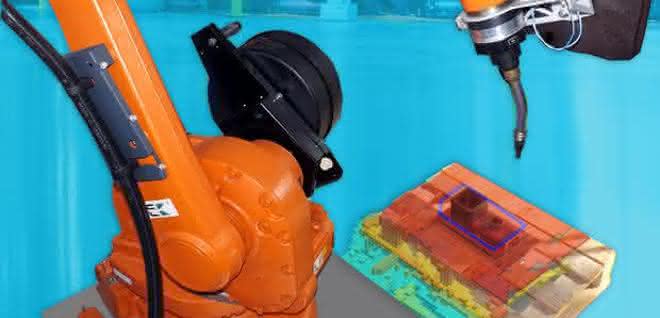
Railroad planning software. The research project "Camera-based path planning KaBa" at the ISW of the University of Stuttgart is working on the development of scalable path planning software. It is designed to plan collision-free robot paths and compensate for deviations in the real component.
The rate of automation in manufacturing is increasing worldwide. Due to constantly falling investment costs, industrial robots are becoming increasingly interesting for small and medium-sized enterprises (SMEs). However, the flexible use of industrial robots poses challenges for these companies in particular, which prevents the economic use of robots in SMEs.
New methods are needed to achieve the goal of "batch size one". The "KaBa" camera-based path planning research project is developing scalable path planning software for automatic path generation for industrial robots.
When producing small batches with a large number of variants, preparing the robot task is very time-consuming. The programming time is often longer than the actual production time. A separate robot program must be created for each variant of a component. In addition, in the context of small-batch production, it is often not possible to guarantee the exact clamping of the workpieces for each repetition. For this reason, small deviations in the position and orientation of the workpiece occur. These invalidate a robot program. The effort required therefore makes the use of industrial robots in small series production uneconomical.
In order to reduce the additional time required for programming in small series production, planning software should automatically plan collision-free robot paths and compensate for deviations in the real component. Using a line laser mounted on the robot flange, the workpiece is scanned before each path planning and a 3D point cloud is recorded. Poses to be approached are programmed directly in CAD or by tracking a pointing device directly on the component.
Permissible deviations from the target path can be defined for collision avoidance. A step size heuristic based on the occupancy of the space enables short planning times with high accuracy of the collision calculation.
The planning software is based on a 3D model of the workpiece. This is used to determine the exact orientation and position of the workpiece using a matching process. This allows the target path to be adapted precisely to the actual position of the workpiece. In addition, a deformation model is calculated between the scan data and the 3D model. In this way, the path can be adapted to local deviations or the part can be recognized as a reject.
The KaBa path planner significantly reduces the time required to plan and prepare a robot task. Manual programming is no longer necessary. Instead, a path is planned and executed automatically using a camera. This makes the use of industrial robots economical even for small series and individual part production in SMEs.
The KaBa research project is funded by the Federal Ministry for Economic Affairs and Energy (BMWi) as part of the Central Program for Innovation in SMEs (ZIM). The project partners are Münster University of Applied Sciences, ISW University of Stuttgart and CLK GmbH.
The ISW presents current research results at the SPS.
P. Weßeler/B. Kaiser/as
Hall 3, Stand 358

Briefly explained: The MHI e.V.
The Wissenschaftliche Gesellschaft für Montage, Handhabung und Industrierobotik e.V. (MHI e.V.) is a network of renowned university professors - institute directors and chair holders - from German-speaking countries. The members conduct both fundamental and application-oriented research on a wide range of current topics in the fields of assembly, handling and industrial robotics. Further information on the society, its members and activities: www.wgmhi.de.

Briefly explained: The ISW
The Institute for Control Engineering of Machine Tools and Production Equipment (ISW) was established at the University of Stuttgart in 1965 and has developed into one of the most recognized research institutes in its field. In the course of its more than 50 years of existence, the main areas of research and application have been constantly expanded. Current areas of focus include drive control, additive manufacturing, communication, machine technology, control, simulation and virtual production. The guiding principle is the development and application of control technology and other computer-aided means for solving automation tasks. http://www.isw.uni-stuttgart.de


You might also be interested in
ebm-papst is growing again thanks to AI and data centers
ebm-papst returned to a growth trajectory in fiscal year 2025/26. Air Technology, data center applications, and artificial intelligence are driving revenue and investment.
 read more...
SPE on the Verge of a Market Breakthrough
Single Pair Ethernet (SPE) has moved beyond the conceptual phase and is increasingly being implemented in industrial settings. The focus here is not only on higher data rates and simplified cabling, but above all on the issue of system integration...
read more...More than 900 exhibitors already registered
Around six months before the start of the trade fair, more than 900 companies have registered for SPS 2026 in Nuremberg. The trade fair focuses on industrial AI, cyber security and digital transformation.
read more...Virtual PLCs in practice: How vPLCs make production systems more flexible and scalable
The increasing networking of IT and OT is fundamentally changing industrial automation. The IT/OT Integration Summit shows how modern technologies can make production environments more efficient, flexible and future-proof. The event will focus on...
read more...Sales growth in a turbulent market environment
Thanks to innovations and a focus on strategic industrial markets, Sick was able to moderately increase its sales in the 2025 financial year. In a turbulent market environment, the company was able to maintain its position and gain market share with...
read more...Siemens presents new AI agent
Siemens is launching 'Eigen Engineering Agent', an AI for automation technology. The solution is integrated into the TIA Portal, has been tested with over 100 companies and is designed to significantly accelerate engineering processes.
read more...Schaeffler keeps sales almost stable
Schaeffler generated revenue of EUR 23.5 billion in 2025 and increased EBIT before special items to EUR 936 million. At 266 million euros, free cash flow was significantly above the prior year and forecast. Net income remained negative due to high...
read more...Advancing artificial intelligence together
Helukabel is stepping up its activities in the field of artificial intelligence and is now a member of the IPAI. The innovation and collaboration platform for companies, research facilities, institutions and administration has set itself the goal of...
read more...New impetus for ifm sales
Two new positions were filled at ifm at the start of 2026: Markus Wolf becomes Managing Director Sales Germany, Sven Quant takes over the position of Central Managing Director in the Process Sensors division within the ifm Group.
read more...