
Robonet 4.0 research project
Robot colleague becomes a craftsman
Robonet 4.0 research project: How can the potential of industrial robots also be used in the skilled trades? Robonet 4.0" provides the answers. The intuitively controllable robot unit suitable for the skilled trades was developed by the Chamber of Skilled Crafts for Lower Franconia and the Fraunhofer IGCV. At the heart of the solution is a flexible Motoman GP50 from Yaskawa.
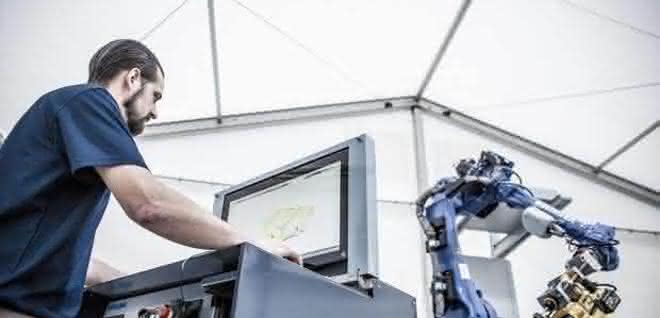
"The basic idea was to find out whether it is possible to implement a robot in the skilled trades without in-depth programming knowledge," says project manager Thomas Planer, describing the aim of developing "Robonet 4.0". As part of the "Handwerk digital" research project, the Chamber of Crafts for Lower Franconia and the Augsburg-based Fraunhofer Institute for Casting, Composite and Processing Technology (Fraunhofer IGCV) investigated the use of future-proof robot technologies in the assembly and production areas of small and medium-sized craft businesses. The research focused on the possibility of intuitively programming robots without complex programming code. Instead, the robot was to be operated and controlled with AR (augmented reality) glasses using human gestures.
Autonomous drilling with a mobile robot unit
Specifically, a solution for autonomous, robot-based drilling was implemented. "On the one hand, we chose this use case because our tradespeople want machine-based relief, especially for physically heavy work such as overhead drilling in concrete ceilings," explains project manager Planer. "On the other hand, the drilling application is relevant for many professions and can also be transferred to other work."
The result of around two years of development work is a mobile robot unit. An industrial robot mounted on a mobile platform enables drilling with millimeter precision at a height of up to three and a half meters, even overhead. Programming is intuitively controlled using human gestures. Data can also be transferred directly from CAD programs.
The robot used is a Motoman GP50 from Yaskawa with a load capacity of 50 kilograms. The decision was made following a public tender. The fact that this model guarantees the required precision thanks to its load-bearing capacity and mechanical rigidity, but is not too heavy for the mobile substructure, spoke in favor of this model. The GP series from Yaskawa's Motoman portfolio is designed for fast joining, packaging and general handling applications. "GP" stands for "General Purpose", i.e. for a wide range of applications.
Safety and connectivity
Another argument in favor of the six-axis robot was its high-performance Motoman YRC1000 controller. The compact controller with a cabinet volume of just 125 liters enables optimum use of space - and therefore also fits into the mobile substructure of the Robonet 4.0 unit.
An integrated safety controller also turns the controller into a complete category 3 functional safety controller (FSU) with up to 32 definable safety zones. This enables operation in safe mode and the robot can be operated safely in the specific application even without a safety fence.
The programming handset of the YRC1000 control unit, which weighs just 730 grams, is ergonomic and clearly laid out. The touchscreen enables intuitive operation and therefore simple movement and scrolling with the cursor. A 3D simulation on the screen of the teach pendant can display the movement of the real robot arm and the limits of the safe working area.
In addition, open interfaces, for example to Ethernet and ROS (Robot Operating System), make the current controller generation ideal for use in Industry 4.0 environments and for linking with other programs. as


You might also be interested in
Cutting solutions in 2D and 3D
Microstep showed 2D and 3D cutting solutions in action on sheet metal, tubes, profiles and container bases, including bevel cutting with plasma or waterjet and dynamic fiber laser cutting, as well as drilling, milling and marking demonstrations.
 read more...
Precision machining of bores
Paul Horn is presenting an innovative extension for the Supermini system in the field of ultra-fine machining at EMO 2023. The system has been supplemented by a variant with an ultra-fine ground cutting surface.
read more...Deep drill holes optimized with PCD
When the Schlote Group built a new plant in Harzgerode in 2017, production was geared towards series production of a single component right from the start.
read more...Production goes digital
EMO, the world's leading trade fair for production technology, invites the industry to Hanover from September 18 to 23.
read more...Vibration-free groove turning process
Adjustable damped boring bar
Paul Horn is exhibiting innovations and product enhancements at the EMO in Hanover. Among other things, the company is exhibiting a boring bar that can be adjusted to the vibration amplitudes that occur.
read more...Efficiency with digital twins
Digitalization and automation are the way to increase efficiency and flexibility in machining. The Tebis team will be presenting suitable solutions for mechanical engineering at EMO.
read more...Many highlights in Leipzig
Ceratizit will be presenting the highlights from its portfolio at Intec. In addition to the latest tools for milling, turning and drilling, automation solutions will also be a top topic at the tool manufacturer's stand.
read more...How smart robot simulation works
More intelligent, more efficient, easier to operate - robots are developing rapidly. Among other things, great care is required when setting them up and operating them in order to avoid cost-intensive downtimes. Robot simulation tools are...
read more...Milling, turning and grinding center
Milling, turning, grinding and gear cutting on one and the same machine - in a single clamping operation: Soraluce's multitasking machines are the answer to technically complex workpieces with tight tolerances that require various machining...
read more...