

60 production variants
Learning palletizing cell
MartinMechanic has developed an adaptive palletizing cell to prepare carbide indexable inserts for heat treatment in a sintering furnace.
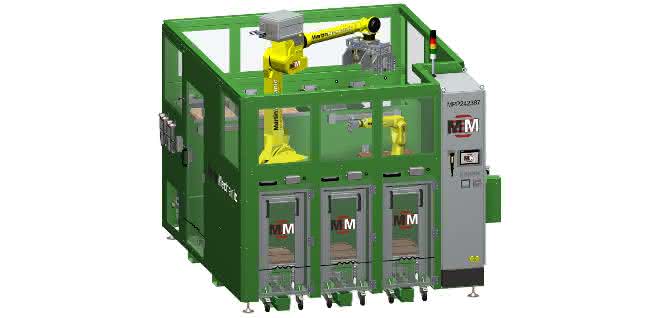
With the help of two Fanuc robots, the corresponding pick tool and the S1500F PLC controller from Siemens, 60 variants with different part geometries can be processed. As the number of parts to be produced is very high, the customer has ordered two identical work cells with the designation MPP242387 with a floor area of 22 square meters and a working height of 3.50 meters.
The pressed indexable inserts are placed on a conveyor belt that feeds the six-axis Fanuc LR Mate 200iD robot inside the cell. A workpiece is made available every four seconds. The robot is equipped with a magnetic gripper and a pick tool as special additional software. It recognizes the workpiece on the moving conveyor belt and picks it up with its magnetic gripper using the vision line tracking method before placing it on one of two ceramic plates at the staging area. The ceramic plates are stored on plastic trays. This solution can be used flexibly and can therefore be individually adapted to the respective requirements.
Once the worker has taught the robot the workpiece contour and the pick-up and deposit positions, it automatically recognizes the green parts.
A new variant can be taught in with just three positions. For this purpose, the system has an enabling switch that enables ergonomic set-up in manual mode with the safety function bypassed. To make teach-in easier, the possible positions are visually displayed on the operating panel of the PLC control system. The Siemens control system automatically calculates all subsequent storage positions from the allocation plan. Once both ceramic plates have been loaded, they move to the next station.
However, before the robot can load the ceramic plates in the manner described, its larger Fanuc brother, the M-710iC/50, has the task of first preparing the plastic trays on which they are stored and then the ceramic plates. It is equipped with different grippers for this purpose. Its 2050 millimeter long gripper arm can lift up to 50 kilograms. There are two loading positions at the rear of the work cell. On the one hand, these consist of two shafts for the ceramic plates, 20 of which are stacked on top of each other. Secondly, there are two chutes for the plastic trays, ten of which are stacked on top of each other.
The robot picks up a plastic tray, takes it to a special test stand and then places it on the staging area.
He then grabs the first of two ceramic plates, which must first pass the endurance test. To do this, he takes them to a second test station, where they are tested for fragility with a defined force in the center. The plates are then placed on the plastic tray and each is loaded with the green bodies. Once both ceramic plates have been loaded, the robot picks up the plastic tray again to lift it onto the transport trolley provided.
The transport trolley is fully loaded with ten trays. The worker then pulls it out of the work cell to push it on to the next system. This is a depalletizing cell from MartinMechanic, which empties the transport trolley piece by piece. The ceramic plates loaded with the green bodies are placed on the furnace belt and pushed into the sintering furnace. dsc


You might also be interested in
ebm-papst is growing again thanks to AI and data centers
ebm-papst returned to a growth trajectory in fiscal year 2025/26. Air Technology, data center applications, and artificial intelligence are driving revenue and investment.
 read more...
SPE on the Verge of a Market Breakthrough
Single Pair Ethernet (SPE) has moved beyond the conceptual phase and is increasingly being implemented in industrial settings. The focus here is not only on higher data rates and simplified cabling, but above all on the issue of system integration...
read more...More than 900 exhibitors already registered
Around six months before the start of the trade fair, more than 900 companies have registered for SPS 2026 in Nuremberg. The trade fair focuses on industrial AI, cyber security and digital transformation.
read more...Virtual PLCs in practice: How vPLCs make production systems more flexible and scalable
The increasing networking of IT and OT is fundamentally changing industrial automation. The IT/OT Integration Summit shows how modern technologies can make production environments more efficient, flexible and future-proof. The event will focus on...
read more...Sales growth in a turbulent market environment
Thanks to innovations and a focus on strategic industrial markets, Sick was able to moderately increase its sales in the 2025 financial year. In a turbulent market environment, the company was able to maintain its position and gain market share with...
read more...Siemens presents new AI agent
Siemens is launching 'Eigen Engineering Agent', an AI for automation technology. The solution is integrated into the TIA Portal, has been tested with over 100 companies and is designed to significantly accelerate engineering processes.
read more...Schaeffler keeps sales almost stable
Schaeffler generated revenue of EUR 23.5 billion in 2025 and increased EBIT before special items to EUR 936 million. At 266 million euros, free cash flow was significantly above the prior year and forecast. Net income remained negative due to high...
read more...Advancing artificial intelligence together
Helukabel is stepping up its activities in the field of artificial intelligence and is now a member of the IPAI. The innovation and collaboration platform for companies, research facilities, institutions and administration has set itself the goal of...
read more...New impetus for ifm sales
Two new positions were filled at ifm at the start of 2026: Markus Wolf becomes Managing Director Sales Germany, Sven Quant takes over the position of Central Managing Director in the Process Sensors division within the ifm Group.
read more...