
Human-robot collaboration
A word with the workplace
Workplace 4.0. The next-level human-robot collaboration developed by IBG is used to design the assembly workplace. The user is recognized by a 3D camera and the work environment automatically adjusts to them. The robot is controlled by gestures and speech.
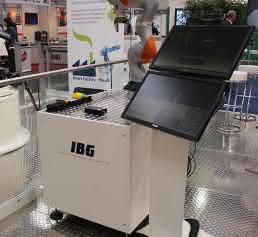
According to IBG, the current state of the art involves a shared workspace for humans and robots, but without any significant interaction between the two. The robot solution developed, on the other hand, enables hand-in-hand work. The robot is controlled by gestures or speech, calculates its movement in real time and can therefore follow the user's hand, for example. At the same time, all information about the user and the working environment is recorded, evaluated and adapted. The user is recognized by a 3D camera and logged into the system. Ergonomic adjustments to the working environment, such as table height and lighting, are made automatically. The user can even talk to the robot and give commands as well as receive information from the robot, such as status information, instructions or environmental information.
The robot's movements are primarily carried out by recognizing the user's hands using a 3D sensor. The robot moves to the center of the hand and can follow the hand. A gripping movement of the hand causes the robot to release the component into the hand. Once the user has completed their processing tasks, they can hand the component back to the robot.
The system is displayed as a 3D visualization on the 3D HMI so that the system can be viewed, operated and observed in real time. Different and new technologies are combined to create this working environment. By detecting the user and emotions, the robot can react accordingly and work more slowly or give instructions. In addition, the user is not tied to a terminal, but can move freely and operate and adjust the robot from a distance via smartphone or smartwatch.
Next-level human-robot collaboration can be used wherever a lot of manual work is required and a high level of quality is demanded. The individual work steps are displayed, thus improving quality and efficiency. It is not tied to a specific field of application, but can relieve the burden of heavy or repetitive work. The robot can decide for itself when the user is not in the work environment: it can then either perform secondary tasks or go into standby mode so that it optimizes its work performance or consumes less energy.
The system can be used flexibly. The user can configure the robot using fixed or dynamic programs and guide it to the intended positions or to an object and generate its movements without any programming experience. This opens up a wide range of possible applications. In addition, the robot can be mounted on a mobile carrier and move autonomously to the desired workstations and support the user accordingly during the activities. as


You might also be interested in
Smart process monitoring via LED
With Helulight Static Process, the Helukabel Group presents an intelligent lighting and signaling system for a wide range of industrial applications.
 read more...
Holger Ritter becomes new CTO at LED2WORK
Technical director with a new spirit
No sooner had LED2WORK announced the founding of LED2WORK Inc. and its development strategy in the USA than Holger Ritter was introduced as Chief Technology Officer (CTO) at the luminaire manufacturer's headquarters in Pforzheim.
read more...Savings potential in operation
Saving energy with light
Rising electricity prices, higher heating costs and the desire to make a contribution to greater environmental protection: More and more companies are addressing the issue of saving energy and taking the appropriate measures.
read more...User-friendly and efficient image processing
There is no doubt that artificial intelligence offers enormous potential. However, many companies in the machine vision sector lack the necessary expertise and time to deal with the topic in depth.
read more...Robots and system concepts from Kuka
Under the motto "Keep on Moving", Kuka Automation Group will be demonstrating in Munich from June 27 to 30 how robots and system concepts are evolving to sustainably shape a changing world.
read more...Digital assistance systems make manual production easier
Increasing productivity in the face of a shortage of skilled workers and a growing number of product variants is a challenge for many medium-sized industrial companies. Software-based assistance systems such as elution two assembly from Elabo offer...
read more...Artificial intelligence in industrial image processing
Recent advances in AI-based image analysis make machine vision accessible to companies of all sizes, even without technical experience or programming knowledge. This reduces the time required to set up inspection applications and increases the...
read more...Image processing for accelerated production
At automatica 2023 in Munich from June 27 to 30, 2023, Cognex will present its current product portfolio for the automation of simple to complex applications in the fields of defect and assembly inspection, classification, measurement, robotics,...
read more...Digital assembly processes to combat the shortage of skilled workers
The increasing shortage of skilled workers is putting even well-established companies in manual assembly under pressure. According to the "DIHK Skilled Workers 2022 Report", 58% of industrial companies were unable to fill vacancies in the long term....
read more...