

Foundry and forging industry
Hot handling
The use of robot grippers makes it possible to remove employees from hazardous areas, such as the vicinity of red-hot parts, which reduces the risk of accidents.
JDT is a manufacturer of round steel chains and accessories for mining and industrial technology. Although JDT's chains appear quite coarse at first glance, they meet high precision requirements. A specially developed production process guarantees the robustness and long service life of the heavily stressed components. "If a chain breaks underground, an entire mine may come to a standstill and it becomes really expensive," says Thorsten Heidingsfelder, responsible for project planning and design at JDT, describing the challenge faced by customers.
Gripper in high-temperature version
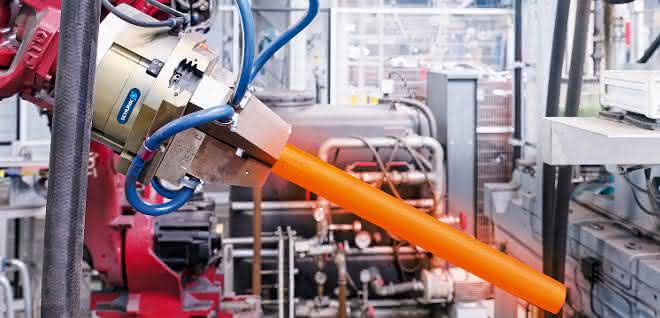
An automation solution built by JDT for the production of mining chains clearly demonstrates how cost-effectiveness, process reliability and a long service life can be combined under demanding conditions. After the tiller cut to length with a diameter of 40 to 60 millimetres has been heated, the red-hot parts are gripped fully automatically by a PZN-plus universal gripper from Schunk, removed from the heating process and fed to the subsequent process.
While this task was usually carried out directly by an employee, JDT has succeeded in automating the process and removing the employees from the danger zone. They simply request the tiller at the touch of a button, but are no longer in the immediate danger zone, which reduces the risk of accidents. The key component in the handling process is a robust PZN-plus centric gripper in a high-temperature design with patented multi-tooth guidance and water-cooled gripper fingers.
"We put a lot of expertise into the jaw technology for our automation solutions so that as many parts as possible can be covered with one and the same jaw," explains Thorsten Heidingsfelder. "This makes things much easier for the user, as they don't have to change jaws or use double grippers." The aim is always to design the systems to be as efficient and simple as possible.
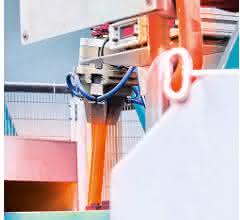
Should a malfunction occur, the employees are usually able to rectify it themselves. The gripper in turn ensures that the red-hot pin remains reliably gripped even during dynamic movements of the robot and is not thrown through the system. "We have been using Schunk components for years and know that the grippers work very reliably, especially in demanding applications," says Heidingsfelder.
Hardly any wear
The team at JDT had previously tested the centric gripper: If the gripping force is too high, the glowing pin is crushed. If it is too low, the pin does not hold its position or is lost. "In tests, we found that the PZN-plus works exceptionally well," confirms the mechanical engineer.
The high-temperature gripper has now been in use for more than three years. A heat protection jacket or heat protection plates were deliberately omitted in order to achieve the slimmest possible solution. With each cycle, the gripper holds the red-hot pin in its cooled fingers for several seconds and has to withstand the radiant heat of the pin. Special seals and greases ensure trouble-free operation of the high-temperature version of the gripper. "So far, we have hardly noticed any signs of wear. We only change the gripper jaws once a year," says Heidingsfelder. "It is precisely this process reliability that is crucial for us, because in the worst-case scenario, the robot stops, we can't produce a chain and we end up with a mine."
Extensive range of accessories
The PZN-plus is part of the Schunk modular gripper system and therefore has an extensive range of accessories. Almost the entire spectrum of conceivable automation applications can be mastered with process reliability, from machine and system loading in the machining industry and foundries to assembly applications in the automotive and electrical industries and sensitive handling tasks in the medical technology and pharmaceutical industries. The universal grippers are just as suitable for use at high temperatures, in dirty environments and with aggressive media as they are for clean rooms.
The power supply can be provided either via a screw connection or a hose-free direct connection. On request, the modules are available with spring protection for mechanical gripping force maintenance, with a compensation unit to compensate for angular errors, as a dust-tight version or as a precision version. A wide range of sensors is also available, from inductive proximity switches and magnetic switches to position sensors for querying and monitoring the stroke position.
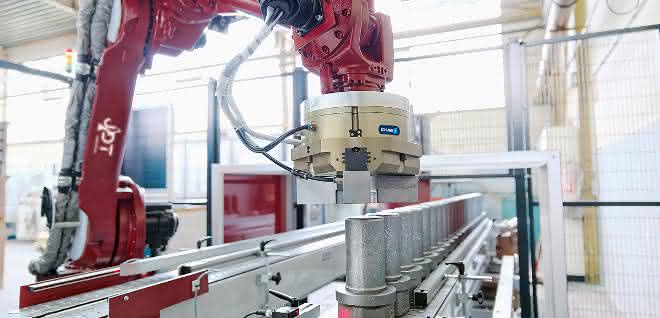
Although Thorsten Heidingsfelder has recently seen more and more advantages in mechatronic gripping system components, the multi-tooth guided pneumatic grippers from Schunk are still his number one choice. "If a pneumatic gripper fails, I replace the valve or reseal the gripper," he explains. "Some of our employees are so attached to the components that they refuse to use new ones because they know that the old ones will work reliably for years, even if a leak occurs and the seal has to be replaced."
Potential in automation
Thorsten Heidingsfelder expects automation to continue to offer great potential in the future: "If you walk through our customers' production facilities, there are still many processes that can be automated economically." Another example is JDT's own production: until the introduction of robot technology, employees in the semi-finished products area had to manually handle components weighing up to 52 kilograms. Today, this task is performed by a robot.
"This makes work much easier and creates the opportunity to expand production elsewhere where manpower is required." He himself is convinced that collaborative applications will gain in importance in the future as soon as standardized HRC robots and peripheral components for collaborative applications are available. "Essentially, it's always about using automation to simplify work, improve ergonomics and secure Germany as a business location." as


You might also be interested in
Lifting oven grates
Bharat Forge CDP is a supplier of forged chassis and engine components as well as non-automotive systems. Since 2020, the company has been working with Kito-ER2 electric chain hoists to lift furnace grates in the production hall.
 read more...
Mobile and intelligent handling solutions
Scaglia Indeva has been developing and producing industrial manipulators and handling solutions for more than half a century. The company will be presenting its latest products for logistics at LogiMat.
read more...Mink at the Hannover Messe 2023
Transportation on brushes
Technical brushes from Mink are suitable for the gentle transportation of sensitive workpieces. According to the manufacturer, the adaptability of the brushes to different surfaces ensures part quality and avoids rejects.
read more...Partial automation in wood processing
Rescue from the staff shortage
The Schnurr company in Nordrach in the Black Forest has been processing wood for almost 170 years. Today, the company is a sought-after partner when it comes to individual wooden packaging or sawn and planed wood.
read more...Products for better ergonomics
At Intec, Scaglia Indeva will be presenting innovative ergonomic products for intralogistics. The focus is on products for better ergonomics, smoother work processes and protection of employees against overload.
read more...New pallet roller for the warehouse
Conveyor technology specialist Rulmeca is expanding its range of conveyor rollers for pallets and other heavy goods with the XPS series.
read more...Individual energy management
When a Festoon cable carrier system for a crane system with a travel distance of 30 meters was to be replaced, Tsubaki Kabelschlepp designed a complete package consisting of chain and cables, guide channel including substructure and an individual...
read more...Plan and manage maintenance
The health and safety regulations and statutory inspection guidelines for operating equipment in companies are strict and extensive. As a result, it is not easy to keep track of all inspection regulations and periods in day-to-day operations.
read more...Fully automated conveyor system for battery systems
With a fully automated and flexibly expandable conveyor system for truck loading, a manufacturer of battery systems in the electric automotive industry is meeting the increasing demand.
read more...