
Handling
Dealing with deformable objects
Interdisciplinary research project "Soft Tissue Robotics". Researchers are working on a multi-body system approach for the automated handling of soft components.
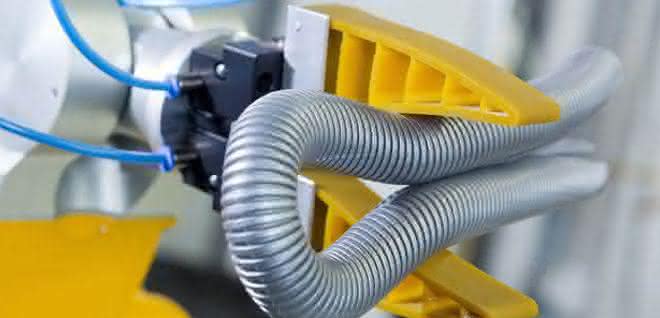
In the production environment, industrial robots carry out uniform and consistent work processes precisely and reliably; they outperform humans in terms of accuracy and endurance. But they cannot (yet) compensate for process uncertainties or react flexibly to unforeseen changes in the workflow. However, handling tasks involving soft materials and deformable components such as cables, hoses, sealing rings, textiles and foodstuffs are subject to the influence of disturbance variables: Soft components vary in their characteristics depending on time and process; the geometric shape, kinematic and dynamic behavior or material parameters such as stiffness and damping properties change.
Tasks that humans can solve intuitively with their sensorimotor and cognitive abilities, such as recognizing a deformed object and deriving a suitable gripping strategy, is a challenge for robot systems that has not yet been solved. This is why the degree of automation for handling and assembly tasks with soft and flexible components is still low. Existing approaches are mostly application-specific individual solutions. In order to find automation solutions for soft materials, the complex material behavior and its effects on the handling processes must first be understood; only then can the resulting uncertainties be estimated and compensated for in terms of control technology.
An international research training group at the University of Stuttgart, in cooperation with the University of Auckland, New Zealand, is taking an interdisciplinary approach to this topic in order to explicitly investigate the generally anisotropic and highly non-linear behavior of materials. The project is funded by the German Research Foundation (DFG). Scientists from the fields of biomechanics, medical and simulation technology as well as control engineering are working together to predict the complex material behavior using modern simulation methods in order to integrate this information into the robot control architecture. The research program has three main focus areas: Modeling and development of new simulation techniques; Automation, control and optimization; Biological and technical concepts of appropriate robot kinematics. The Institute for Control Engineering of Machine Tools and Production Facilities at the University of Stuttgart (ISW) is contributing its core competencies in control engineering, control and modeling to the research project, thereby closing the interfaces between the virtual and real worlds.
Soft objects are a tough nut to crack
While the handling of rigid objects is limited to controlling the six degrees of freedom of the rigid body to be handled, an infinite number of degrees of freedom must theoretically be controlled when handling soft objects. As it is only possible to influence the object directly where it is gripped, the other degrees of freedom can only be influenced indirectly. The extent to which a system input (gripper movement) affects the system output (change in position of the handling object) is described by the interaction of the dynamic deformation behavior and the external contact forces.
In order to understand this complex interaction, a behavioral model of the material is required. Humans achieve this through learning: through interaction and observation, they understand the material behavior and can estimate status information for handling and assembly tasks; the highly developed sensory system (eyes and sense of touch) in combination with a highly complex neural network (brain) makes this possible.
Although these two components can already be technically simulated, there is still a long way to go before robots are equipped with something approaching human intelligence and can use such learned behavior models reliably to plan and control handling tasks. One approach is to approximate material behavior using physical models in which basic mechanical relationships are mapped. This already takes into account a priori knowledge of the fundamental laws governing soft materials.
The best-known representative of physical modeling is the finite element method (FEM). The main disadvantage here is the calculation time, which increases enormously when analyzing the non-linear time-dependent dynamic behaviour. This method is impractical in practice, especially when contact and large rotations are taken into account.
Behavior model multi-body system
An alternative approach is to model soft components using multi-body systems. This approach is based on the assumption that the material behavior can be simulated by linking mechanical model elements such as masses, inertias, springs, dampers and joints. An example of the modeling of cables and hoses is the finite segment method: the deformable object is interpreted as a system of rigid bodies that are coupled together by corresponding joints. Spring-damper elements in the joints model the compliance behavior of the entire system. This allows large deformations of objects and large rotational movements to be modeled with comparatively few degrees of freedom. These reduced models are much better suited for use in control algorithms. For example, the information stored in the physical models about the object properties and deformation behavior can be used in trajectory planning and for model-based control of the robot. In the future, autonomous robot systems that independently find solution strategies for handling tasks with soft objects are to be realized.
Markus Wnuk/Armin Lechler/Alexander Verl/pb
University of Stuttgart, Institute for Control Engineering of Machine Tools and Manufacturing Units (ISW)
www.isw.uni-stuttgart.de


You might also be interested in
Helu makes its first trade fair appearance under a new brand name
Helu Kabel will be presenting itself as Helu for the first time at Hannover Messe 2026, showcasing system solutions, Heluchain cables and new industrial luminaires.
 read more...
Strategic realignment with brand relaunch
In future, Helukabel will trade as Helu
The Helukabel Group is parting with part of its name: in future, the company will only operate under the Helu brand. With this step, the specialist for electrical connection technology is underlining its strategic development from a classic cable...
read more...Modular plant construction for corrugated board
Insight into the production of corrugators at BHS Corrugated: Automated, modular and equipped with Helukabel components.
read more...Best quality for the steel
Conditions in the steel industry are harsh and inhospitable. The machines used must be able to withstand the demanding environmental conditions in order to deliver the best quality at all times.
read more...If the standard cable is not sufficient
Lapp offers cables for countless applications - but not for all of them. From time to time, the developers have to modify a standard cable or develop a special cable.
read more...Slight decline in sales, strong investments
The Lapp Group has not been spared from the weakening global economy. However, the company only recorded a slight loss in the past 2024 financial year.
read more...Electrical connection technology
Cables and wires for industrial automation
Heukabel offers system solutions for cable routing from a single source. The subsidiary EKD Systems specializes in tailor-made cable drag chains made of steel, stainless steel and plastic, which are used in moving machines and systems as well as in...
read more...Lapp relies on Ultramid from BASF
Mobile charging of electric vehicles
The automotive industry is currently undergoing the biggest transformation in its history. The boom in battery electric vehicles in particular is presenting the industry with major challenges. Lapp, as a supplier of cables and connection...
read more...Cable handling application
At this year's Motek, ArtiMinds Robotics is showcasing a robot-based automation solution for the sensor-assisted assembly of flexible cables in connector housings.
read more...