
Collaborating robots
Cobots for measuring systems
Fluri Präzisions- und Mikromechanik relieved its workers of monotonous and repetitive work steps by introducing cobots. Staveb Automation was responsible for the implementation.
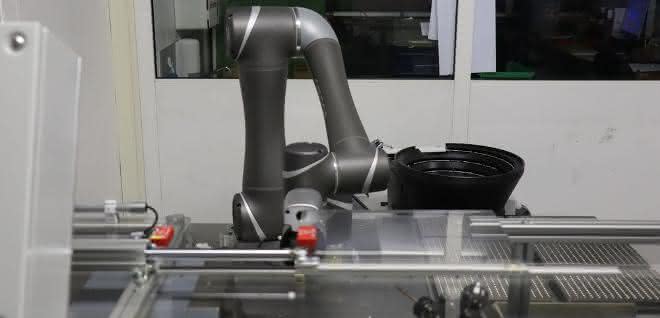
Fluri Präzisions- und Mikromechanik is one of the leading Swiss companies in the field of high-precision micromechanics. In addition to contract manufacturing, the company also manufactures its own products. Staveb Automation carried out the implementation of the cobot when a collaborative robot was introduced for use in production.
Repetitive and monotonous work steps
The Fluri team had several reasons for introducing the cobot in the production of shafts and sleeves: Deburring and cleaning the components are repetitive and very monotonous work steps. In addition, these are time-consuming activities, but they are very important for the functionality of the end product.
The quality of the work steps carried out is therefore all the more important, especially when large quantities need to be delivered at short notice. Fluri therefore wanted to make these processes independent of time and capacity and was looking for a fully automated solution.
High precision essential
"We manufacture both preliminary products for high-precision measuring systems, so these work steps have to be carried out very precisely and accurately," explains Managing Director Stefan Fluri. The solution was found by Philipp A. Walden from Staveb Automation. The decisive factor was that both components are machined in different versions on the same system.
Walden explains: "At Fluri, we use the collaborative TM robot from Omron. This has an integrated image processing system and a wide field of vision. Thanks to the modern lighting technology, flawless object recognition is possible under all conditions."
Cobot in core production
In sleeve production, the cobot picks up a sleeve, positions it and loads it onto a lathe, which removes a burr inside the sleeve and brushes out the machining residues. The solution from Staveb Automation controls the collet chuck and the turret arm with the various tools.
The cobot then picks up the sleeve again and places it in a box. In the case of the shafts, the cobot picks them up, changes the grip position and places them on a blower to blow residue out of the internal thread. The shaft is then neatly palletized in six different washing baskets.
Standard gripper
The robot is equipped with a standard gripper with product-specific fingers. Thanks to the plug-and-play software, it is ready to start immediately and can also be used in other fields of application. By using a standard Schaublin 102 lathe with gripper and standard turret, the employees feel safe and had no training difficulties.
With the Cobot, Fluri uses a vibratory conveyor to transport the individual parts to the pick-up position. After initial difficulties in recognizing the reflective parts, the lighting and optics were adapted. "Due to our time capacities, these two production steps in shaft and sleeve production are carried out autonomously and independently of personnel planning. Thanks to Staveb Automation's extensive technical experience, we were able to draw the right conclusions in terms of functionality," emphasizes Fluri.


You might also be interested in
Sustainability Through Simulation
Digital material selection reduces CO2 emissions by 40 percent
The use of digital material simulations can significantly reduce CO₂ emissions during the development and manufacturing of components. A real-world project by Schunk and Cadfem demonstrates how data-driven material selection can yield savings of up...
 read more...
From ERP System to AI Platform
RNA, based in Aachen, manufactures up to 2,000 custom-designed feeding systems annually and handles all order processing through a central ERP platform.
read more...Cybus Brings in Siemens Executive Stefan Schwab to Lead the Company
The Hamburg-based software provider Cybus will have a dual leadership structure going forward: Stefan Schwab will join co-founder Peter Sorowka as co-CEO.
read more...Artificial Intelligence for the Physical Space
Alibaba Expands Qwen Model Family with a Robotics Suite for Physical AI
Alibaba is expanding its Qwen model family with a robotics suite for Physical AI. The three models—for manipulation, navigation, and simulation—are designed to assist autonomous robots with complex tasks in real-world environments.
read more...5 Challenges for AI Projects in Manufacturing
Manufacturing companies have high hopes for AI. IFS highlights the five most common reasons why AI projects fail.
read more...Implementing Manufacturing Software: 5 Practical Tips
To remain competitive in the market in the future, more and more companies are considering digitizing their CNC manufacturing processes. The right software solutions can make process knowledge transparently accessible and significantly reduce the...
read more...AI automation specialist reorganizes...
Generation change at Insiders Technologies
After almost 30 years at the helm, Werner Weiss is handing over the management of Insiders Technologies. Andree Albrecht takes over the management after a transition phase.
read more...Intelligent brownfield networking
Many industrial companies are struggling with established plant structures and proprietary interfaces. Stefan Klaus' presentation will show in a practical way how brownfield environments can be efficiently networked with open technologies and made...
read more...Factory-X in practice
How can set-up processes in highly variant production be automated efficiently? Markus Benndorff from soffico shows how Factory-X, industrial data rooms and modular architectures create new possibilities for flexible production concepts.
read more...