
Robot systems
Automatically wired
Wiring of control cabinets. The RoboSchalt project is researching a robot-assisted solution for automating individual assembly steps in the production of control cabinets - with a focus on the wiring of components.
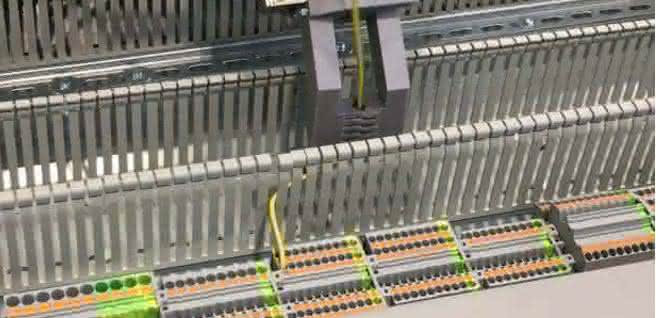
Control cabinets are required in many areas of industry and their production is therefore of great economic importance. However, due to the individuality of the control cabinets, production is still carried out manually at high cost. For this reason, the RoboSchalt research project is currently working on a robot-assisted solution for automating individual assembly steps. The focus of the project is on automating the wiring of the components installed in the enclosure. However, the automation concept should be flexible enough to potentially automate other assembly processes, such as the assembly of terminals.
Service-oriented architecture
The tool coordinates (TCP, Tool Center Point), necessary work objects and poses relative to the work objects are usually defined in the industrial robot program. This information can then be used to program the desired motion sequence. However, this monolithic approach leads to a central problem: the definition of the tool data in the robot program leads to a close link between the tool and the robot. As soon as another process is considered, a new tool results in different tool data. The motion sequence is also different. For example, the assembly of a wire in a terminal with push-in technology is carried out using a linear forward movement, while the assembly of the terminal on a top-hat rail requires a tilting movement. This increases the complexity of the robot program with each new task and makes it more difficult to expand, reuse and maintain individual modules.
A service-oriented architecture (SOA) is implemented as a solution approach. Each service should be self-contained, i.e. work independently of the other services, even if other services can be used to perform a task.
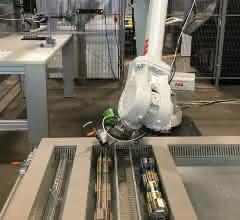
Based on the planning data, the first service is the geometry service. This generates a comprehensive digital model of the control cabinet from the order data. In addition to a three-dimensional representation, the model contains detailed information on the individual components, such as the insertion positions of the wires. It is based on a knowledge database that provides specific information about individual components. Together with planning data, the model is created in the system-neutral AutomationML standard and can be used by other services to query assembly positions, for example.
The main difference to the monolithic implementation becomes clear in the handling service. In addition to a software component, this includes the control of the industrial robot. The service - and therefore also the industrial robot - has no information about the guided tool. This separates the implementation of the robot movement from the specific assembly movements of the respective tool and the service can remain unchanged when the tool is replaced. The remaining tasks of the service are thus the approach of system-specific poses, such as the location of an external inspection camera, as well as the approach of control cabinet-specific poses, for example the assembly position of a wire for a specific terminal. As the control cabinet-specific poses are obtained from the planning data, the interface is designed in such a way that target poses can be specified. Assembly-related tolerances are automatically recognized and compensated for by the service, making it much easier to use.
Two further services are required to implement the wiring task: the tool service, which handles the wires, and an external inspection service, which is used to analyze the ends of a gripped cable.
Orchestration of services
Using the service-oriented architecture, an assembly task can be implemented by orchestrating the individual services. To insert a cable into a terminal, the cable is gripped and the insertion position is approached. The insertion position is supplied via the geometry service. Tolerances in the cable are compensated by the external inspection service and tolerances in the control cabinet by the handling service. The complexity of the task is thus distributed across the different services, which reduces the complexity within the individual services and allows them to be used more generally. This improves the reusability of individual services and increases the flexibility of the overall system. The system set up in this way can currently install individual cables and thread them in and out of the cable duct. As the project progresses, work will continue on connecting a cable magazine and handling the fill level of the cable ducts so that the wiring process can be fully automated.
The RoboSchalt research project (funding code ZF4060720RP7) is funded by the Federal Ministry for Economic Affairs and Energy (BMWi) as part of the Central Innovation Program for SMEs (ZIM) based on a resolution of the German Bundestag. S. Spies, B. Kuhlenkötter/as
Briefly explained: The LPS
The Chair of Production Systems (LPS) is headed by Prof. Dr. Bernd Kuhlenkötter. The scientific focus of the LPS covers the fields of production management, production automation and industrial robotics. The LPS operates a learning and research factory (LFF) in which the theoretical concepts are implemented and evaluated. Through these demonstrations of the results, the LPS promotes the transfer of technology to industry.

Briefly explained: The MHI e.V.
The Wissenschaftliche Gesellschaft für Montage, Handhabung und Industrierobotik e.V. (MHI e.V.) is a network of renowned university professors - institute directors and chair holders - from German-speaking countries. The members conduct both fundamental and application-oriented research on a wide range of current topics in the fields of assembly, handling and industrial robotics. Further information on the society, its members and activities: http://www.wgmhi.de.


You might also be interested in
Helu makes its first trade fair appearance under a new brand name
Helu Kabel will be presenting itself as Helu for the first time at Hannover Messe 2026, showcasing system solutions, Heluchain cables and new industrial luminaires.
 read more...
Strategic realignment with brand relaunch
In future, Helukabel will trade as Helu
The Helukabel Group is parting with part of its name: in future, the company will only operate under the Helu brand. With this step, the specialist for electrical connection technology is underlining its strategic development from a classic cable...
read more...Modular plant construction for corrugated board
Insight into the production of corrugators at BHS Corrugated: Automated, modular and equipped with Helukabel components.
read more...Best quality for the steel
Conditions in the steel industry are harsh and inhospitable. The machines used must be able to withstand the demanding environmental conditions in order to deliver the best quality at all times.
read more...If the standard cable is not sufficient
Lapp offers cables for countless applications - but not for all of them. From time to time, the developers have to modify a standard cable or develop a special cable.
read more...Slight decline in sales, strong investments
The Lapp Group has not been spared from the weakening global economy. However, the company only recorded a slight loss in the past 2024 financial year.
read more...Electrical connection technology
Cables and wires for industrial automation
Heukabel offers system solutions for cable routing from a single source. The subsidiary EKD Systems specializes in tailor-made cable drag chains made of steel, stainless steel and plastic, which are used in moving machines and systems as well as in...
read more...Lapp relies on Ultramid from BASF
Mobile charging of electric vehicles
The automotive industry is currently undergoing the biggest transformation in its history. The boom in battery electric vehicles in particular is presenting the industry with major challenges. Lapp, as a supplier of cables and connection...
read more...Cable handling application
At this year's Motek, ArtiMinds Robotics is showcasing a robot-based automation solution for the sensor-assisted assembly of flexible cables in connector housings.
read more...